

table of contents
A social content strategy is your master plan for everything you publish online. It’s what makes sure every post, video, and story has a real purpose, turning random social media activity into a reliable engine for growing your business.
Without one, you’re pretty much just shouting into the void and hoping someone happens to listen.
What Is a Social Content Strategy and Why It Matters
Ever tried to build a house without a blueprint? You might buy some wood and nails, and maybe you’d even get a wall or two up. But without a plan, you’ll burn through time, money, and energy, and what you end up with will probably fall apart.
A social content strategy is that exact blueprint for your brand’s online presence. It maps out what you’ll post, who you’re talking to, where you’ll post it, and most importantly, why it matters for your actual business goals.
Just posting content whenever you have a spare moment is one of the biggest traps for small businesses. A documented strategy gets you out of that reactive, last-minute cycle and into a proactive, organized rhythm. That shift is what builds a consistent brand voice and a community that actually sticks around. For a deeper dive, this social media content strategy playbook is a fantastic resource.
The Purpose of Strategic Planning
A formal plan does way more than just organize your posts. It forces you to make the tough decisions that connect your social media work to real-world results. Think of it as the framework that helps you turn followers into actual customers.
This structure gives you a few key advantages:
- Resource Allocation: It shows you where to put your time, budget, and creative energy to get the best results. No more wasting effort on platforms or content types that your audience doesn’t care about.
- Brand Consistency: It keeps your messaging, tone of voice, and visuals consistent everywhere. This is how you build brand recognition and get people to trust you.
- Meaningful Measurement: A strategy defines what success looks like from the start. This lets you track important Key Performance Indicators (KPIs) instead of getting distracted by vanity metrics like likes.
A great strategy answers one simple question: “Why should our ideal customer follow us?” If your content doesn’t give them a compelling reason—whether through value, education, or entertainment—you’ll struggle to build a loyal audience.
This flowchart breaks down how a high-level strategy flows down into your daily content and, eventually, measurable growth.
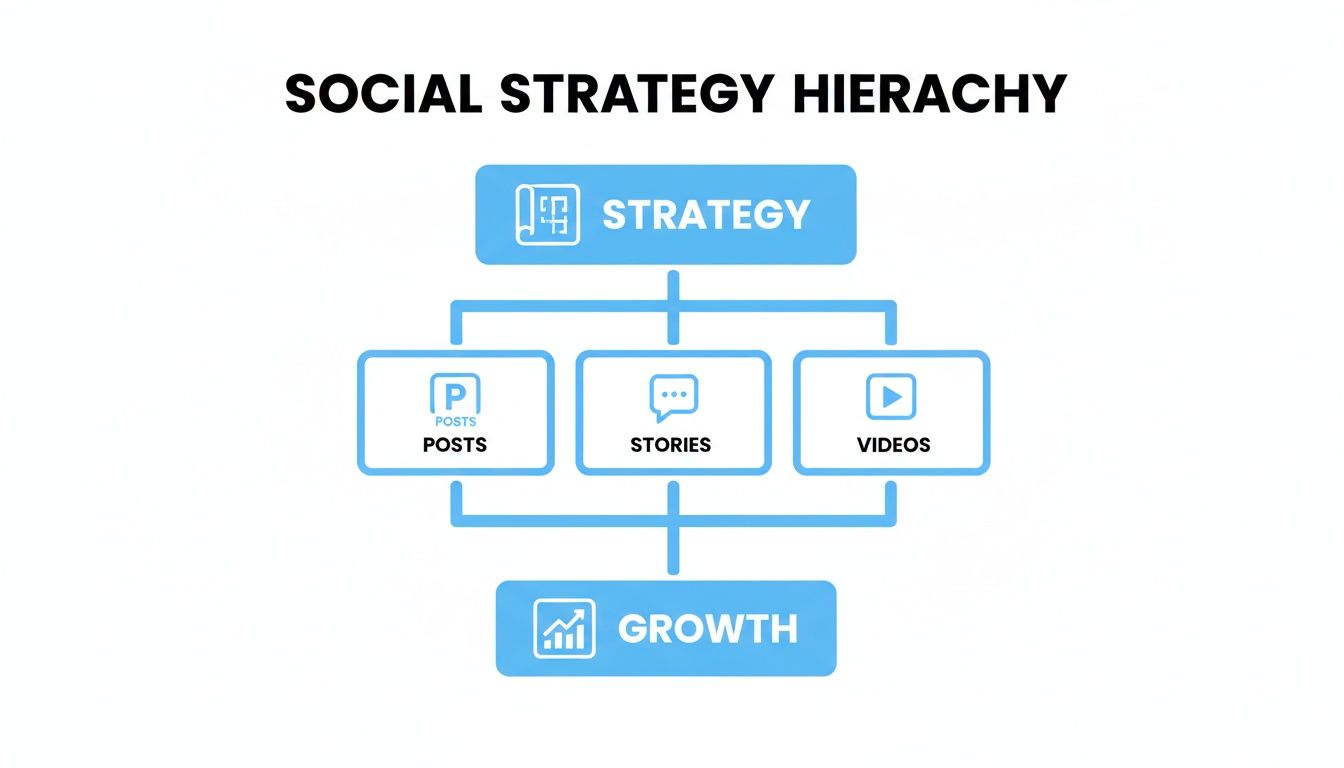
As you can see, the big-picture plan directly informs the kind of content you create, which is what fuels your business growth. If you’re a small business owner looking to dial in your approach, you might find these social media marketing tips for small business helpful as a next step.
Ultimately, having a solid plan is what separates brands that just use social media from those that build thriving communities and drive real revenue with it.
Defining Your Goals and Measuring Success
Before you create a single post, you need to know where you’re going. A social content strategy without clear goals is like a road trip with no map—you’re definitely moving, but you have no idea if you’re getting any closer to your destination. Just aiming for “more followers” is a wish, not a business objective.
The best goals are tangible and tied directly to what your business needs to grow. This simple shift turns your social media activity from a daily chore into a powerful, results-driven operation.
Using The SMART Framework for Clear Goals
To set goals that actually make a difference, the SMART framework is your best friend. It’s a simple system that forces you to define your objectives clearly and, most importantly, make them trackable.
Here’s how it breaks down:
- Specific: Your goal needs to be crystal clear. Instead of “increase brand awareness,” a better goal is “grow our Instagram audience in the Tampa Bay area.”
- Measurable: You have to be able to track your progress with real numbers. “Increase website traffic” becomes “Drive 500 new website visitors from LinkedIn each month.”
- Achievable: Be ambitious, but don’t set yourself up for failure. If you currently get 10 leads a month, aiming for 1,000 next month is probably unrealistic.
- Relevant: Does this social media goal actually support a larger business objective? If your company needs to boost sales, a goal like “increase video views” isn’t as relevant as “generate 20 qualified leads from Facebook ads.”
- Time-bound: Every goal needs a deadline to create urgency and a clear timeline. For example: “Generate 20 qualified leads from Facebook ads within the next 90 days.”
A SMART goal is your North Star. It guides every content decision you make and gives you a concrete benchmark to measure your performance against, making it easy to prove your marketing efforts are working.
This framework forces you to move beyond vague metrics and focus on activities that truly grow your business.
Connecting Goals to Key Performance Indicators
Once you have a SMART goal, you need the right metrics to measure it. These are your Key Performance Indicators (KPIs). Think of a KPI as a measurable value that shows you how effectively you’re hitting your main business objective.
For every goal, there’s a specific set of KPIs you should be watching.
Goal Example 1: A local St. Petersburg retail store wants to get more people through the door.
- SMART Goal: Drive 50 in-store visits from customers who saw our Instagram campaign within the next 30 days.
- KPIs to Track:
- Reach of Localized Posts: How many unique users in our target zip codes saw the campaign.
- Coupon Code Redemptions: The number of people who actually used a special “INSTA20” code in the store.
- “How did you hear about us?” Mentions: Tracking what customers say at the checkout counter.
Goal Example 2: A B2B software company wants more qualified leads.
- SMART Goal: Generate 15 demo requests through our LinkedIn content in Q3.
- KPIs to Track:
- Click-Through Rate (CTR): The percentage of people who clicked the link in our posts that led to the demo landing page.
- Conversion Rate: The percentage of visitors who actually filled out the demo request form on that page.
- Cost Per Lead (CPL): The total amount we spent on ads divided by the number of leads we generated.
Choosing the right KPIs keeps you focused on what really matters. It’s easy to get excited about a post with high engagement, but if it doesn’t help you reach your main goal, it’s just noise. When you understand your numbers, you can also get a much clearer picture of your return on investment. For more on this, check out our guide on how to measure your content marketing ROI.
Of course, engagement itself is still a powerful indicator, especially on the right platform. For example, TikTok boasts an impressive average engagement rate of 3.70%, a figure that jumped 49% year-over-year. That crushes Instagram’s 0.48% and Facebook’s 0.15%, which explains why so many brands are shifting their attention to where the audience is most active.
Understanding Your Audience and Choosing Your Platforms
An effective social content strategy doesn’t shout at a faceless crowd. It speaks directly to a specific person, tapping into their real-world problems, interests, and what gets them excited. To pull this off, you have to go way beyond basic demographics and build a genuine, empathetic picture of who you’re trying to reach.
This is where creating a detailed audience persona is a total game-changer. Think of it as writing a character profile for your perfect customer. What keeps them up at night? What are their biggest career goals? What jokes actually make them laugh? When you know someone this well, creating content they’ll actually care about becomes almost effortless.
This deep knowledge also makes picking your social media platforms a whole lot easier. Instead of spreading yourself thin trying to be everywhere, you can pour your energy into the channels where your ideal customers are already hanging out and ready to listen.
Building Your Audience Persona
A strong persona is built on two things: demographics (the “who”) and psychographics (the “why”). Demographics give you the basic facts, but the psychographics are where the magic happens—they reveal the human motivations that actually drive decisions. The more detail you can pack in, the more your content will connect.
Here are the key things you need to figure out for your ideal customer:
- Demographics: This is your starting point—age, location, job title, and income level. It gives you the basic outline.
- Goals and Motivations: What are they trying to accomplish? Are they looking to scale their business, save more time in their day, or finally learn that new skill?
- Challenges and Pain Points: What’s getting in their way? This is your opening. Your product or service should be the solution they’ve been searching for.
- Values and Beliefs: What really matters to them? Do they value sustainability, convenience, or being on the cutting edge of innovation?
- Information Sources: Where do they get their info? Do they tune into specific podcasts, read certain blogs, or follow particular influencers on social media?
A well-built persona is your ultimate gut check. Before you hit “publish,” just ask yourself: “Would [Persona’s Name] find this useful, entertaining, or valuable?” If the answer is a hard no, it’s time to go back to the drawing board.
Building these profiles is a fundamental part of any smart marketing plan. To get you started on the right foot, we have a guide that takes a more detailed look at target audience analysis.
Matching Your Persona to the Right Platform
Once you know your audience inside and out, choosing the right social media channels is just a matter of logic. Every platform has its own unique user base and a distinct vibe. Your job is to find that sweet spot where your audience spends their time and your brand’s content can truly shine.
Trying to be active on every single platform is a classic mistake that only leads to burnout and mediocre content. It’s far better to master one or two channels where you can make a real splash.
Here’s a simple way to think about it:
Scenario 1: A B2C Fashion Boutique Targeting Millennials
- Persona: “Stylish Sarah,” a 28-year-old marketing coordinator who lives for visual inspiration, follows fashion influencers, and values authentic brands.
- Platform Fit: Instagram and TikTok are the obvious winners here. These platforms are all about visuals, trends, and have a massive user base in her age group. The focus should be on gorgeous photos, Reels showing off new arrivals, and maybe some collaborations with local influencers. Posting on LinkedIn would be a complete waste of time.
Scenario 2: A B2B Financial Consulting Firm
- Persona: “Decision-Maker Dave,” a 45-year-old CFO who craves industry insights, trusts data-driven analysis, and uses social media for professional networking.
- Platform Fit: LinkedIn is the only platform that really matters. This is where Dave goes for professional development and to connect with his peers. The firm’s content strategy should revolve around sharing insightful articles, case studies, and expert analysis to build authority and trust. A TikTok dance just isn’t going to land here.
By lining up your sharply defined persona with the specific culture of each social platform, you make sure your message doesn’t just reach the right people—it reaches them in a place where they’re actually open to hearing it.
Developing Your Core Content Pillars
Okay, so you know who you’re talking to. The next big hurdle is figuring out what to say—not just today, but week after week. We’ve all been there, staring at a blank calendar with that familiar sense of dread. This is exactly where content pillars come in. They’re the foundation of your entire social media plan.
Think of content pillars as the 3-5 core themes your brand will own and talk about consistently. They’re like the main sections of your own online magazine, sitting at that sweet spot where your audience’s interests meet your business expertise. Once you establish these, you can stop chasing random trends and start building real authority.
This simple framework transforms your whole approach. Instead of desperately asking, “What should I post today?” you can ask, “What can I create under my ‘Nutrition Myths’ pillar this week?” That small shift makes content creation sustainable and guarantees everything you post is relevant to your brand and your audience.

Identifying Your Brand’s Core Themes
Your content pillars should feel natural, flowing directly from your brand’s purpose and what your audience actually needs. The goal is to find topics broad enough to spark dozens of ideas but specific enough to carve out your niche. A great pillar isn’t just about what you sell; it’s about the problems you solve.
Here’s a simple process to nail down your pillars:
- Brainstorm Your Expertise: Jot down everything you know that could genuinely help your ideal customer. What topics could you talk about for hours? What are the top questions clients ask you over and over again?
- Review Your Audience Personas: Go back to their goals, pain points, and interests. What are they searching for online? What problems are keeping them up at night that you have a solution for?
- Find the Overlap: Now, compare those two lists. The topics that appear on both are your goldmine. These are your potential content pillars. Try to group related ideas into 3-5 distinct categories.
For a local fitness coach here in St. Petersburg, this might look like:
- Pillar 1: Quick At-Home Workouts: Perfect for busy professionals who can’t make it to the gym.
- Pillar 2: Nutrition Myths Debunked: Cutting through the noise to offer simple, healthy eating advice.
- Pillar 3: Mindset and Motivation: Focusing on the mental game of fitness to keep clients from giving up.
Think of your content pillars as the guardrails for your social media strategy. They keep you on track, make sure your content is always on-brand, and signal to your audience exactly what to expect when they follow you.
Creating a Balanced Mix of Content Formats
Once your pillars are set, the next step is deciding how you’ll bring that information to life. Relying on a single content format is a surefire way to make your feed feel stale. A wall of text posts or an endless grid of stock photos will bore your audience fast.
A healthy mix of formats keeps your feed dynamic and interesting. People consume content in different ways, and variety helps you connect with more of them. For a deeper dive, our guide on how to create social media content is a great next step.
Here are the essential formats to work into your plan:
- Short-Form Video (Reels, TikToks, Shorts): This is non-negotiable. Use it for quick tips, behind-the-scenes moments, or fun skits related to your pillars. Video generates far more engagement than static posts.
- Carousels and Infographics: These are perfect for breaking down complex topics into bite-sized, swipeable slides. They’re workhorses for educational content.
- Stories: Use these for informal, interactive content like polls, Q&As, and daily check-ins. Stories build a personal connection and are a low-pressure way to engage your community.
- High-Quality Images: Don’t forget the power of a great photo. Showcase your products, your team, or happy customers. A strong visual identity is still a must.
- Text-Based Posts or Tweets: Sometimes, a powerful message or a thought-provoking question is all you need to start a conversation around your pillar topics.
By building your content plan around these core pillars and mixing up your formats, you create a social media presence that’s both manageable for you and consistently valuable for your followers.
Creating a Practical Social Media Content Calendar
Your social content strategy gives you the “why,” but a content calendar is where you figure out the “what” and “when.” This is the point where big ideas become a real, day-to-day workflow. Think of it less like a simple schedule and more like an operational blueprint—the tool that keeps you consistent, helps you plan cohesive campaigns, and ensures you’re posting a balanced mix of content.
Without this structure, even the sharpest strategy can crumble under the pressure of just running the business. A calendar provides the framework to execute your plan, turning social media from a reactive chore into a proactive way to grow. This organized approach is the engine that drives a powerful social content strategy.

Core Components of an Effective Calendar
A good content calendar doesn’t have to be complicated. Whether you’re using a basic spreadsheet or a fancy software tool, it just needs to track a few key details for every single post.
Here are the must-haves:
- Date and Time: The exact day and hour the post will go live.
- Platform: Which social channel is this for? (e.g., Instagram, LinkedIn).
- Content Pillar: The core theme this post ties back to, keeping everything on-brand.
- Content Format: Is it a Reel, a carousel, a static image, or a simple text update?
- Copy and Hashtags: The final caption and the hashtags you plan to use.
- Visuals: A link to the approved image or video file.
- Status: A simple way to see where things stand (e.g., Draft, In Review, Scheduled).
Tracking these details eliminates the last-minute scramble and ensures every piece of content is thoughtfully put together ahead of time. For a deeper dive, check out our guide on how to create a content calendar that actually works for your team.
Balancing Machine Efficiency with Human Creativity
Modern tools, especially those with AI, can seriously speed up how you build your calendar. They’re great for generating post ideas, brainstorming captions, and even finding the best times to post based on when your audience is most active. That efficiency buys you back precious time to focus on the creative stuff.
But here’s the catch: leaning too hard on automation can strip your content of its most important ingredient—authenticity. While AI can build the frame, the real connection comes from the human touch. Your unique brand voice, your sense of humor, your genuine empathy for your audience—that’s what people connect with.
The 2024 Social Media Content Strategy Report highlights this tension perfectly. A massive 94% of marketers plan to use AI in their content creation, yet consumers are practically shouting that they want human-generated content that feels real.
AI should be your assistant, not your author. Use it to handle the repetitive tasks, but always make sure the final message is infused with your brand’s personality and a genuine human connection. This is what builds trust and loyalty.
At the end of the day, your social media content calendar is your game plan. It keeps your workflow organized and your posting consistent. But it’s the creative spark you bring to it that will grab your audience’s attention and keep them coming back.
Analyzing Performance and Optimizing Your Strategy
Think of your initial social content strategy as your best-educated guess. It’s a well-researched hypothesis about what will connect with your audience. But the real growth happens when you stop guessing and start listening to the data. This is where analysis and optimization turn a good plan into a great one.
This process isn’t about proving you were “right” or “wrong.” It’s about being smart enough to adapt. By digging into your social media analytics, you learn exactly what your audience responds to, letting you double down on what works and quickly move on from what doesn’t.
Making Sense of Your Social Media Analytics
Every social platform dashboard is packed with numbers, and it can feel a little overwhelming at first. The trick is to tune out the noise and focus on the Key Performance Indicators (KPIs) you set earlier. These are the only metrics that tie directly back to your SMART goals.
You have to look beyond simple likes and follower counts. The real insights come from understanding how people behave.
- Engagement Rate: This is your most important health metric. It tells you what percentage of people who saw your post actually did something—liked, commented, shared, or saved it. A high engagement rate means your content is genuinely hitting the mark.
- Click-Through Rate (CTR): This one is simple but powerful. It tracks how many people clicked a link in your post. If your goal is to drive website traffic or generate leads, this KPI is your best friend.
- Reach vs. Impressions: Reach is the number of unique people who saw your content. Impressions are the total number of times your content was seen. If your impressions are way higher than your reach, it means your followers are seeing your posts multiple times—a fantastic sign that the algorithm likes what you’re doing.
The numbers tell a story. A post with high reach but low engagement might mean your headline grabbed attention, but the content didn’t hold it. High saves on an educational post? That tells you the audience found it so valuable they wanted to come back to it later.
By consistently watching these core KPIs, you shift from just making content to making calculated decisions that improve your strategy over time.
Turning Insights into Action
Data is useless if you don’t do anything with it. The whole point of analysis is to spot patterns that help you refine your approach. This cycle of review and adjustment is what creates compounding results from your efforts.
Set aside time each month to look at your performance and ask these questions:
- Which Content Pillars Drove the Most Engagement? If your “Behind-the-Scenes” posts consistently get more shares and comments than your “Product Spotlights,” you know where to invest more of your creative energy.
- What Content Formats Are Winning? Are your short-form videos crushing your static images? If so, it might be time to lean more heavily into creating Reels or TikToks.
- Which Posts Drove Clicks and Conversions? Pinpoint the exact posts that sent people to your website or brought in leads. Break down their copy, call-to-action, and visuals so you can replicate that success.
- What Time of Day Delivers the Best Results? Your platform’s analytics will show you when your audience is most active. Schedule your most important content for those peak windows to maximize its impact.
This feedback loop is the engine that powers a successful social media program. It ensures your social content strategy isn’t a static document but a living, breathing plan that evolves with your audience and keeps delivering real business value.
Your Social Content Strategy FAQ
Even the best-laid plans come with a few questions. This section cuts through the noise with clear, practical answers to the most common things people ask when building a social content strategy.
How Often Should I Post on Social Media?
This really boils down to the platform you’re on and, more importantly, your team’s ability to create great content without burning out.
For fast-moving feeds like X (formerly Twitter) or TikTok, posting multiple times a day can work well. But on platforms like Instagram or Facebook, 3-5 strong posts per week is a fantastic starting point. For a more professional network like LinkedIn, 2-3 well-thought-out posts a week is usually plenty to stay on your audience’s radar.
The golden rule here is consistency over quantity. It’s always better to share three amazing posts every single week than to drop ten mediocre ones and then go silent.
What Is the Difference Between a Content Strategy and a Content Calendar?
Think of it this way: your strategy is the “why,” and your calendar is the “when.”
Your social content strategy is your big-picture game plan. It’s the blueprint that defines your goals, who you’re talking to, your brand voice, and the core topics (or pillars) you’ll focus on. It’s the thinking behind everything you do.
The content calendar, on the other hand, is the tool you use to bring that strategy to life. It’s where you schedule out the specific posts, organize the copy and images, and map out when everything goes live.
A calendar without a strategy is just a list of random posts waiting to be published. A strategy without a calendar is a collection of good ideas that rarely see the light of day.
How Much Should I Budget for a Social Content Strategy?
Your budget can start small and grow with you. The main costs usually come from two places: content creation (like graphic design, video editing, or copywriting) and any tools you use for scheduling and analytics.
A small business can absolutely get started on a lean budget using fantastic free tools like Canva for design and Meta Business Suite for scheduling.
A modest starting budget might be a few hundred dollars a month to hire a freelance designer or put a little ad spend behind your most important posts. Once you see what’s working and can prove a return, you can scale up to invest in things like higher-quality video production or influencer partnerships. To get even more out of your budget, you can use techniques like A/B testing for your content strategy to refine your approach.
How Long Does It Take to See Results from a New Strategy?
Patience is a must. While you can often spot early signs of life—like a bump in engagement or reach—within the first 30-60 days, the big business results take more time.
Meaningful outcomes like generating new leads or driving direct sales typically take 3-6 months of consistent, focused effort. Remember, social media is about building relationships and trust, and that just doesn’t happen overnight.
Focus on your leading indicators (reach, engagement, follower growth) in the short term. These will tell you if you’re on the right track while you work toward the lagging indicators (leads and sales) that really move the needle long-term.
A powerful social content strategy turns your online presence into a predictable growth engine. If you’re ready to build a plan that drives real, measurable results for your business, Netco Design LLC can help. We create and execute revenue-focused strategies that attract qualified customers and convert them into loyal fans. Learn more about our social media marketing services and start growing today.

