

table of contents
A solid social media strategy is more than just a plan; it’s the bridge between random posting and creating content that actually builds your community, drives traffic, and generates revenue. It’s what gives every single post a purpose, ensuring your efforts are intentional and effective.
Laying the Groundwork for a Winning Strategy
Before you even think about what to post, you need to get crystal clear on your foundation. So many businesses jump right into creating content without figuring out why they’re doing it or who they’re talking to. That’s a surefire way to waste time and see minimal results. A winning strategy is always built on a solid base of purpose and deep audience understanding.
This first phase is all about connecting your business goals to your audience’s needs through research. It’s a simple but powerful flow.
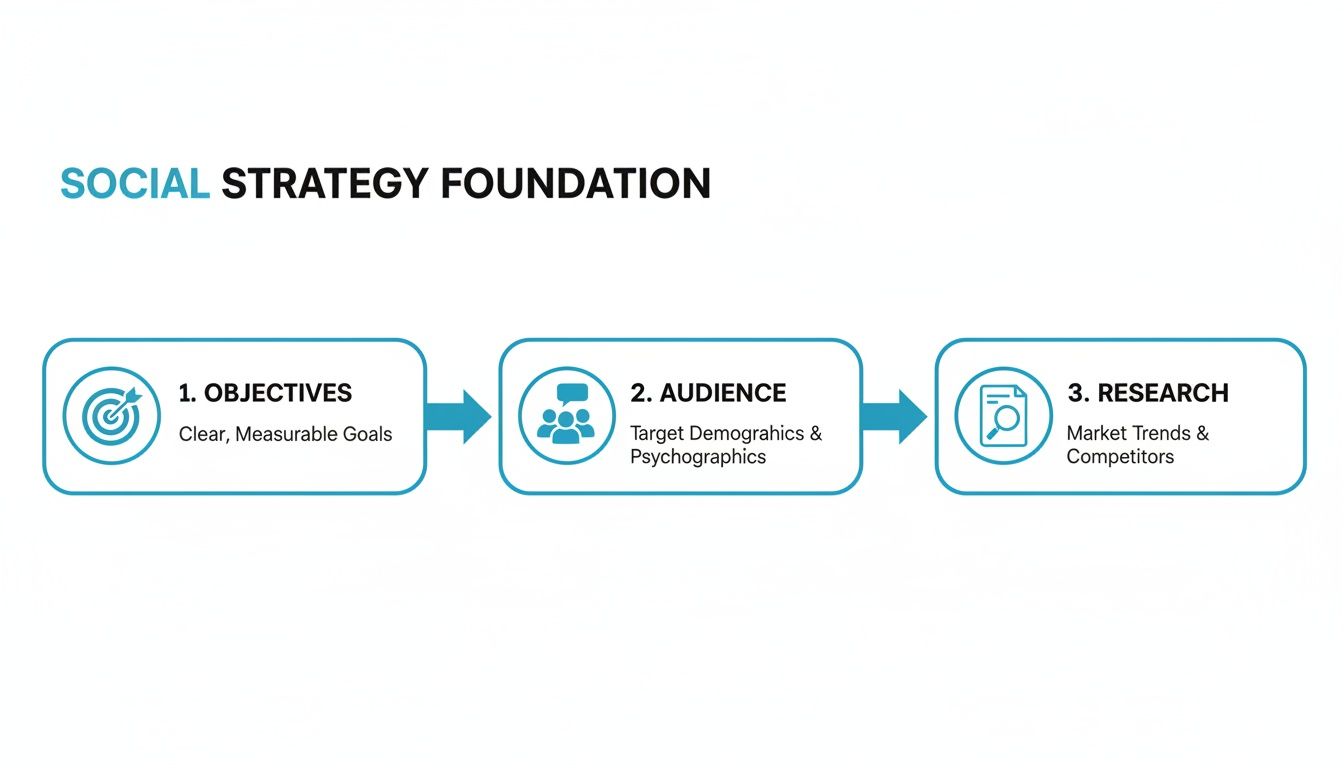
Following this process from the start ensures every piece of content you create is strategically aligned with what your business needs and what your audience wants to see.
Define Your Business Objectives
Your social media activity has to connect back to real, tangible business outcomes. Simply chasing more followers is a vanity metric that won’t pay the bills. You need to ask yourself: what do we really want social media to accomplish for our business?
Start by identifying your main goals. Are you trying to:
- Generate more qualified leads for your sales team?
- Drive online sales for a specific product or service?
- Boost brand awareness in a new market?
- Build a loyal community to improve customer retention?
For instance, a local home services company in St. Petersburg might set a goal to generate 20 new service inquiries per month through its Facebook and Instagram pages. This specific, measurable target gives their content a clear job to do: attract and convert local homeowners.
A goal without a measurement is just a dream. By linking your social media activity to concrete business objectives like lead generation or sales, you transform your content from a cost center into a revenue driver.
Deeply Understand Your Audience
Once you’ve figured out your “why,” it’s time to define your “who.” Creating content without knowing your audience is like shouting into an empty room. This is where you need to build detailed buyer personas that feel like real people.
Go beyond basic demographics. You need to dig into their genuine challenges, what motivates them, and how they behave online. What keeps them up at night? What are they searching for? Answering these questions is everything. Knowing your audience prefers short, educational videos on TikTok over long-form articles on LinkedIn will completely change your content plan. To get this right, you have to be intentional about mastering your social media content strategy from the ground up.
Customer expectations have also changed. We’ve moved from an era of just publishing content to one where community engagement is paramount. In fact, 76% of consumers feel more loyal to brands that actively reply to comments, and 52% are less likely to buy from those that ignore them. Your strategy has to prioritize real, meaningful interactions.
Building out detailed customer profiles is a critical first step. Our guide on how to create buyer personas provides a practical framework to help you get this done, ensuring your content truly connects on a human level: https://netcodesign.com/how-to-create-buyer-personas/
Defining Your Core Content Pillars and Themes
Okay, you’ve set your goals and you know exactly who you’re talking to. What’s next? Deciding what your brand is actually going to talk about, consistently. If you’re just posting random thoughts, you’ll create a confusing and forgettable presence. This is where content pillars save the day.

Think of content pillars as the 3-5 foundational topics your brand will own. These are the broad subjects that prove your expertise, solve your audience’s problems, and naturally point back to what you sell. They give you the focus you need to make content creation simpler and way more effective.
How to Brainstorm Your Content Pillars
The sweet spot for content pillars is right at the intersection of what your audience cares about and what your business is brilliant at. You’re not just pulling topics out of a hat; you’re making strategic choices based on the audience research you’ve already done.
Go back to those customer personas you built. What are their biggest questions, daily challenges, and long-term goals? Jot them down. Now, think about how your products or services solve those exact problems. The overlap is where your best pillar ideas are hiding.
Let’s say a local cafe in Tampa Bay is mapping this out. Their pillars might look like this:
- Behind-the-Scenes Brewing: This is where they show off their craft. Think sourcing beans, perfecting latte art, and the overall quality of their coffee-making process.
- Community Spotlights: Here, they position themselves as a neighborhood hub by featuring local artists, nearby events, and other small businesses.
- Coffee Education: This pillar provides value with simple home-brewing tips, explanations of different roast profiles, and answers to common coffee questions.
Each pillar is directly tied to their business but gives genuine value to their local audience. This is how you make sure your content serves a purpose beyond just trying to make a sale.
From Pillars to Diverse Content Themes
Once your pillars are locked in, you can break them down into smaller, more specific content themes. Themes are the different angles or story ideas that bring your pillars to life. This is the secret to keeping your content fresh and not sounding like a broken record.
Let’s revisit the software company example. If one of their pillars is “Productivity Hacks,” the themes could spin off in all sorts of directions:
- Theme 1: Time management techniques for busy professionals.
- Theme 2: Tutorials on using specific software features to save time.
- Theme 3: Interviews with industry leaders about their productivity routines.
- Theme 4: Quick tips for organizing your digital workspace.
This structure gives you a nearly endless stream of ideas that all trace back to a core strategic topic. Over time, it builds a cohesive story that reinforces your brand’s expertise. For a great real-world look at how this all comes together, check out this detailed content strategy example.
The goal is to create a structured yet flexible plan. Your pillars provide the guardrails, while your themes give you the creative freedom to explore different angles, formats, and stories that keep your audience engaged.
By defining these pillars and themes, you shift from a reactive “what on earth should I post today?” mindset to a proactive, strategic one. You know what to focus on, making it easier to plan, create, and maintain a social media presence that actually makes an impact. Every post has a purpose, strengthening your brand identity and building your authority.
Building a High-Impact Content Creation System
A brilliant strategy is only as good as its execution. You’ve set your goals and defined your content pillars, which is a huge step. Now, it’s time to build the engine that actually powers your social media presence—a reliable, repeatable system for creating and managing compelling content.
This is where the rubber meets the road, turning abstract ideas into actual posts that stop the scroll and get people talking.
Don’t mistake “system” for “complicated.” The goal here is a straightforward workflow that guarantees consistency, makes sure every post serves your strategy, and frees you up to actually engage with your community. It really boils down to two things: a diverse content mix and a well-organized editorial calendar.
Crafting a Diverse Content Mix
If you’re only posting one type of content, you’re leaving opportunities on the table. Plain and simple. Your audience consumes information in dozens of different ways, and your content should reflect that. A well-rounded approach keeps your feed from getting stale, appeals to different audience segments, and helps you play nice with various platform algorithms.
This means moving beyond just static images and text. Visuals still rule social media, and the data is pretty clear: visual formats are 40 times more likely to be shared than text-only posts. And when you bring video into the mix? The results jump even higher. In fact, 74% of customers actively share branded video content with their friends and followers.
To build a mix that actually works, start integrating formats like these:
- Short-Form Video (Reels, TikToks, Shorts): These are attention-grabbing gold. Use them for quick tips, behind-the-scenes moments, or hopping on a trending sound that fits your brand’s personality.
- Carousel Posts: Perfect for breaking down complex topics and telling a story. Take a concept from one of your content pillars and turn it into a series of digestible, swipe-friendly slides.
- High-Quality Static Images: They’re not going anywhere. A stunning photo is still one of the best ways to showcase a product, announce a sale, or share a glowing customer review.
- User-Generated Content (UGC): Sharing posts from happy customers is the most authentic social proof you can get. It builds trust in a way that a branded ad just can’t match.
- Interactive Content: Get your audience involved! Use polls, quizzes, and “ask me anything” sessions in your Stories to spark conversations and gather instant feedback.
Your content mix should be a direct reflection of your pillars and audience. A B2B service provider might lean heavily on educational carousels and client case studies for LinkedIn. A local boutique, on the other hand, will probably find more success with Reels and UGC on Instagram.
Organizing Your Workflow with a Content Calendar
A content calendar is the single most important tool for bringing your social media content strategy to life. Think of it as your command center—it transforms a jumble of ideas into a clear, actionable schedule. Without one, you’re stuck scrambling for last-minute posts, and consistency goes right out the window.
You don’t need fancy software; a simple spreadsheet can do the trick. The whole point is to map out what you’re posting, when you’re posting it, and where. This foresight is a game-changer, letting you batch-create your content to save a ton of time while maintaining a steady presence.
Your calendar doesn’t need to be overly complex, but it should track a few key details for every post:
- Date and Time: When is it scheduled to go live?
- Platform(s): Where will it be published (e.g., Instagram, Facebook, LinkedIn)?
- Content Pillar: Which of your strategic pillars does this support?
- Format: What is it? (e.g., Reel, Carousel, Photo).
- Caption and Hashtags: The copy that will go with the post.
- Visual Asset: A link to the final image or video file.
- Status: A simple tracker to know where things stand (e.g., Idea, In Progress, Scheduled).
This structure makes sure every single post has a purpose and ties back to your big-picture goals. It also gives you a bird’s-eye view of your content mix, helping you avoid posting five videos in a row or accidentally neglecting a key pillar for weeks.
Getting organized like this will instantly make your social media presence feel more cohesive and professional. If you want a step-by-step guide to setting one up, our article on how to create a content calendar offers some great tips and templates: https://netcodesign.com/how-to-create-a-content-calendar/
Ultimately, a strong content creation system isn’t about being rigid. It’s about being prepared. It gives you the framework you need to be creative and jump on spontaneous opportunities, all while ensuring your strategic goals stay front and center.
Using AI and Smart Tools in Your Workflow
Working smarter, not harder, is the real secret to a social media presence that actually works and doesn’t burn you out. Let’s be honest, churning out high-quality content day after day can feel like a marathon. This is where smart tools and AI come in—they’re no longer just neat gadgets but essential assistants that can seriously power up your workflow.
The trick is to let technology handle the tedious, repetitive stuff. This frees you up to focus on the human elements that make all the difference: strategy, creativity, and genuinely connecting with your community.
Streamlining Content Ideation and Creation
One of the biggest headaches in any social media content strategy is the constant need for fresh ideas. Staring at a blank screen is the worst. AI can be an incredible brainstorming partner, helping you smash through creative blocks and find new angles for your content pillars.
Instead of waiting for inspiration to strike, you can feed an AI tool a single keyword and get back a list of blog titles, video concepts, or discussion prompts. Imagine a real estate agent plugging in “first-time homebuyer tips” and getting dozens of ready-to-go ideas for Reels, carousel posts, and helpful guides.
The goal isn’t for AI to replace your creativity, but to supercharge it. Use AI-generated concepts as a launchpad, then sprinkle in your unique brand voice, personal stories, and audience knowledge to make the content truly yours.
This shifts AI from being just a content generator to a powerful productivity booster. Our guide on AI for small business marketing dives much deeper into specific prompts and tools you can start using right away: https://netcodesign.com/ai-for-small-business-marketing/
Optimizing Scheduling and Automation
Once you’ve created your content, getting it published consistently is the next challenge. This is where scheduling platforms are an absolute lifesaver. Instead of logging in to post manually every single day, you can batch-create your content and schedule it all out for the next week or even a month.
This system has some major perks:
- Time Savings: Block out a few hours for content creation and scheduling, then reclaim your daily schedule for important things like talking to customers.
- Consistency: A steady flow of content keeps you top-of-mind with your audience, even on your busiest days.
- Strategic Timing: Most schedulers show you when your audience is most active, so you can publish posts when they’ll get the most eyes and engagement.
Tools like Buffer, Later, or Hootsuite are built to make this simple, giving you one central dashboard to run all your social media profiles.
Balancing Automation with Authenticity
AI in content creation has gone from a fringe experiment to a core part of the modern marketing machine. In fact, nearly 60% of marketers already use AI weekly, and 70% say it makes their jobs way easier. As this tech becomes standard, the brands that win will be the ones who nail the balance between automated efficiency and human authenticity.
This means using AI for what it excels at—analyzing data, whipping up first drafts, and handling repetitive tasks. But the final edits, the brand voice, and the real conversations? That’s all you. For instance, you could ask an AI to write five caption options for a post, then you step in to pick and polish the one that perfectly captures your brand’s personality.
If you’re looking to maximize your ad campaigns with real customer content, exploring AI-powered UGC ad solutions can be a total game-changer. These platforms help you find and use customer content at scale, mixing automation with the undeniable power of social proof.
Ultimately, the smartest social media content strategy uses technology not to replace the human touch, but to amplify it.
Measuring What Matters to Optimize Your Strategy
A social media content strategy isn’t a “set it and forget it” plan. Think of it as a living system that gets smarter with data. To make good decisions, you have to look past the vanity metrics like follower counts and post likes. Sure, those numbers feel good, but they don’t tell you if your hard work is actually moving the needle for your business.
The real magic happens when you track Key Performance Indicators (KPIs) that connect your social posts to real-world outcomes. This is how you prove your value and build a feedback loop where performance data constantly sharpens your future content.
Moving Beyond Vanity Metrics
It’s so easy to get caught up in metrics that look impressive on the surface. A post with a thousand likes seems like a huge win, but what did it actually do for your business? Did anyone visit your website, sign up for your newsletter, or buy something?
To really measure success, you need to shift your focus to metrics that show what your audience is actually doing.
- Engagement Rate: This is the percentage of your audience that’s actively interacting with your content—liking, commenting, sharing, and saving. It’s a much better sign of content quality than likes alone.
- Click-Through Rate (CTR): This tells you how many people who saw your post actually clicked the link inside it. A high CTR means your call-to-action and content were compelling enough to get someone to take that next step.
- Conversion Rate: This is the ultimate bottom-line metric. It tracks how many people completed a specific action after clicking your link, like downloading a guide or making a purchase.
Focusing on these KPIs helps you understand not just if people see your content, but what they do because of it.
Using Platform Analytics to Your Advantage
Don’t be intimidated by the charts and numbers inside your social media analytics dashboards. Every major platform has one, and they are packed with gold. These tools are built to give you clear insights into what’s working and what’s not.
Make it a habit to dive into your analytics regularly to answer some critical questions:
- Which of my content pillars are getting the most engagement?
- Are videos, carousels, or static images driving the most clicks?
- When are my followers most active and likely to see my posts?
- Which specific posts are sending the most traffic back to my website?
For example, you might find that your “Behind-the-Scenes” pillar is a massive hit with Instagram Reels but completely flops as a static post on Facebook. That’s a powerful insight. It lets you double down on what works for each platform and stop wasting time on what doesn’t.
The data doesn’t lie. Your analytics dashboard is a roadmap that shows you exactly what your audience wants more of. Ignoring it is like driving with your eyes closed.
Implementing Simple A/B Testing
You don’t need a fancy lab to start making your content better. A/B testing, also known as split testing, is just a simple way to compare two versions of a post to see which one performs better. It’s the perfect tool for fine-tuning your messaging, visuals, and calls-to-action over time.
You can test almost any part of a post. Try running simple experiments like these:
- Caption Length: Post the same image twice. Give one a short, punchy caption and the other a longer, more detailed story. Which one gets a higher engagement rate?
- Visuals: Test a high-quality photo against a custom graphic with text overlay. Which one drives more clicks?
- Call-to-Action (CTA): Try different phrases. Does “Learn More” outperform “Shop Now” or “Download the Guide”?
Track the results of these small tests. Over time, these little improvements add up, making your entire social media content strategy more effective and profitable. This data-driven approach is also crucial when you need to calculate your marketing ROI and prove the financial impact of your social media efforts. By measuring what matters, you turn your social media presence from an expense into a powerful, revenue-generating asset.
Got Questions About Social Media Strategy? We’ve Got Answers.
Even with a perfect plan on paper, putting a social media strategy into action always brings up a few questions. It’s completely normal. Let’s walk through some of the most common hurdles businesses run into when they get started.
How Often Should I Post on Social Media?
This is easily the most-asked question, and the honest answer is: it depends. There’s no magic number. Posting too often can feel spammy and push followers away, but posting too little makes you look like you’re not really in business.
The real key isn’t frequency—it’s consistency and quality. It’s far better to publish three genuinely useful posts a week than to scramble and push out seven low-effort ones just to hit a quota. Start with a cadence you know you can maintain, then watch your analytics.
Your data will tell you everything you need to know. Pay close attention to your engagement rates and reach. If you see a dip after increasing your post frequency, you might be fatiguing your audience. But if engagement stays strong or grows, you’ve got room to experiment with posting more.
If you need a starting point, here are some solid baselines:
- Instagram: Aim for 3-5 times per week on the main feed.
- Facebook: 3-5 times per week works well here, too.
- LinkedIn: Stick to 2-4 high-quality posts per week.
- X (formerly Twitter): Given its fast pace, 1-3 times per day is common.
Which Social Media Platforms Should My Business Be On?
Spreading your team thin across every single platform is a classic mistake. It leads to burnout and mediocre content everywhere. The smarter move is to go where your audience already is. Don’t jump on TikTok just because it’s trending—jump on because your ideal customers are there.
This is where those buyer personas you built earlier come in handy. Where do those people actually spend their time online?
- If you’re a B2B company, like a law firm or a SaaS provider, LinkedIn is non-negotiable. It’s built for professional conversations, making it the perfect spot for industry insights and case studies.
- For visual brands—think e-commerce, restaurants, or designers—Instagram and Pinterest are your best friends. They are designed from the ground up to showcase products and aesthetics beautifully.
- If your target market is younger (Gen Z and millennials) and you have the chops to create fun, short-form video, then TikTok and Instagram Reels should be your focus.
- Trying to reach a broad local community? Facebook is still a titan, especially with its powerful local groups and community-building features.
Don’t try to be everywhere at once. Get really good at one or two platforms where your ideal customers hang out. You can always expand later after you’ve built a solid foundation.
How Much Should a Social Media Strategy Cost?
Your social media budget really comes down to three things: tools, content creation, and ads. The good news is you don’t need a massive budget to get results, especially when you’re starting out. You just need to be smart about where you put your money.
Think about your resources. If you have more time than cash, you can lean heavily into organic growth by creating fantastic content yourself. If you have more money than time, you can invest more in paid ads and tools that automate some of the work.
A practical budget for a small business could look something like this:
- Scheduling & Analytics Tools: Platforms like Buffer or Later offer free or affordable plans (think $10-$50/month) that can save you a ton of time.
- Content Creation: This could be a subscription to a design tool like Canva (around $15/month) or hiring a local photographer for a one-off shoot to get professional images ($300-$1000).
- Paid Advertising: This is where your budget can really vary. But even a small ad spend of $5-$10 per day on Facebook or Instagram can give your best content a significant boost, helping you reach a much larger and more targeted audience.
The best approach is to start small, measure your results obsessively, and then double down on what’s working. Once you can show a clear return on your initial investment, you can confidently scale up the channels and tactics that are driving real growth for your business.
At Netco Design LLC, we build revenue-focused digital marketing strategies that turn your social media presence into a powerful engine for growth. If you’re ready to create a measurable plan that attracts qualified customers, let’s talk. Learn how our expertise can elevate your brand at https://netcodesign.com.

