

table of contents
TL;DR:
- A sustainable SEO strategy relies on ethical, long-term practices that build lasting online authority and visibility. It emphasizes patience, technical health, quality content, and genuine link building to withstand algorithm updates and AI recognition. Consistent monitoring, adaptation, and focus on trusted authority lead to durable rankings over time.
A sustainable SEO strategy is a set of ethical, long-term practices designed to build lasting online visibility and organic growth by aligning technical, content, and authority factors consistently over time. Unlike short-term tactics that chase algorithm loopholes, this approach treats search visibility as a compounding asset. Digital marketers and small business owners who commit to sustainable SEO practices gain rankings that hold through algorithm updates, not just until the next Google core update reshuffles the deck. The industry term for this discipline is “long-term SEO,” and understanding what is sustainable SEO strategy means understanding why patience and ethics outperform shortcuts every time.
What is a sustainable SEO strategy and why does it matter?
A sustainable SEO strategy is built on three interlocking pillars: technical health, content quality, and ethical authority building. These pillars work together to create compounding organic growth that accelerates after the first 9–12 months of consistent effort. That timeline surprises many business owners, but it reflects how search engines reward trust built over time, not traffic bought overnight.

The stakes are real. Sites that rely on manipulative link schemes face severe consequences. Over 40% of sites with purchased links dropped 20 or more positions during 2025 search updates. That kind of ranking collapse can wipe out months of revenue for a small business. Ethical digital PR link-building, by contrast, delivered an average ROI of 312% over the same period.
Sustainable SEO also matters because AI-driven search engines have fundamentally changed the rules. AI instantly recognizes patterned manipulation, making growth hacks ineffective almost the moment they are deployed. The only durable path forward is building genuine topical authority that search engines trust as a reliable answer source.
What are the key components of a sustainable SEO strategy?
Every durable SEO program rests on five core components. Each one reinforces the others, so neglecting any single pillar weakens the whole structure.
- Technical SEO foundation. Site speed, crawlability, HTTPS, and mobile-first design are the baseline. Google’s Core Web Vitals measure loading performance, interactivity, and visual stability. A site that fails these benchmarks loses rankings regardless of how good its content is.
- Topical authority through content. Content organized into interconnected pillar pages and cluster articles signals deep expertise to search engines. Content pillars and clusters build resilience against updates that penalize thin or isolated pages.
- Ethical link building. Digital PR, original research, and genuine outreach earn backlinks that pass lasting authority. Purchased links or link schemes carry the risk of a 20-plus position drop, as the 2025 update data confirms.
- User experience and Core Web Vitals. Page experience signals directly influence rankings. Fast load times, clear navigation, and mobile-friendly layouts reduce bounce rates and increase dwell time, both of which reinforce ranking signals.
- Semantic SEO and Schema markup. Schema markup and semantic optimization help search engines understand your business entity clearly. Structured data maps your services, location, and expertise into a format that AI-driven search engines can cite with confidence.
Pro Tip: Start your Schema implementation with Organization, LocalBusiness, and FAQ schema types. These three alone improve how Google and AI answer engines represent your brand in search results.
How does sustainable SEO differ from short-term SEO or growth hacks?
Short-term SEO tactics produce fast but fragile results. Keyword stuffing, paid link schemes, and thin content pages may generate a traffic spike for one to six weeks, but purely short-term tactics reverse after algorithm updates and do not sustain ROI. The business owner who celebrates a ranking jump in month one often faces a ranking collapse in month three.
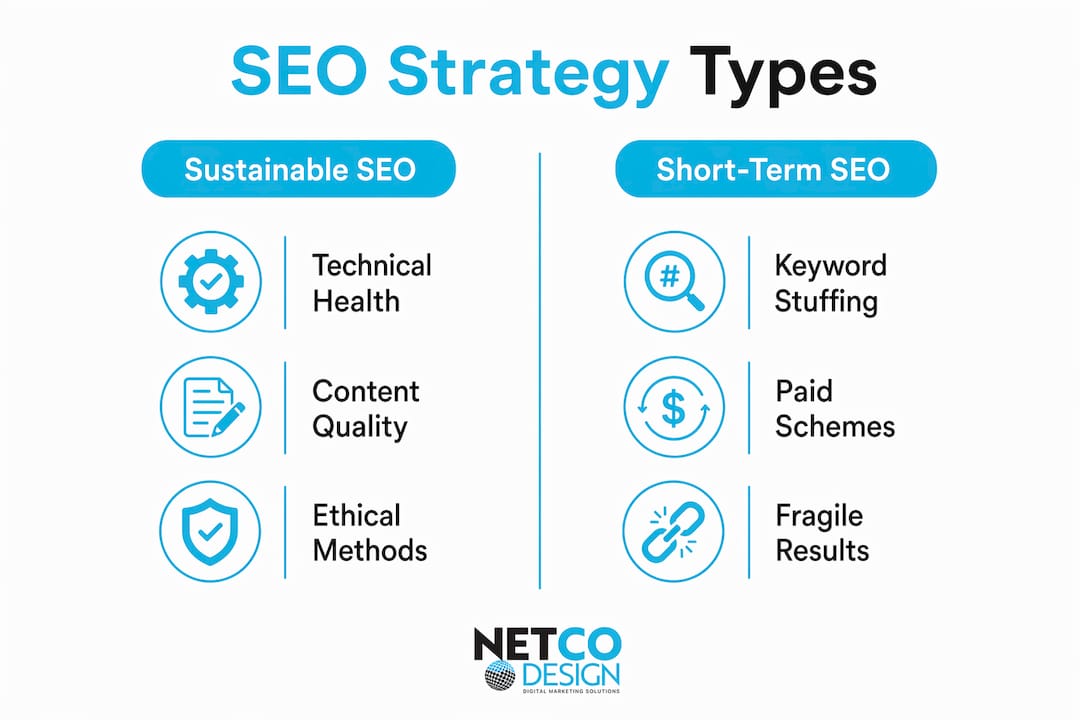
The contrast between the two approaches comes down to mindset. Short-term SEO plays a finite game: win a ranking, extract traffic, move on. Sustainable SEO plays what researchers call the “Infinite Game,” where the goal is to own a topic so thoroughly that search engines treat your site as the default trusted answer source. That status compounds over time.
Here is how the two approaches compare in practice:
- Short-term hacks: Purchased backlinks, keyword stuffing, content spinning, clickbait titles, and exact-match anchor text manipulation.
- Sustainable SEO practices: Original research, digital PR outreach, topical cluster content, Schema markup, and Core Web Vitals optimization.
- Risk profile of hacks: High. Over 40% of sites using black-hat link tactics dropped 20-plus positions in 2025.
- Risk profile of sustainable SEO: Low. Authority built through ethical practices survives algorithm updates because it reflects genuine relevance.
- Time to results: Hacks peak in weeks. Sustainable SEO compounds over 9–12 months and continues growing.
Pro Tip: Use legitimate quick-win tactics like mention reclamation and HARO responses in your first three months. These build early momentum without the penalty risk of purchased links, and they complement your long-term authority-building plan.
How to implement sustainable SEO practices step by step
Building a sustainable SEO program does not require a massive budget. It requires a clear sequence of actions applied consistently.
-
Conduct mission-focused keyword research. Identify the topics your audience searches at every stage of the buying journey. Group keywords by intent: informational, navigational, and transactional. This grouping becomes the blueprint for your content hub.
-
Build content hubs and topical clusters. Create one authoritative pillar page for each core topic, then write supporting cluster articles that link back to it. This structure signals topical depth to search engines and protects your rankings when Google updates its quality guidelines.
-
Run regular technical audits. Check for crawl errors, broken links, duplicate content, and Core Web Vitals failures at least once per quarter. Technical problems silently suppress rankings even when your content is excellent.
-
Apply semantic SEO and Schema markup. Use structured data to map your business entity, services, and location. Semantic triplet mapping through Schema transitions your SEO into the Answer Engine Optimization era, where AI-driven results pull directly from structured, trusted sources.
-
Launch ethical link-building campaigns. Pitch original data, expert commentary, and resource guides to relevant publications. Digital PR earns links that carry genuine authority. Avoid any service that sells links in bulk.
-
Monitor performance and adapt. Track organic traffic, keyword rankings, Core Web Vitals scores, and conversion rates monthly. Use these signals to identify which content needs updating and which topics deserve new cluster articles. Staying ahead of algorithm updates requires treating SEO as an ongoing program, not a one-time project.
What role does adaptability play in sustaining SEO success?
Adaptability is what separates businesses that maintain rankings from those that lose them after every major Google update. Consistency in updates, technical health, and content relevancy maintains steady performance amid constant change. A site that publishes once and walks away will see its rankings erode as competitors publish fresher, more thorough content.
Ongoing optimization means more than fixing broken links. It means reading user behavior signals, expanding content that earns engagement, and retiring or consolidating pages that no longer serve a clear purpose. The businesses that grow organic traffic year over year treat their content library as a living asset, not a static archive.
Common pitfalls to avoid in ongoing SEO management:
- Chasing vanity metrics. Impressions and raw traffic numbers mean little if they do not convert. Focus on qualified traffic and conversion rate alongside ranking position.
- Ignoring content decay. Pages published two or three years ago often lose relevance as search intent shifts. Quarterly content audits catch decay before it becomes a ranking problem.
- Reacting to every algorithm update. Not every update affects every site. Diagnose before you act. Knee-jerk content overhauls often do more damage than the update itself.
- Neglecting AI-driven search signals. AI answer engines now surface content based on entity authority and structured data, not just keyword density. Sites without Schema markup are increasingly invisible in AI-generated answers.
The businesses that win long-term SEO treat adaptability as a core discipline, not an emergency response.
Key Takeaways
A sustainable SEO strategy builds compounding organic authority through technical health, topical content, ethical link building, and continuous adaptation, producing durable rankings that short-term tactics cannot match.
- Point | Details
- Sustainable SEO defined | It is a long-term, ethical approach that aligns technical, content, and authority factors to build lasting organic visibility.
- Ethical link building pays | Digital PR link-building delivered 312% ROI on average, while black-hat tactics caused 40%-plus of sites to drop 20-plus positions.
- Content hubs build resilience | Organizing content into pillar pages and clusters protects rankings against algorithm updates that penalize thin, isolated pages.
- Schema markup is non-negotiable | Structured data maps your business entity for AI-driven search engines, supporting visibility in both traditional and AI answer results.
- Adaptability sustains growth | Regular technical audits, content updates, and performance monitoring prevent ranking decay and keep your site competitive over time.
Why I think most businesses misunderstand sustainable SEO
By Lori Piencykoski
After working with digital marketers and small business owners across dozens of industries, the pattern I see most often is this: businesses invest in SEO for three months, see modest results, and then either abandon the effort or pivot to a shortcut. That pivot almost always costs them more than the original investment.
The uncomfortable truth is that sustainable SEO is not a marketing channel. It is a business asset. Think of it the way you think of a rental property. The first year involves upfront investment with modest returns. By year three, the compounding effect of authority, backlinks, and topical depth produces returns that dwarf the initial cost. The businesses I have watched succeed with long-term SEO strategies are the ones that committed to the process before they saw the payoff.
What I find most underappreciated is the role of semantic SEO and entity authority. Most small business owners have never heard of Schema markup, yet it is one of the highest-leverage technical investments available right now. AI-driven search engines do not just read your content. They parse your structured data to decide whether your business is a trusted entity worth citing. Skipping Schema in 2026 is like skipping mobile optimization in 2015. You will feel the consequences before you understand the cause.
My advice is direct: stop measuring SEO success at the 90-day mark. Set a 12-month baseline, commit to monthly content and technical work, and build your link profile through genuine relationships and original research. The businesses that do this consistently do not just rank. They own their topic.
— Lori Piencykoski
How Netco Design builds lasting SEO results for your business
Netco Design takes a structured, long-term approach to SEO that covers every layer of sustainable growth, from technical audits and Schema implementation to content strategy and ethical link building.

The team at Netco Design integrates AI-driven SEO services with proven content and authority-building methods, giving small businesses and marketing teams a program that compounds in value over time. Whether you need a full SEO content strategy built from scratch or guidance on staying ahead of the latest search trends, Netco Design provides transparent KPIs and measurable results at every stage. Explore the 2025 SEO trends guide to see how these principles apply to your market, or reach out to the Netco Design team for a consultation tailored to your business goals.
FAQ
What is a sustainable SEO strategy?
A sustainable SEO strategy is a long-term approach that builds organic visibility through ethical practices including technical optimization, topical content, and genuine link building. It prioritizes durable rankings over quick wins that reverse after algorithm updates.
How long does sustainable SEO take to show results?
Sustainable SEO typically produces compounding results after 9–12 months of consistent effort, with meaningful gains in authority and traffic continuing to grow beyond that initial period.
Why do short-term SEO tactics fail?
Short-term tactics like purchased links and keyword stuffing are detected by AI-driven search engines almost immediately. Sites using black-hat link schemes dropped 20-plus positions during 2025 updates, confirming that manipulative tactics carry high penalty risk.
What is Schema markup and why does it matter for sustainable SEO?
Schema markup is structured data code that helps search engines understand your business entity, services, and location. It supports entity authority and improves visibility in both traditional search results and AI-generated answers.
How often should you update your SEO strategy?
SEO performance should be reviewed monthly, with full technical audits and content reviews conducted at least quarterly. Algorithm updates require ongoing monitoring to catch ranking changes before they become traffic losses.

