

table of contents
Target audience analysis is all about figuring out the specific group of people most likely to buy from you. It’s the shift from making broad assumptions to using real data to understand who your best customers are, what they actually care about, and where you can connect with them. This process is the bedrock of any marketing strategy that works.
What Is Target Audience Analysis and Why It Matters

Think of your marketing budget like a ring of keys. You could try every single one on a door, hoping one finally works, or you could find the one key that fits the lock perfectly. Target audience analysis is how you find that perfect key. It saves you time, money, and a whole lot of frustration.
This is how you move from shouting your message into a crowd to having a meaningful conversation with the people who are already looking for what you offer.
Without this crucial step, marketing is just a guessing game. You might create amazing content or launch flashy ad campaigns, but if they don’t reach the right people, all that effort goes down the drain. This isn’t just a “nice-to-have” anymore; it’s the core of a smart business strategy.
The Core Benefits of Knowing Your Audience
Getting a deep understanding of your audience has a direct impact on your bottom line and how efficiently you operate. When you put in the time to do a thorough target audience analysis, you unlock some serious advantages.
- Sharpened Marketing Focus: You can create hyper-relevant content, ads, and offers that speak directly to your audience’s specific problems and goals.
- Improved ROI: By putting your budget toward the channels and messages most likely to convert, you stop wasting money and get the most out of every dollar spent.
- Enhanced Product Development: Audience insights can shine a light on unmet needs or frustrations, giving you a clear roadmap for new features, services, or even whole new products.
- Stronger Customer Loyalty: When customers feel like you “get” them, they’re far more likely to stick with your brand, leading to repeat business and great word-of-mouth.
From Data to Decisions
The real goal here is to turn raw data into insights you can actually use. To see how this works in practice, check out this guide on how to identify your target audience for a B2B podcast—the principles are universal. This process helps you go beyond basic demographics like age and location to build a much richer picture of your customer’s world.
The real power of audience analysis lies in uncovering the ‘why’ behind customer behavior. It’s not just about knowing who they are, but why they make the choices they do. This insight is what separates average marketing from exceptional marketing.
Ultimately, all this detailed research serves as the blueprint for creating detailed customer profiles, or buyer personas. If you want to go deeper, we have a complete guide that shows you how to create buyer personas. This knowledge gives you the power to make smarter, more confident decisions across every part of your business.
The Shift to Audience-First Marketing
The world of digital marketing has gone through a quiet but seismic shift. For years, the undisputed king was the keyword. Businesses built entire strategies around search terms, treating them as the ultimate signal of what a user wanted. But that approach was like trying to understand a person by only listening to a few words they say out of context.
That old model is fading fast. Today, we’ve moved into an era centered on people, not just phrases. It’s a fundamental change from a keyword-first to an audience-first mindset. Modern marketing finally acknowledges that behind every search query and every click is a real person with complex needs, motivations, and pain points.
This isn’t just a philosophical shift; it’s driven by technology. Platforms like Google and Meta now use incredibly sophisticated AI to understand user intent on a much deeper level. They prioritize connecting people with hyper-relevant content that genuinely solves their problems, making a deep understanding of your audience more critical than ever before.
The Power of People Over Keywords
In the past, marketing effectiveness felt like a numbers game with a whole lot of guesswork. Campaigns were blasted out widely, hoping to catch the right people in a big net. This keyword-centric model meant advertisers were bidding on search queries as loose proxies for intent—a method that was far from perfect.
Historically, this approach resulted in achieving only about 35% of impressions within ideal audiences. The game has changed dramatically with the rise of AI-driven, audience-centric models. These intelligent systems have elevated that impression share to 65%, nearly doubling targeting accuracy. As a result, click-through rates have jumped from 1.5% to 2.2% simply because the ads and messaging are better aligned with the people seeing them.
This data tells a clear story: when you focus on the audience, the performance metrics naturally follow. Your marketing becomes less about casting a wide net and more about precision fishing.
AI as the Engine of Personalization
Artificial intelligence is the engine powering this audience-first movement. AI algorithms analyze billions of data points in real-time—browsing history, past purchases, content engagement, and more—to build a comprehensive picture of individual users. This allows for a level of personalization that was once the stuff of science fiction.
Instead of showing everyone the same ad for “running shoes,” AI can now show a specific ad for trail running shoes to a user who has been watching videos about hiking and lives near a mountainous area. This is the new standard of relevance.
This capability transforms marketing from a series of disconnected campaigns into a dynamic, ongoing conversation. Each interaction informs the next, creating a customer journey that feels personal and intuitive. By building your SEO, PPC, and content strategies on a solid foundation of target audience analysis, you create a system for sustainable growth.
Building an effective online presence starts with knowing exactly who you’re talking to. A strong social media content strategy, for example, is entirely dependent on understanding the audience on each platform. It’s about creating content that doesn’t just interrupt their feed but adds genuine value to their day.
When you get this right, your marketing stops feeling like marketing. It becomes a reliable engine for building authentic customer relationships, fostering loyalty, and consistently outperforming competitors who are still stuck shouting keywords into the void. This is how you turn audience insights into your most powerful competitive advantage.
A Practical Framework for Audience Analysis
Knowing the theory behind audience analysis is one thing, but putting it into practice is where you’ll actually see growth. Moving from abstract ideas to tangible insights requires a structured process. This practical, four-step framework is built to be repeatable, helping you turn raw information into a solid foundation for your entire marketing strategy.
This process will guide you from gathering scattered data to creating vivid customer profiles that inform every single decision you make.
Step 1: Data Collection
First things first, you need to gather the raw materials for your analysis. Think of yourself as a detective collecting clues from various sources to build a case. Your goal here is to combine two types of data to get the full picture.
Quantitative Data: This is the “what.” It’s all the measurable, numerical information that tells you what actions people are taking.
- Google Analytics: Uncover which pages are most popular, how visitors find your site, and where they’re dropping off.
- CRM Software: Analyze purchase history, customer lifetime value, and how often people interact with you.
- Social Media Analytics: Track follower demographics, post reach, and engagement rates.
Qualitative Data: This is the “why.” It’s the descriptive, non-numerical info that reveals the motivations and feelings behind the numbers.
- Customer Surveys: Go straight to the source and ask your audience about their challenges, goals, and what they think of your brand.
- Online Reviews and Testimonials: Read the exact words customers use to describe their experiences, both good and bad.
- Sales Team Feedback: Your sales team is on the front lines, hearing objections and questions every day—this is a goldmine of insight.
By blending these two data types, you create a much richer, more nuanced understanding of your audience than either could ever provide alone. In fact, a comprehensive market assessment almost always kicks off with this crucial data collection phase.
Step 2: Audience Segmentation
Once you have your data, the next job is to organize it into meaningful groups. This process, known as segmentation, is like sorting a giant pile of mixed puzzle pieces into smaller, manageable sections based on color or shape. Instead of trying to talk to everyone at once, you can tailor your message to specific clusters of people who share common traits.
For instance, understanding demographic segmentation examines basic characteristics like age, gender, income, and location.
Other powerful ways to segment your audience include:
- Psychographic Segmentation: Grouping people based on their lifestyle, values, interests, and personality traits.
- Behavioral Segmentation: Clustering users based on their purchasing habits, brand interactions, and product usage.
- Geographic Segmentation: Dividing your audience by country, state, city, or even neighborhood—absolutely vital for local SEO.
Getting segmentation right is a cornerstone of modern marketing. A HubSpot report found that 50% of marketers now rank conversion rate optimization just behind audience segmentation as a top priority. It’s that important.
Step 3: Persona Creation
With your audience neatly segmented, it’s time to bring these groups to life. Persona creation is the process of turning those data-driven segments into fictional characters that represent your ideal customers. These aren’t just generic profiles; they are detailed, semi-fictional representations complete with names, goals, challenges, and motivations.
A well-crafted buyer persona gives your abstract data a human face. It stops you from marketing to “millennials in Florida” and helps you start communicating with “Marketing Manager Michelle,” who is struggling to prove ROI to her boss.
A strong persona should always include:
- A name and a stock photo.
- Demographic details like age, job title, and income.
- Their primary goals and what they want to achieve.
- Their biggest pain points and challenges.
- How your product or service helps them solve those problems.
Creating these personas makes it so much easier for your entire team—from marketing to sales to product development—to stay focused on the same customer.
This shift is central to the evolution of modern marketing, moving from a rigid keyword focus toward an AI-driven and, ultimately, an audience-first approach.
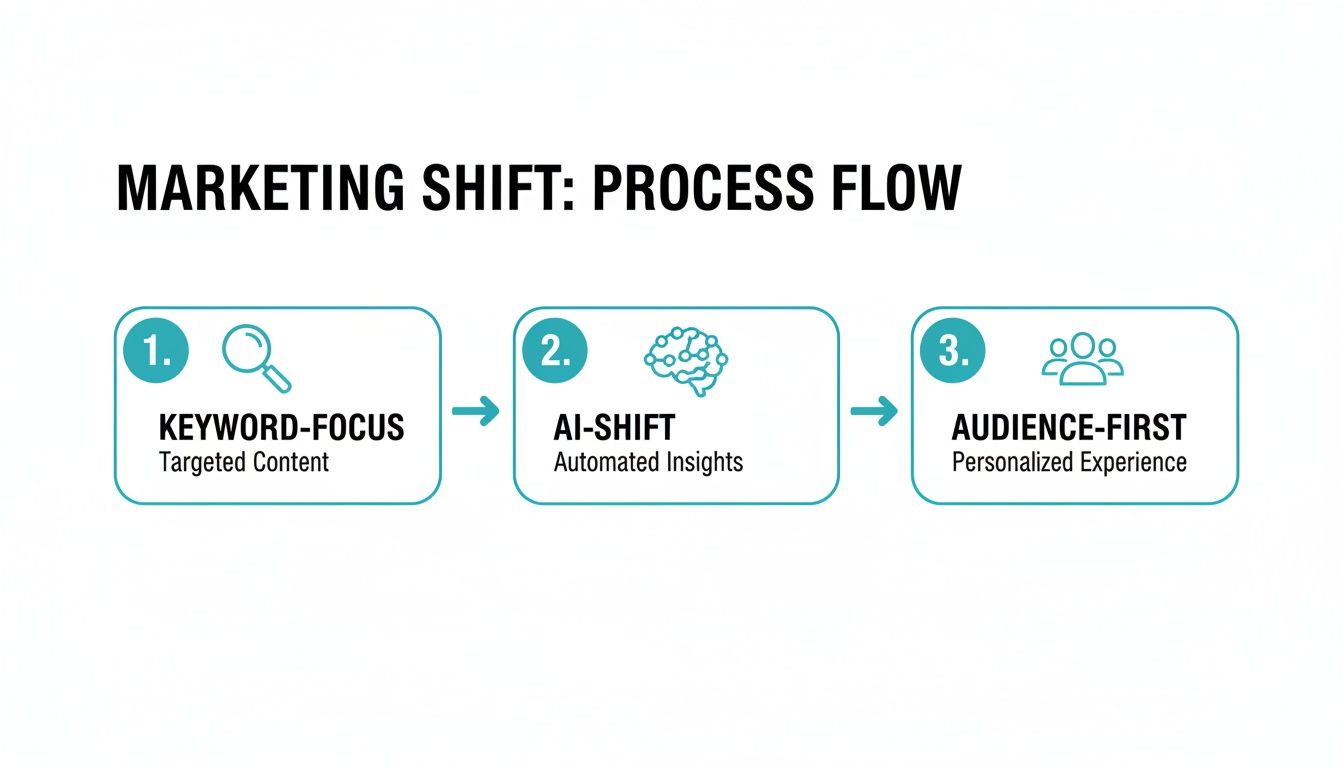
The key takeaway is that lasting success comes from building strategies around deep human understanding, not just technical queries.
Step 4: Behavior and Intent Mapping
The final step connects all the dots. Behavior and intent mapping involves charting out the journey your personas take from the moment they realize they have a problem to the point where they become a loyal customer. It’s all about getting inside their head at each stage.
This means asking critical questions like:
- Awareness Stage: What triggers their need? What questions are they typing into Google?
- Consideration Stage: What solutions are they comparing? What features are most important to them?
- Decision Stage: What information do they need to feel confident in their choice? What are their final barriers to purchase?
Mapping this journey reveals exactly what content and messaging your audience needs at each step. It allows you to create a seamless experience that guides them from one stage to the next, building trust and showing them you truly get it. This structured framework turns target audience analysis from a complex task into a clear, actionable process.
Turning Audience Insights Into a Winning Strategy
Gathering all that rich data and building out detailed personas is a huge win, but honestly, it’s only half the battle. The real magic happens when you translate those insights from your target audience analysis into an actual, winning strategy. This is where understanding becomes execution—making sure every marketing dollar and every minute you spend is aimed in exactly the right direction.
Think of your audience insights as a highly detailed map. Before, you were kind of navigating in the dark. Now, you can chart the most direct path to your customers, speaking their language and meeting their needs every step of the way.
Let’s walk through a practical playbook for applying your newfound knowledge across your most important marketing channels. It’s time to shift your strategy from generic to exceptionally relevant.
Weaving Insights Into Your SEO and Content
Your audience personas are a goldmine for search engine optimization. Instead of just guessing which keywords to chase, you can now dig into your personas’ biggest pain points, goals, and common questions to uncover the high-intent phrases they’re actually typing into Google.
For instance, say one of your personas is “Small Business Sam,” and he’s constantly worried about cash flow. Your analysis shows he’s searching for things like “how to improve business cash flow” or “best invoice tracking software for small business.” Boom. Those are the exact keywords you should be building your content around.
This audience-first approach to SEO helps you:
- Create Problem-Solving Content: You can develop blog posts, guides, and videos that directly answer the questions your personas are asking. This builds authority and, more importantly, trust.
- Target Long-Tail Keywords: By using the specific language and phrasing from your persona research, you capture highly qualified traffic that’s much closer to making a decision.
- Optimize for User Intent: You can structure your content to match what a user wants to accomplish, whether they’re just learning, comparing options, or ready to buy.
When your content speaks directly to a user’s problem, Google notices. Aligning what a user needs with the solution you provide is precisely what drives higher rankings and brings in sustainable organic traffic.
Building Hyper-Targeted PPC Campaigns
Paid advertising can sometimes feel like a gamble, but a solid target audience analysis stacks the odds firmly in your favor. With your audience segments clearly defined, you can move past broad, scattershot targeting and create hyper-specific ad campaigns that truly resonate with each group.
For example, you can create entirely separate ad groups for different personas. An ad aimed at “E-commerce Emily” might highlight your platform’s seamless Shopify integration. Meanwhile, an ad for “Startup Steve” could focus on budget-friendly scalability. This level of personalization is what dramatically increases click-through rates and lowers your cost per acquisition.
A personalized ad that reflects a customer’s specific needs doesn’t feel like an interruption; it feels like a solution. This is how you maximize your ad spend and turn clicks into conversions.
By applying your insights, you can tailor every single element of your campaign—from the ad copy and imagery to the landing page experience—to match the unique motivations of each segment. A well-designed marketing strategy often involves guiding these targeted leads through a structured process. To get a better handle on this, you can learn more about how to create a sales funnel that converts.
Enhancing Website UX and Conversions
Your website is often the final stop on a customer’s journey. Understanding how your audience behaves is the key to creating a user experience (UX) that feels intuitive and guides them effortlessly toward a conversion.
Your data might show that one persona overwhelmingly uses mobile devices and values speed above all else. That’s your cue to prioritize mobile-first design and obsess over page load times. Another segment might need to see detailed case studies and testimonials before they feel confident enough to buy. You can then make sure that social proof is featured prominently on your key service pages.
Use your audience analysis to:
- Simplify Navigation: Structure your site menu and information architecture around your personas’ primary goals. Make it easy for them to find what they’re looking for.
- Optimize Calls-to-Action (CTAs): Write CTAs that use the language your audience uses and speak directly to their core motivations.
- Personalize the User Journey: Show different content or offers to different audience segments. This creates a far more relevant and engaging experience.
Ultimately, turning insights into strategy means making sure every marketing touchpoint—from the first ad they see to the final button they click—feels like it was designed just for them. That’s how you create a powerful, cohesive experience that builds brand loyalty and drives real, measurable growth.
Engaging Your Audience on Social Media and Video

Think of social media platforms as more than just digital billboards. They’re living, breathing laboratories for audience research. Channels like Instagram, TikTok, and LinkedIn give you a real-time pulse on what people are talking about, the exact language they use, and what they want next.
This makes them powerful tools for continuous target audience analysis. Instead of just shouting messages at your followers, start listening. The comments, questions, and conversations happening around your industry are unfiltered gold. This direct feedback is invaluable for sharpening your customer personas.
Harnessing the Power of Short-Form Video
Short-form video is the dominant language of the internet now. Platforms like TikTok and Instagram Reels have completely changed how brands grab attention and tell their stories. To really connect, you need to speak this language fluently.
The secret to great video content is tying it directly to your audience analysis. What would actually make your ideal customer stop scrolling? Let your personas be your guide.
- For “Small Business Sam,” create quick, 60-second tutorials that solve a common operational headache. Make it fast and practical.
- For “E-commerce Emily,” film behind-the-scenes clips of your products being made or packaged. This builds authenticity and trust.
- For “Startup Steve,” share inspiring founder stories or testimonials from similar companies who won with your help.
This approach ensures your videos aren’t just adding to the noise. They become meaningful touchpoints that turn passive viewers into a real community.
Listening and Adapting Your Strategy
The sheer scale of social media makes a precise target audience analysis non-negotiable. With a projected 6.61 billion people reachable by social ads by 2030 and 83.8% of video ad spend going to mobile, you simply can’t afford to guess.
Consider this: by 2026, 57% of marketers plan to use TikTok in their strategy, and 32% already say it’s a top source for ROI. You can dig into more numbers in this complete report on digital marketing industry statistics.
The trend is clear: your audience is on these platforms, and they’re watching video. Your job is to meet them there with content that feels like it was made just for them.
Social media engagement is a two-way street. Every like, comment, and share is a data point. Use polls, Q&A sessions, and direct messages to actively solicit feedback and learn what your audience wants to see next.
By treating social media as an ongoing research project, you can gather invaluable feedback and turn followers into loyal customers. This continuous loop of listening, creating, and adapting keeps your marketing sharp and effective.
How to Measure Your Audience-Focused Success
A great marketing strategy isn’t just creative—it’s measurable. Once you’ve put the insights from your target audience analysis to work, you have to track the real-world impact. It’s time to stop worrying about vanity metrics like likes and shares and start focusing on the key performance indicators (KPIs) that actually grow your business.
This is how you move from guessing if your strategy is working to proving it with hard data.
Focusing on Business-Critical KPIs
To really know if you’re on the right track, you need to watch the metrics that directly impact your bottom line. These are the numbers that tell you if your audience-focused approach is turning into real results.
Here are three of the most important metrics to keep an eye on:
- Conversion Rate: This is the percentage of people who take the action you want them to, whether that’s making a purchase or filling out a form. When your conversion rate starts climbing, it’s a strong signal that your messaging is finally clicking with the right people.
- Customer Acquisition Cost (CAC): This tells you exactly how much you’re spending in sales and marketing to land a single new customer. A deep understanding of your audience should make your ad spend far more efficient, driving your CAC down.
- Customer Lifetime Value (CLV): This metric forecasts the total revenue you can expect from a single customer over their entire relationship with your business. When you attract the right customers, they stick around longer and spend more, which naturally boosts your CLV.
The ultimate goal is to see a direct line between your deeper audience understanding and improvements in these core business metrics. When CLV rises and CAC falls, you know your analysis is paying off.
An Ongoing Cycle of Improvement
Finally, remember that target audience analysis isn’t a “set it and forget it” task. Markets shift, customer tastes change, and new trends pop up all the time. Your analysis needs to be a continuous cycle of learning, testing, and tweaking to keep your marketing sharp and effective.
To dive deeper into measuring your success, you can learn more by exploring our guide on how to calculate marketing ROI and its importance.
Frequently Asked Questions About Audience Analysis
Even with a solid framework, some questions always pop up when you start putting theory into practice. Here are a few clear, straightforward answers to the most common things people ask about audience analysis.
How Often Should I Analyze My Target Audience?
Think of audience analysis as a continuous conversation, not a one-time project. It’s a good idea to do a major, deep-dive analysis once a year or whenever you’re planning a big move, like launching a new product.
Beyond that, you should be checking in on your audience quarterly. These regular check-ins help you stay current with market trends, shifts in customer behavior, and any new challenges your audience is facing. It’s like a routine health check to keep your marketing strategy sharp and relevant.
What Are the Best Free Tools for Audience Research?
You don’t need a massive budget to get started. There are plenty of powerful, free tools that can give you a ton of information about your audience.
- Google Analytics: This is non-negotiable. It shows you crucial demographic data, how users behave on your site, and what content they actually care about.
- Social Media Insights: Platforms like Facebook Audience Insights, LinkedIn Analytics, and Instagram Insights give you a direct window into the demographics and interests of the people who follow you.
- Google Trends: Use this to see how popular certain search terms are over time. It’s a great way to spot emerging trends related to what your audience is looking for.
For any small business, these tools provide a solid foundation for target audience analysis without having to spend a dime.
Can a Small Business Do Audience Analysis Effectively?
Absolutely. In fact, small businesses often have a huge advantage here because they’re so much closer to their customers. You can gather priceless qualitative data just by having real conversations, paying attention during customer service interactions, and building personal relationships—something big corporations struggle to do.
For a small business, audience analysis isn’t about big data; it’s about deep understanding. Simple surveys, listening on social media, and analyzing sales data can provide incredibly powerful insights to guide your strategy.
By combining free tools with direct customer feedback, any small business can build accurate and actionable customer personas that truly work.
How Does Audience Analysis Improve Local SEO?
For any business serving a specific geographic area, audience analysis is a total game-changer for local SEO. It helps you get inside the heads of customers in your community, understanding their unique needs, the language they use, and how they search for local services.
When you know your local audience, you can create content and optimize your Google Business Profile using the exact terms and phrases they’re typing into Google. This alignment with local user intent sends powerful signals to search engines that your business is the best, most relevant answer for local searches, which can dramatically boost your visibility in the local map pack and search results.
Ready to stop guessing and start connecting with the customers who matter most? At Netco Design LLC, we specialize in using data-driven target audience analysis to build websites and SEO strategies that get real results. Let us help you find your key to growth. Learn more about our approach at https://netcodesign.com.

