

table of contents
Technical SEO is defined as the process of optimizing a website’s infrastructure so search engines and AI platforms can efficiently crawl, render, index, and cite its content. Unlike on-page SEO, which focuses on content quality, technical SEO addresses the underlying architecture that determines whether your pages are even eligible to rank. The core pillars are crawlability, indexability, and rendering. Understanding technical SEO is the first step toward building a site that performs in both traditional Google search and AI-driven platforms like ChatGPT and Perplexity. This guide covers every foundational concept, current best practices, and the emerging AI compatibility requirements that define technical SEO in 2026.
What is technical SEO explained: core components and how they work
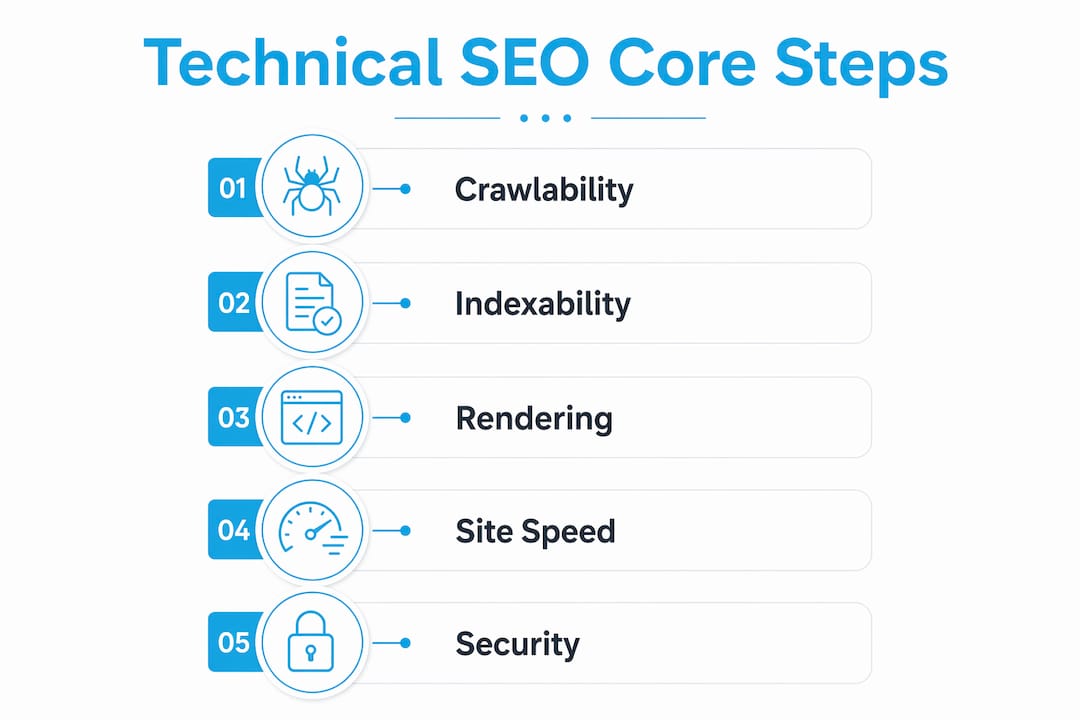
Technical SEO covers six fundamental areas: crawlability, indexability, site speed, security, structured data, and site architecture. Each area addresses a different stage in how a search engine discovers, evaluates, and stores your content. Miss one, and your entire SEO effort can stall regardless of how strong your content is.

Crawlability
Crawlability determines whether search engine bots can find and access your pages. Bots follow links to discover URLs, so a broken internal linking structure or a misconfigured robots.txt file can block entire sections of your site from being discovered. Think of your robots.txt as a set of instructions for bots. It tells them where they can and cannot go, but it does not control whether a page appears in search results.
Indexability
Indexability controls whether a discovered page gets stored in a search engine’s index. A page must be indexed to rank. The noindex meta tag is the correct tool for keeping a page out of the index. Canonical URLs tell search engines which version of a page is the authoritative one, preventing duplicate content from splitting ranking signals.
Rendering and JavaScript
Rendering is how a search engine processes and reads your page’s content. Static HTML pages render instantly. Pages that rely heavily on JavaScript require the search engine to execute that code before reading the content, which adds delay and risk. Server-side rendering delivers fully built HTML to the bot, making content immediately readable and reducing indexing errors.
Site speed and Core Web Vitals
Core Web Vitals are Google’s primary speed metrics and direct ranking signals. The three metrics are Largest Contentful Paint (LCP), which measures loading speed; Interaction to Next Paint (INP), which measures responsiveness; and Cumulative Layout Shift (CLS), which measures visual stability. A page that loads slowly or shifts content unexpectedly will rank below a faster, more stable competitor.
Security and structured data
HTTPS is a baseline ranking requirement. Google confirmed HTTPS as a ranking signal years ago, and browsers now flag non-secure sites with visible warnings that reduce user trust. Structured data using Schema.org markup helps search engines understand what your content means, not just what it says. JSON-LD format is the standard implementation method and can unlock rich results like star ratings, FAQs, and product details directly in search results.
Pro Tip: Run Google’s PageSpeed Insights on your top five landing pages first. Fix LCP issues before anything else. Loading speed has the most direct impact on both rankings and conversions.
How does AI search compatibility change technical SEO?
Technical SEO now includes AI search engine compatibility as a required discipline. Platforms like ChatGPT, Claude, and Gemini use their own crawlers to read and index web content for AI-generated answers. If your site blocks those crawlers, your content will not appear in AI citations regardless of how well it ranks on Google.
The key changes you need to make fall into three areas:
- Robots.txt configuration: Review your
robots.txtfile to confirm you are not blocking AI crawlers. Many sites block all unknown bots by default, which inadvertently excludes AI indexing agents. Check for overly broadDisallowrules and update them. - Structured data completeness: AI systems interpret content as entities, not just text. Complete Schema.org markup helps AI platforms understand who you are, what you offer, and what your content covers. Incomplete or missing structured data makes your content harder for AI to cite accurately.
- Content clarity and entity definition: AI crawlers favor content that clearly defines its subject. Use specific named entities, clear headings, and direct declarative sentences. Vague or heavily qualified content is less likely to be cited in AI-generated answers.
The practical implication is significant. A site that ranks well on Google but blocks AI crawlers is invisible to a growing share of search traffic. AI-driven search is not a future concern. It is a current reality that requires the same technical rigor as traditional SEO.
Pro Tip: Search for your brand name in ChatGPT and Perplexity. If your site is not cited or referenced, check your robots.txt for AI crawler blocks and verify your structured data is complete and valid.
Common technical SEO issues and how to audit your site
Most technical SEO problems fall into a predictable set of categories. Knowing what to look for makes audits faster and fixes more effective.
The robots.txt vs. noindex confusion
Robots.txt manages crawling, not indexing. Blocking a URL in robots.txt prevents bots from visiting it, but the page can still appear in search results if other sites link to it. To remove a page from the index, you must use a noindex tag. Using robots.txt alone to hide pages is one of the most common and costly technical SEO mistakes.
Redirect chains
Redirect chains dilute SEO value and slow crawl efficiency. A chain occurs when URL A redirects to URL B, which redirects to URL C. Each hop loses a fraction of link authority and adds latency. The fix is direct: point the original URL straight to the final destination URL. Audit your redirects regularly, especially after site migrations or URL restructures.
Running a technical SEO audit
A structured audit follows this priority order:
- Crawl the site using an automated crawl tool to map all URLs and identify errors.
- Review crawl errors including 404 responses, 5xx server errors, and blocked resources.
- Check indexation by comparing crawled URLs against what is actually indexed in Google Search Console.
- Audit redirect chains and consolidate multi-hop redirects into single direct redirects.
- Validate structured data using Google’s Rich Results Test to confirm Schema.org markup is error-free.
- Measure Core Web Vitals for both mobile and desktop using PageSpeed Insights or Search Console’s Core Web Vitals report.
| Audit area | Primary tool | What to look for |
|---|---|---|
| Crawl errors | Google Search Console | 404s, blocked pages, server errors |
| Core Web Vitals | PageSpeed Insights | LCP above 2.5s, CLS above 0.1 |
| Structured data | Rich Results Test | Errors, missing required fields |
| Redirect chains | Crawl tool | Multi-hop redirects, redirect loops |
| Index coverage | Google Search Console | Excluded pages, noindex conflicts |
Technical SEO requires ongoing audits, not a single pass. Every code deployment, content migration, or plugin update can introduce new crawl or indexation issues. Schedule a full audit at least quarterly and monitor Search Console weekly for new errors.
Pro Tip: Set up automated alerts in Google Search Console for coverage drops and Core Web Vitals regressions. Catching issues within days of a deployment is far cheaper than discovering them weeks later.
How technical SEO fits into your broader marketing strategy
Technical SEO is the foundation that every other SEO effort depends on. Content marketing, link building, and on-page optimization all require a technically sound site to deliver results. A site with crawl errors or slow load times will underperform even with excellent content and strong backlinks.
The relationship between technical, on-page, and off-page SEO works like this:
- Technical SEO makes your site accessible and readable to search engines and AI platforms.
- On-page SEO ensures your content matches search intent and uses the right keywords and structure.
- Off-page SEO builds authority through backlinks and brand mentions.
Technical issues break this chain at the foundation. If bots cannot crawl your pages, your content never reaches the index. If your pages load slowly, users leave before converting, and Google records that negative signal. Website architecture directly affects how link authority flows through your site and how efficiently bots allocate crawl budget across your pages.
Mobile usability is a technical SEO factor with direct business impact. Google uses mobile-first indexing, meaning it evaluates the mobile version of your site for ranking purposes. A site that performs well on desktop but poorly on mobile will rank below a mobile-optimized competitor. Technical SEO, done correctly, supports every conversion and visibility goal in your digital marketing plan.
Technical SEO is a discipline, not a project
I have worked with dozens of websites where the owner treated technical SEO as a one-time checklist. They fixed the issues, closed the audit report, and moved on. Six months later, a site migration, a new plugin, or a template update had quietly reintroduced the same problems. Rankings dropped. Traffic fell. The audit had to start over.
The most honest thing I can tell you about technical SEO is this: it never stops. Every change to your site is a potential source of new technical debt. JavaScript rendering issues are the blind spot I see most often. A developer adds a new feature built in a JavaScript framework, and suddenly key content is invisible to bots because it only renders client-side. Redirect chains are the second most common issue. They accumulate silently over months of URL changes and content reorganization.
My practical advice is to fix foundational issues first. Crawlability and indexability problems cost you the most. A page that cannot be crawled or indexed earns zero ranking benefit regardless of its content quality. Once those are resolved, move to Core Web Vitals and structured data. The gains from fixing a slow LCP or adding complete Schema.org markup are measurable within weeks in Search Console data.
Treat technical SEO the way you treat accounting. You do not do it once and assume it stays correct. You monitor it, audit it regularly, and fix issues as they appear. That discipline is what separates sites that hold their rankings from sites that lose them quietly over time.
— Lori
Netcodesign builds sites that search engines and AI platforms can read
Technical SEO is only effective when it is built into a site from the start, not patched on afterward. Netcodesign designs and builds websites with crawlability, Core Web Vitals, and structured data as core requirements, not afterthoughts.

Netcodesign’s team handles full technical audits, structured data implementation, and ongoing monitoring for clients across Tampa Bay and beyond. If your site has crawl errors, slow load times, or AI crawler blocks, those issues are costing you traffic right now. Explore web design for small businesses built with technical SEO at its core, or review SEO tips tailored for small businesses to understand what a technically sound site can do for your visibility and revenue.
Key takeaways
Technical SEO is the infrastructure layer that determines whether your content can be found, indexed, and cited by search engines and AI platforms.
| Point | Details |
|---|---|
| Crawlability comes first | Bots must be able to access your pages before any other SEO effort can deliver results. |
| Robots.txt does not block indexing | Use noindex tags to remove pages from search indexes; robots.txt only controls crawl access. |
| Core Web Vitals are ranking signals | LCP, INP, and CLS directly affect rankings and must be monitored continuously. |
| AI crawlers need explicit access | Review robots.txt to confirm AI platforms like ChatGPT and Gemini are not blocked. |
| Technical SEO requires ongoing audits | Site changes introduce new issues; schedule full audits quarterly and monitor Search Console weekly. |
FAQ
What is technical SEO in simple terms?
Technical SEO is the practice of configuring your website so search engines and AI platforms can crawl, render, and index your content correctly. It covers site speed, security, structured data, and crawl access.
How does technical SEO differ from on-page SEO?
Technical SEO addresses site infrastructure, including crawlability, indexability, and speed. On-page SEO focuses on content quality, keyword use, and page structure. Both are required for strong rankings.
Why does robots.txt configuration matter for AI search?
AI platforms like ChatGPT and Gemini use their own crawlers. A robots.txt file that blocks unknown bots will prevent those crawlers from reading your site, removing your content from AI-generated answers.
How often should I run a technical SEO audit?
Run a full technical audit at least quarterly. Monitor Google Search Console weekly for new crawl errors, coverage drops, and Core Web Vitals regressions introduced by site updates.
What is the fastest technical SEO fix for most sites?
Resolving redirect chains and fixing crawl errors in Google Search Console delivers the fastest gains. These issues directly limit how many pages get indexed and how efficiently link authority flows through your site.

