

table of contents
Website analytics sales is the practice of analyzing visitor behavior and engagement data on your website to uncover insights that directly drive revenue. Businesses that effectively use website analytics can see revenue increases of up to 15%. That number reflects a real shift: analytics is no longer a reporting tool. It is a sales engine. Platforms like GA4 give you traffic data, but the full picture requires connecting that data to your sales pipeline through CRM integration and visitor identification. This guide explains how to make that connection work for your business.
How does the role of website analytics in sales actually work?
Website analytics improves sales by showing you exactly where buyers lose interest and where they are ready to act. Every click, scroll, and page visit is a signal. When you read those signals correctly, you stop guessing and start selling with evidence.
Conversion rate optimization (CRO) is the discipline of using that behavioral data to improve the parts of your site that turn visitors into buyers. It focuses on calls to action, landing page copy, and form design based on what real visitors actually do, not what you assume they do.
Here is what behavioral data reveals when you pay attention to it:
- Pricing page dwell time shows which visitors are seriously evaluating your offer versus those who are just browsing.
- Cart abandonment rates identify the exact step where purchase intent breaks down.
- Lead form engagement tells you whether your form is too long, confusing, or poorly placed.
- Repeat visit patterns signal a prospect who is comparing options and moving toward a decision.
- Content scroll depth shows whether your messaging reaches the point where it asks for action.
Segmenting visitors by behavior lets you personalize follow-up outreach. A prospect who spent four minutes on your pricing page and then visited your case studies page is a different conversation than someone who bounced after the homepage. Treating them the same wastes both your time and theirs.
Pro Tip: Set up behavior-based segments in GA4 to flag visitors who hit your pricing or contact pages. Route those segments directly to your sales team as warm leads rather than waiting for a form fill.

Learning how to improve website conversion rates starts with reading these behavioral signals before making any changes to your site.
Why does connecting anonymous visitor data to your pipeline matter?
Most businesses are flying blind on 97% of their web traffic. GA4 tracks activity but does not identify who is visiting. That means the vast majority of your potential buyers leave no trace in your CRM.
The standard workaround is the contact form. The problem is that forms capture roughly 3% of your traffic. You are building your entire sales pipeline on a fraction of the people who actually showed interest.
Identity graph matching tools solve this gap. These tools identify 30–40% of anonymous visitors, which is 10–15 times more effective than relying on form fills alone. That improvement in lead intelligence changes how your sales team prioritizes outreach.
The practical approach is what analysts call a “dual-stack” setup. You pair GA4 for broad traffic and channel performance with a visitor identification layer that connects anonymous behavior to real companies or individuals. Together, they give you a complete picture.
Here is what that dual-stack approach delivers:
- Pipeline visibility beyond the small percentage of visitors who fill out forms.
- Account-level intent data showing which companies are researching your solutions.
- Earlier sales signals that let your team reach out before a competitor does.
- Shorter sales cycles because your team knows what a prospect has already reviewed.
Web engagement spikes in the four weeks before opportunity creation correlate with 32% faster closes and 18% higher win rates. That statistic makes the case for investing in visitor identification. The businesses that connect anonymous behavior to known revenue outcomes consistently outperform those that focus only on traffic volume.
Pro Tip: Integrate your visitor identification tool directly with your CRM. When a target account visits your pricing page three times in one week, your sales rep should get an automatic alert, not a weekly report.
Understanding what makes a sales qualified lead becomes far more precise when you have behavioral data attached to each prospect record.
What sales performance metrics should you track with website analytics?
Traffic metrics and sales metrics are not the same thing. Page views and sessions tell you how busy your site is. Sales performance metrics tell you whether that activity is turning into revenue.
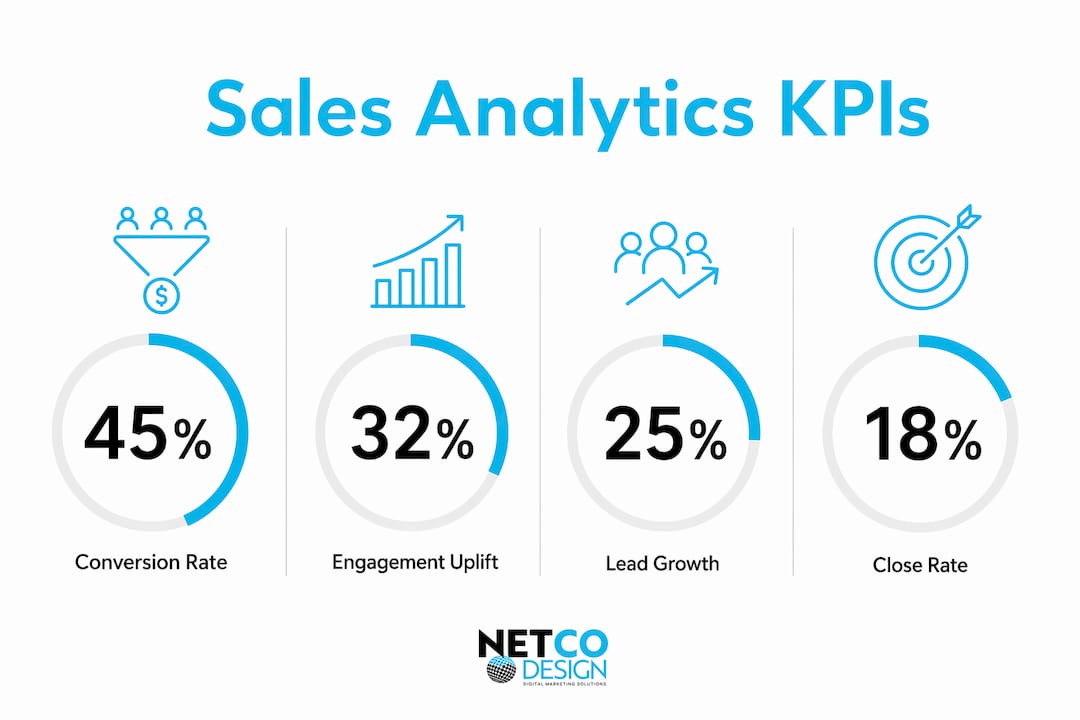
Sales teams gain more value when analytics reveal decision-stage intent rather than just traffic volume. The metrics that matter most are the ones that connect visitor behavior to pipeline movement.
Traffic metrics vs. pipeline-focused sales KPIs
Traffic metrics (useful for channel performance):
- Sessions and unique visitors
- Bounce rate by page
- Traffic source breakdown
- Average time on page
Pipeline-focused sales KPIs (useful for revenue decisions):
- Conversion rate by traffic source
- Lead-to-opportunity rate from web forms
- Pipeline influenced by organic vs. paid traffic
- Revenue attributed to specific landing pages
- Decision-stage indicators (pricing page visits, comparison loops, repeat sessions)
The distinction matters because full-journey revenue attribution reveals the true marketing impact on sales. Last-click models credit the final touchpoint before conversion and ignore every earlier interaction that built the buyer’s confidence. A prospect who read three blog posts, attended a webinar, and then clicked a paid ad did not convert because of the ad alone.
Decision-stage readiness signals like pricing page dwell time and comparison loops reduce forecast variance and sales objections. When your sales team knows a prospect has already spent time evaluating your pricing, they enter the conversation at a different level. They skip the education phase and move directly to addressing specific concerns.
Budget allocation also changes when you track these metrics properly. If organic traffic consistently produces higher-quality leads than paid search, that data justifies shifting spend. Without pipeline-focused KPIs, you are making budget decisions based on cost per click rather than cost per closed deal.
How can small businesses implement website analytics to boost sales?
Practical implementation starts with the right tool stack and a clear plan for how data flows from your website into your sales process. The technology is available to businesses of every size. The gap is usually in how teams use it.
Follow these steps to build a working analytics-to-sales system:
- Install GA4 and configure conversion events. Set up goals for form submissions, phone clicks, pricing page visits, and any other action that signals buyer intent.
- Add a visitor identification layer. Pair GA4 with a visitor ID tool to capture company-level or person-level data on anonymous traffic.
- Connect analytics to your CRM. Push behavioral data into your CRM so sales reps see web activity alongside contact records.
- Define your high-intent signals. Agree with your sales team on which behaviors qualify as warm leads: for example, three or more visits, pricing page view, and a case study download.
- Build shared dashboards. Give both marketing and sales access to the same data. Alignment breaks down when each team works from a different report.
- Track SEO and paid traffic separately. SEO influences pipeline across the full buyer journey. Measure organic visits linked to leads and closed revenue, not just rankings.
- Review and adjust monthly. Analytics is not a set-and-forget system. Monthly reviews catch shifts in buyer behavior before they hurt your pipeline.
The most common pitfall is focusing on vanity metrics. High traffic with low conversion is a content problem, not a success story. The second most common mistake is ignoring decision-stage data entirely and treating all leads as equal.
Pro Tip: Run a monthly “signal audit” where you review the top 10 pages visited by prospects who eventually closed. Those pages are your best sales assets. Strengthen them first.
Exploring proven tactics to generate leads online gives you a framework for turning analytics insights into a repeatable lead generation system.
Key Takeaways
Website analytics drives sales growth when it connects visitor behavior to pipeline outcomes, not just traffic counts.
| Point | Details |
|---|---|
| Analytics directly impacts revenue | Businesses using analytics effectively can see revenue increases of up to 15%. |
| Anonymous traffic is the biggest gap | GA4 identifies activity but not people; 97% of visitors leave no CRM trace without additional tools. |
| Visitor identification multiplies lead intelligence | Identity graph tools identify 30–40% of anonymous visitors, far exceeding form-fill rates. |
| Decision-stage metrics outperform traffic metrics | Pricing page dwell time and repeat visits predict close rates better than sessions or bounce rate. |
| CRM integration is non-negotiable | Analytics data only improves sales when it flows directly into the tools your sales team uses daily. |
Analytics tells you what traffic never will
I have worked with enough small businesses to know the pattern. They install GA4, watch the traffic numbers go up, and call it a win. Then the quarter ends and the revenue does not match the traffic. That disconnect is where most SMBs lose confidence in analytics entirely.
The shift I have seen work is moving from traffic reporting to decision intelligence. When a business starts tracking which pages their closed customers visited before buying, everything changes. You stop asking “how do we get more traffic?” and start asking “how do we get more of the right traffic to the right pages?”
The businesses that grow fastest are not the ones with the most visitors. They are the ones who know what a ready buyer looks like on their site and build their entire sales process around that signal. Anonymous traffic data is a starting point. Revenue intelligence is the destination.
Investing in visitor identification and CRM integration is not a luxury for enterprise companies. It is the practical next step for any SMB that wants to stop leaving pipeline on the table. The tools exist. The data is already there. The only question is whether you are reading it.
— Lori Piencykoski
How Netco Design uses analytics to build sales-ready websites
Netco Design builds websites and digital marketing programs that connect traffic data to real revenue outcomes for small and mid-sized businesses.

The team pairs technical SEO with conversion-focused design, so every page on your site works as a sales asset, not just a content placeholder. From digital marketing strategies for small businesses to full CRO programs, Netco Design ties every tactic back to measurable pipeline impact. If your analytics show traffic but your sales pipeline stays flat, that is exactly the problem Netco Design is built to solve. Reach out to learn how a data-driven approach can turn your website into your best-performing sales channel.
FAQ
What is the role of website analytics in sales?
Website analytics tracks visitor behavior to reveal which pages, traffic sources, and content drive conversions and revenue. It gives sales and marketing teams the data they need to prioritize outreach and improve buyer journeys.
How does GA4 help with sales performance?
GA4 tracks traffic, engagement, and conversion events across your site. It shows which channels and pages produce the most leads, though it requires pairing with visitor identification tools for full pipeline intelligence.
What percentage of website visitors can be identified without forms?
Identity graph matching tools identify 30–40% of anonymous visitors, compared to roughly 3% captured through form fills alone.
Which sales metrics should SMBs track in website analytics?
Focus on conversion rate by traffic source, lead-to-opportunity rate, pipeline influenced by organic search, and decision-stage indicators like pricing page visits and repeat sessions.
How does web engagement predict sales outcomes?
Web engagement spikes in the four weeks before opportunity creation correlate with 32% faster closes and 18% higher win rates, making engagement data a reliable predictor of sales readiness.
Recommended
- How to Increase Online Sales A Practical Guide – Netco Design LLC
- How to Improve Website Conversion Rate and Drive Real Growth – Netco Design LLC
- Your Guide to the Analytics Maturity Model for SMB Growth – Netco Design LLC
- How to Optimize an Ecommerce Site for Conversions and Growth – Netco Design LLC

