

table of contents
TL;DR:
- An SEO audit evaluates a website’s technical, content, backlink, and AI search readiness, guiding prioritized fixes. Small businesses should conduct quarterly audits that include Bing and AI considerations, alongside traditional tools, to maximize search visibility and performance.
An SEO audit process is the systematic evaluation of a website’s ability to perform well in search engines by identifying technical issues, content gaps, and missed opportunities. The industry term for this practice is a “website SEO evaluation” or “SEO performance assessment,” and in 2026 it covers nine distinct layers: crawlability, technical health, on-page structure, content quality, E-E-A-T signals, AI search visibility, backlinks, Core Web Vitals, and analytics. For small business owners and marketers, understanding this process is the difference between a website that generates leads and one that sits invisible on page three. Google Search Console, Core Web Vitals, and Bing Webmaster Tools are the foundational standards every audit references.
What are the key steps in the SEO audit process?
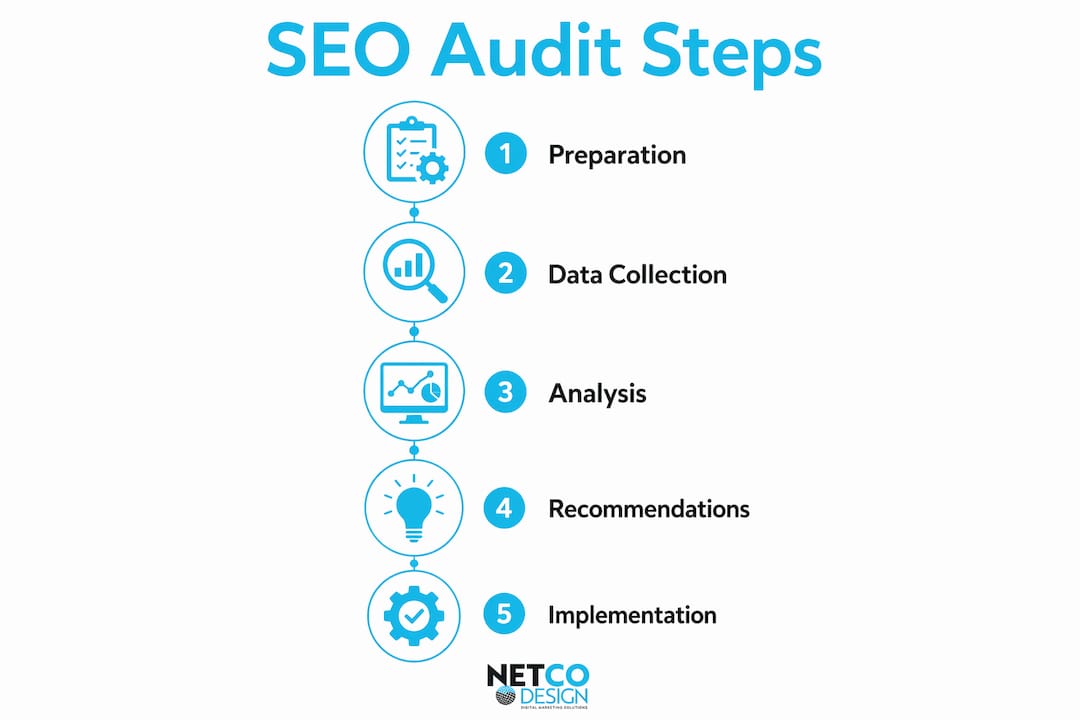
A thorough SEO audit follows a clear sequence. Skipping steps creates blind spots that cost you rankings and traffic.
-
Collect baseline data. Pull reports from Google Search Console, Analytics, and a site crawl tool. These three sources form the diagnostic foundation of every audit. Search Console shows which pages Google indexes and which queries drive clicks. Analytics reveals how visitors behave after they arrive.
-
Run a technical audit. Check crawlability, indexation status, redirect chains, broken links, and duplicate content. Core Web Vitals and mobile usability remain critical ranking factors in 2026. PageSpeed Insights gives you a concrete score you can act on immediately.
-
Audit your content. Review each page for keyword relevance, heading structure, and content duplication. Apply E-E-A-T criteria: does the page demonstrate real experience, expertise, authority, and trustworthiness? Thin or vague content fails both traditional crawlers and AI retrieval systems.
-
Assess your backlink profile. Identify high-quality links that signal authority and flag toxic links that carry ranking risk. Look for link gaps compared to pages that outrank you. A clean, relevant backlink profile accelerates recovery after algorithm updates.
-
Check AI search readiness. Verify that Bing can crawl and render your pages. Confirm that key content is structured so AI engines can extract direct answers. This step is new for most small business audits but is no longer optional.
-
Build a prioritized action plan. Rank every finding by impact, effort, and risk. Fix crawl and indexation blockers first, then address content quality, then pursue link opportunities.
Pro Tip: Use your SEO audit checklist before you start collecting data. A written checklist prevents you from skipping steps under time pressure.
How does the 2026 audit process address AI search and E-E-A-T?

The SEO audit process has expanded significantly because search is no longer just Google. ChatGPT Search, Perplexity, and Bing AI now surface answers directly from web content. That changes what a complete audit must cover.
E-E-A-T evaluation is now a core audit component, not an optional add-on. E-E-A-T stands for Experience, Expertise, Authoritativeness, and Trustworthiness. Auditors assess whether author credentials are visible, whether content cites credible sources, and whether the site earns trust signals like reviews and secure connections. Pages that score poorly on E-E-A-T lose ground in both traditional rankings and AI-generated answers.
AI search visibility requires its own checklist:
- Confirm Bing Webmaster Tools is set up and your sitemap is submitted. Bing’s JavaScript rendering is more restrictive than Googlebot’s, so pages relying on client-side rendering may not index at all.
- Check that key answers appear in the first two paragraphs of each page. AI engines pull from the top of the content, not the middle.
- Use structured data markup (Schema.org) to label FAQs, reviews, and how-to content. This increases the chance of being quoted in AI summaries.
- Audit content for “quotability.” A page earns AI citations when it states clear, direct answers rather than burying conclusions in long paragraphs.
- Review internal linking so AI crawlers can discover your most authoritative pages efficiently.
Pro Tip: A site perfectly optimized for Googlebot can still be invisible to AI retrieval systems if Bing cannot render its pages. Run a Bing fetch test as part of every audit.
The dual audience reality, traditional crawlers plus AI engines, means your audit scope is now wider than it was two years ago. Businesses that ignore this dimension are leaving measurable traffic on the table.
What tools and metrics does an effective SEO audit require?
The right tools make the difference between a surface-level scan and a diagnosis you can act on. Google Search Console, Bing Webmaster Tools, Screaming Frog, and PageSpeed Insights are the four non-negotiable tools for any audit in 2026. Each one covers a different layer of the evaluation.
Key metrics to track across those tools:
- Crawl errors and coverage gaps. Search Console’s Coverage report shows which pages are indexed, excluded, or blocked. A large number of excluded pages often signals a robots.txt or noindex problem.
- Page speed scores. PageSpeed Insights scores pages on a 0–100 scale for both mobile and desktop. A score below 50 on mobile typically correlates with higher bounce rates and lower rankings.
- Content freshness. Pages with outdated statistics or stale dates signal low trust to both crawlers and readers. Flag any page that has not been updated in over 12 months.
- Backlink quality. Cross-reference your link profile against domain authority signals. Links from irrelevant or low-quality sites carry negative weight.
- Index coverage rate. The ratio of indexed pages to total pages tells you how efficiently search engines are processing your site.
Automated crawls detect errors, but editorial assessment reveals deeper content and user experience opportunities. A crawl tool will flag a thin page, but only a human reviewer can judge whether the content actually answers the reader’s question. Use both. Data triangulation, combining Search Console, Analytics, and crawl data, validates findings and prevents you from chasing false positives.
Pro Tip: Export your Search Console performance data for the last 16 months before you start. Seasonal patterns in clicks and impressions reveal ranking drops that a single-month snapshot would miss.
How do you prioritize and implement audit findings?
Audit findings are only useful when they translate into a clear action plan. The impact, effort, and risk matrix is the standard method for prioritizing what to fix first. Every finding gets scored on three dimensions: how much it will move the needle (impact), how long it will take to fix (effort), and what happens if you leave it alone (risk).
-
Fix crawl and indexation blockers first. A page that cannot be crawled earns zero rankings regardless of its content quality. Broken sitemaps, noindex tags on key pages, and redirect loops all fall into this category. These fixes are typically low effort and high impact.
-
Address technical performance issues. Core Web Vitals failures and mobile usability errors affect every page on your site simultaneously. Fixing a slow server response time or an oversized image library lifts rankings site-wide.
-
Improve content on high-traffic, high-conversion pages. Use Analytics to identify which pages already attract visitors but fail to convert. Strengthening E-E-A-T signals, adding structured data, and tightening the content structure on these pages delivers measurable revenue impact faster than building new pages from scratch.
-
Build and clean your backlink profile. Disavow toxic links and pursue link opportunities in your niche. This step takes the most time but compounds over months.
-
Validate every fix with data. After implementing changes, monitor Search Console and Analytics for two to four weeks. A 360° SEO audit includes a QA checklist so you can confirm each fix actually resolved the underlying issue.
Treat auditing as a recurring process, not a one-time project. Search algorithms update continuously, and your competitors are not standing still. Quarterly audits catch regressions before they become ranking crises. For a practical starting point, Netco Design’s guide on how to conduct an SEO audit walks through each phase with marketing-specific examples.
Key Takeaways
A complete SEO audit covers technical health, content quality, backlink profile, and AI search readiness, and its findings only create value when organized into a prioritized action plan.
- Start with data collection. Pull Google Search Console, Analytics, and crawl data before drawing any conclusions.
- Fix crawl blockers first. Indexation errors eliminate ranking potential before content or links can help.
- Audit for E-E-A-T. Content that lacks visible expertise and trust signals loses ground in both traditional and AI-driven search.
- Include Bing and AI checks. Bing’s restrictive JavaScript rendering can make pages invisible to ChatGPT Search and Perplexity.
- Validate after every fix. Use Search Console and Analytics to confirm improvements, then audit again on a quarterly cycle.
Why most small business audits miss half the picture
I have reviewed hundreds of SEO audits over the years, and the pattern is consistent. Most small business audits stop at technical errors and keyword rankings. They catch the obvious problems, broken links, missing meta descriptions, slow load times. What they miss is the layer that now determines whether a site appears in AI-generated answers.
The businesses I see winning in 2026 are the ones that treat Bing indexation and E-E-A-T as first-class audit items, not afterthoughts. A site can have a perfect Google Search Console report and still be invisible to ChatGPT Search because Bing cannot render its JavaScript. That is a traffic loss that never shows up in a traditional audit report.
The other common mistake is treating the audit as a one-time event. An audit completed in january is outdated by april. Algorithm updates, competitor moves, and content decay happen continuously. The businesses that grow consistently run lightweight monthly checks and full audits every quarter. They also align audit priorities with business goals, fixing the pages that convert first, not the pages that are easiest to fix.
My honest advice: start with generative engine optimization concepts before your next audit. Understanding how AI engines retrieve and cite content changes which audit findings you treat as urgent. The technical fundamentals still matter. But AI readiness is the gap most small businesses have not closed yet.
— Lori Piencykoski
Netco Design’s approach to the 2026 SEO audit
Netco Design works with small businesses and marketing teams across Tampa Bay and beyond to run audits that cover all nine layers of a complete website SEO evaluation, including AI search readiness and E-E-A-T assessment. The team combines automated crawl tools with manual editorial review, because automated tools alone cannot assess true content quality or user experience depth.

Every audit Netco Design delivers includes a prioritized action backlog with clear QA criteria, so you know exactly what to fix, in what order, and how to confirm it worked. For businesses ready to align their SEO with 2026 digital marketing trends and AI-driven search, Netco Design’s AI-driven SEO services provide the technical depth and strategic clarity that generic audits skip.
FAQ
What is the SEO audit process?
The SEO audit process is a structured evaluation of a website’s technical health, content quality, backlink profile, and search engine visibility. It identifies issues that prevent pages from ranking and produces a prioritized list of fixes.
How often should a small business run an SEO audit?
A full audit every quarter is the standard practice, with lightweight monthly checks in between. Search algorithms and competitor activity change continuously, so a single annual audit leaves too many gaps.
What tools are needed to conduct an SEO audit?
Google Search Console, Bing Webmaster Tools, Screaming Frog, and PageSpeed Insights cover the core technical and performance layers of any audit. Analytics platforms add behavioral data that crawl tools cannot provide.
Can AI tools replace a full SEO audit?
AI tools assist in validating technical findings but cannot replace a full audit. Comprehensive audits require both automated crawling and manual editorial review to assess content quality and user experience accurately.
What does E-E-A-T mean in an SEO audit?
E-E-A-T stands for Experience, Expertise, Authoritativeness, and Trustworthiness. Auditors evaluate whether content demonstrates these attributes, which affects both traditional rankings and the likelihood of being cited in AI-generated search answers.

