

table of contents
Web content creation is the whole process behind the stuff people consume online. It’s the planning, the actual making, and the publishing of digital assets—think articles, videos, guides, and more—designed to pull in your ideal audience, keep them hooked, and turn them into customers. This isn’t just about churning out blog posts; it’s the absolute foundation of modern marketing, built to solve problems and earn trust.
What Is Web Content Creation and Why It Matters

Think of your website as your digital storefront. If it’s empty, people have no reason to come inside, let alone stick around. Web content creation is the art and science of stocking your store with valuable, interesting, and genuinely helpful things that make people want to walk in and eventually buy something.
This goes way beyond just filling up a page with words. It’s a thoughtful effort to produce material that answers your audience’s biggest questions, soothes their pain points, and gently guides them toward a solution—a solution that, ideally, your business offers.
The Bedrock of Digital Marketing
We live in a world where people fire off over 8.5 billion Google searches per day. Just having a website isn’t going to cut it. You have to show up where your customers are looking for answers, and that’s where great content comes into play.
High-quality content is the engine that powers nearly every part of digital marketing. It’s the primary driver of your visibility, the trust you build, and the authority you command online.
When you get it right, your content does some serious heavy lifting for your business:
- It attracts organic traffic. By creating content around the keywords people are actually searching for, you pull in qualified visitors who are already looking for your expertise.
- It builds authority and trust. Publishing well-researched, helpful content over and over again cements your brand as a go-to leader in your field.
- It nurtures leads. Not everyone is ready to buy the second they land on your site. Content keeps the conversation going, educates potential customers, and keeps you top-of-mind for when they are ready.
- It supports sales. Think about it—detailed product guides, case studies, and killer product descriptions can be the final nudge someone needs to click “buy.”
The Economic Impact of Digital Content
The shift to digital is no longer a trend; it’s the standard. Global ad spending is expected to hit a staggering $1.16 trillion in 2025, and a massive 74.4% of that is aimed at digital channels. This just shows how vital content has become in the battle for online attention.
For small businesses, this isn’t just an opportunity—it’s a necessity for growth. The core benefits of SEO for small business are completely tied to the quality of the content you produce.
To really get the full picture, it helps to understand what is a content creator and the skills they use to make it all happen. In the end, treating content as a core business function instead of an afterthought is what separates the brands that thrive from those that just exist.
Understanding the Core Types of Web Content
Effective web content isn’t a one-size-fits-all game. It’s about choosing the right tool for the right job. Think of it like a carpenter’s toolbox—you wouldn’t use a hammer to cut a board, right? A smart content creator has a whole set of formats, and each one serves a very specific purpose. Getting a handle on these core types is the first step to building a content engine that actually drives results.
Your audience doesn’t engage with every piece of content the same way. Some people are hunting for quick answers, others want to dive deep into a topic, and many are just browsing. A winning strategy meets them right where they are with the perfect format for their needs.
This means you have to move beyond just churning out content and start thinking strategically about how each type guides a visitor from just looking around to becoming a loyal customer.
Blog Posts: The Authority Builders
Blog posts are the absolute workhorses of any solid content strategy. Think of them as your brand’s library, filled with genuinely helpful articles that solve your audience’s biggest problems. It’s no surprise that businesses with blogs generate an average of 67% more leads per month than those without one.
Their main job is to pull in organic traffic from search engines. By targeting the right keywords and answering real user questions, every single post becomes a new digital doorway to your website. Over time, this builds incredible trust and establishes you as an expert in your field.
For instance, a local plumber might write a post on “How to Unclog a Drain Without Harsh Chemicals.” This attracts homeowners who need an immediate fix, introducing them to the brand in a helpful, low-pressure way.
Landing Pages: The Conversion Machines
While a blog post is there to educate and attract, a landing page has one job and one job only: to convert. These are laser-focused, standalone pages, often stripped of the usual website navigation, all designed to push a visitor toward a single, specific action.
A landing page is a specialist. It’s not there to tell your brand’s life story; it’s there to get a signature on a dotted line—whether that’s signing up for a webinar, downloading an ebook, or making a purchase.
This tight focus is incredibly effective. Companies see a 55% increase in leads when they increase their number of landing pages from 10 to 15. The magic is in its singular purpose. By eliminating distractions, you make the desired action the most obvious and easiest next step for the user to take.
Product Descriptions: The Sales Pitch
Product descriptions are probably the most underrated type of web content, yet they’re the closest you get to the actual point of sale. A great product description is so much more than a boring list of features. It’s a persuasive sales pitch that connects what your product is to what your customer needs.
It’s all about bridging the gap between a product’s specs and what it actually does for the customer. You have to use compelling language, head off any potential objections, and paint a vivid picture of how this product will make their life better. This is where you transform a simple item into an irresistible solution.
Multimedia Content: The Engagement Boosters
In a world where attention spans are getting shorter by the second, multimedia content like videos, infographics, and podcasts is your secret weapon. Visuals and audio are brilliant for breaking down complex ideas and creating a brand experience that people actually remember.
- Videos are perfect for showing products in action, offering step-by-step tutorials, or sharing powerful customer testimonials that build a genuine emotional connection.
- Infographics turn dense data and complicated processes into clean, shareable visuals. They’re gold for social media. Visuals are a huge part of modern content, and you can learn more about how to optimize images for your website in our detailed guide.
- Podcasts let you connect with your audience in a much more personal, conversational way while they’re commuting, working out, or just going about their day.
By mixing these different content types into your strategy, you create a much richer and more dynamic experience for your users. This multi-format approach ensures your message hits home with a wider audience, catering to all the different ways people prefer to learn and consume information.
How to Build a Winning Content Strategy
Publishing content without a strategy is like driving without a map. You’re definitely moving, but you have no idea if you’re getting closer to your destination. A solid content strategy is what turns random blog posts and videos into a reliable system for growing your business. It makes sure every single piece you create has a clear purpose.
This is the fundamental difference between businesses that get consistent leads from their content and those that just make noise online. It all begins with a deep, almost obsessive focus on the person you’re trying to reach. Before you type a single word, you have to know exactly who you’re talking to.
Define Your Ideal Customer
You can’t write something compelling if you don’t know who you’re writing it for. This is where customer personas come into play. These aren’t just vague descriptions; they are detailed, semi-fictional profiles of your ideal customers, pieced together from real data and market research. A great persona goes way beyond basic demographics like age and location.
It gets into their goals, their biggest headaches, their motivations, and what keeps them up at night. What problem are they trying to solve that you can help with? When you can answer that, you can create content that hits home and makes your audience feel like you truly get them.
A strong persona usually includes:
- Professional Role: What’s their job title? What does their day-to-day look like?
- Primary Goals: What are they trying to accomplish, both at work and in their personal life?
- Biggest Challenges: What’s standing in their way?
- Information Sources: Where do they hang out online? Think specific blogs, social media channels, or industry forums.
Once you have this level of clarity, your content creation efforts become laser-focused. You stop guessing what might work and start directly addressing the real needs of a specific person.
Uncover What Your Audience Searches For
With your personas locked in, the next step is to figure out what they’re actually typing into Google. This is the heart of keyword research. But it’s not about mindlessly stuffing keywords onto a page. It’s about understanding the exact words and phrases your customers use when they’re looking for answers.
Even more important is mapping those keywords to searcher intent—the “why” behind every search. Is someone just looking for information? Are they comparing different options? Or are they ready to pull out their credit card?
Understanding searcher intent lets you show up with the right answer at every step of their journey. You can create content that helps with their initial questions, guides them as they weigh their options, and finally convinces them that you’re the right choice.
Think about it: someone searching for “best running shoes for flat feet” has a very different goal than someone searching for “buy Nike Air Zoom Pegasus.” The first person is in research mode (informational intent), while the second is ready to buy (transactional intent). Your strategy needs to have content ready for both.
Plan and Organize with an Editorial Calendar
A brilliant strategy is just a document until you have a plan to make it happen. An editorial calendar is the tool that breathes life into your strategy. It’s your roadmap, outlining what content you’ll publish, when it goes live, and who’s in charge of creating it. This simple schedule is the secret to consistency, a huge factor in building an audience and earning trust from search engines.
A good calendar isn’t just a list of topics and dates. It gets your whole team on the same page, tracks your workflow from idea to publication, and ensures every piece of content supports a specific business goal. If you want to build a practical schedule that actually works, you can learn more about how to create a content calendar that works.
By creating personas, mapping keywords to intent, and laying it all out in a calendar, you build a powerful and repeatable framework. This strategic approach makes sure your web content efforts are focused, efficient, and actually contribute to your bottom line.
Your Modern Content Production Workflow
Once you’ve got a winning strategy, it’s time to move from planning to doing. A modern content production workflow is what turns your big-picture goals into a repeatable, efficient system for creating high-quality stuff. This isn’t about some rigid, bureaucratic process; think of it as a flexible framework that prevents chaos and ensures every single piece of content is built for success from the ground up.
This workflow is the bridge between your strategic vision and the final, published article, video, or landing page. It starts with getting everyone on the same page and ends with your finished work in front of the right audience.
The Power of a Great Content Brief
Before a single word is written or a camera starts rolling, the first step is always the content brief. Think of a brief as the architectural blueprint for your content. It’s a short document that spells out everything a creator needs to know to produce an asset that perfectly nails your strategic goals. A well-crafted brief saves hours of back-and-forth revisions and makes sure the final product hits the mark.
A solid brief usually includes:
- Primary Keyword: The main search term we’re targeting.
- Secondary Keywords: Related terms that add depth and context.
- Target Audience: A quick reminder of the specific customer persona.
- Search Intent: What is the user really trying to accomplish with their search?
- Key Talking Points: Essential topics or questions that absolutely must be covered.
- Competitor Links: Examples of top-ranking content for the target keyword.
This simple document becomes the single source of truth for the project, getting writers, editors, and SEO specialists all pointed in the same direction.
Writing for Engagement and On-Page SEO
Writing for the web is a unique beast. It’s a delicate dance between crafting an engaging, easy-to-read story for people and providing clear structural signals for search engine crawlers. Walls of text are a death sentence for engagement. The goal is to make information scannable and digestible.
This means using short paragraphs, clear headings (H1, H2, H3), and bullet points to break up complex ideas. Beyond just formatting, on-page SEO fundamentals have to be baked right into the writing process. This includes naturally weaving your primary keyword into the title, introduction, and a few headings, and using internal links to guide users to other relevant content on your site. For teams looking to make this easier, exploring content marketing automation tools and strategies can be a game-changer for efficiency.
This visual shows the simple but powerful flow from understanding your audience to planning your calendar, which is the foundation of the whole production process.
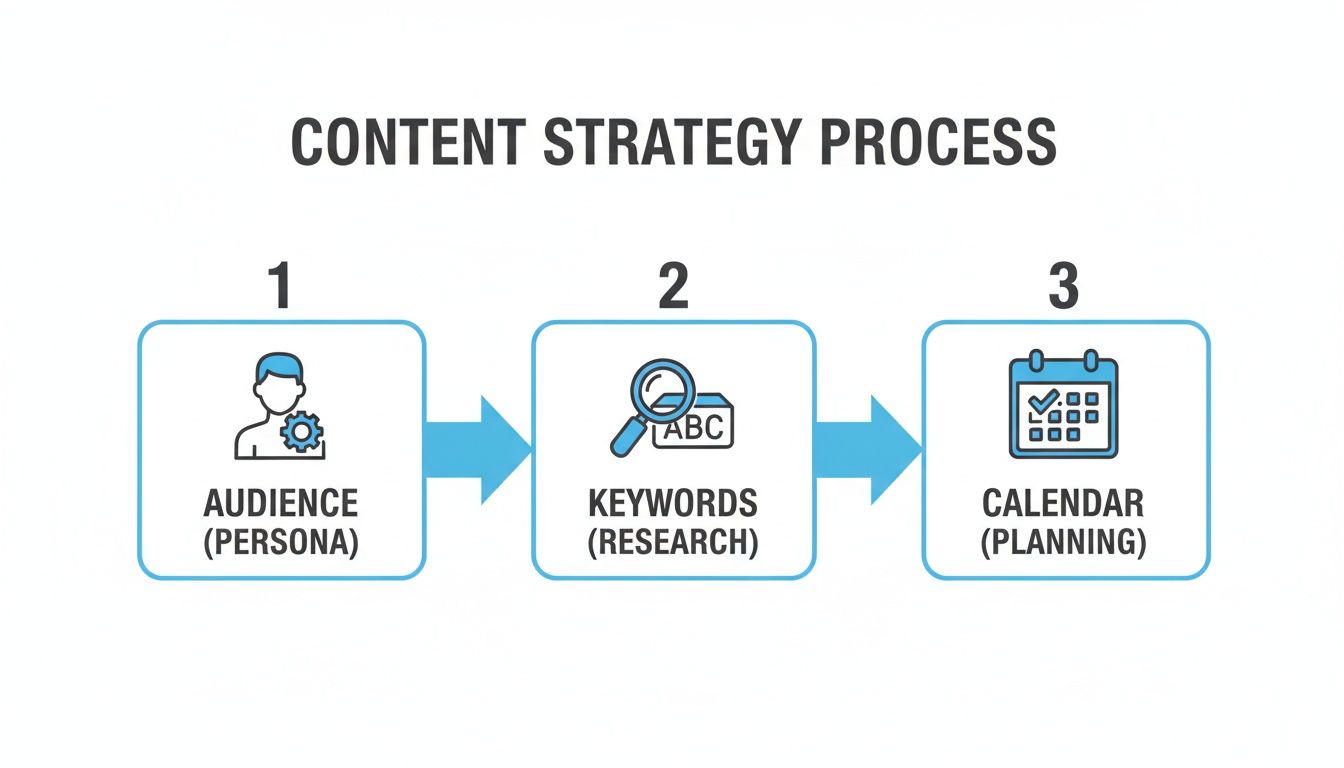
It really highlights how a deep understanding of your audience and what they’re searching for directly feeds the content you schedule and create.
Integrating AI as a Content Assistant
Artificial intelligence is changing the game in web content creation, but not in the way many people fear. It’s not here to replace human creativity; it’s here to supercharge it. AI tools can be incredible assistants for research, outlining, and busting through writer’s block. For instance, AI can analyze the top-ranking articles for a keyword to spot common themes or generate a list of questions your audience is asking online.
The numbers back this up: an estimated 94% of marketers plan to use AI in their content process by 2026. This is already happening, with 47% of e-commerce sellers using AI to write more compelling product descriptions that help them stand out.
The smartest approach is to let AI do the heavy lifting—like data analysis and rough drafting—while a human creator refines the tone, injects brand personality, and double-checks the facts.
This hybrid model lets you produce content faster and more efficiently without sacrificing the authentic voice that builds real trust with your audience.
Promoting Your Content After Publishing
Creating amazing content is only half the battle. Hitting “publish” is the starting line, not the finish line. A classic mistake is to create something great and then just hope people stumble upon it. An effective workflow has a dedicated promotion phase to give your new asset an initial boost and kickstart its journey up the search engine rankings.
Simple but powerful promotion tactics include:
- Email Newsletter: Share your new content with your most dedicated fans—your subscribers.
- Social Media Channels: Post the content across all your relevant platforms, tweaking the message for each one.
- Content Repurposing: A single blog post can be sliced and diced into a series of tweets, a slick infographic, or a script for a short video. For a masterclass in this, check out the webinar content multiplication system to see how you can squeeze maximum value from one event.
By building promotion right into your workflow, you ensure that every piece of content you work so hard on has the best possible shot at reaching its audience and delivering a real return.
Optimizing Content for Conversions and Search

Getting visitors to your website is a huge win, but it’s only half the battle. The real goal of web content creation is to inspire action. Think about it: traffic without conversions is like filling a stadium with fans but never actually playing the game. This is where optimization comes in, transforming your content from a passive information source into an active business-builder.
The whole point is to make it incredibly easy and compelling for a visitor to take that next step. It’s a blend of persuasive psychology, clean design, and clear instructions that guide users from casual interest to firm commitment.
Driving Action with Conversion Rate Optimization
Conversion Rate Optimization (CRO) is the art and science of fine-tuning your content to get more users to complete a desired action—whether that’s making a purchase, filling out a form, or signing up for a newsletter. It all starts with a clear, compelling call-to-action (CTA).
A CTA isn’t just a button; it’s the specific instruction that tells a user what to do next. Vague CTAs like “Click Here” just don’t cut it anymore. They’re far less effective than action-oriented phrases like “Download Your Free Guide Now” or “Get Your Custom Quote.”
Beyond a strong CTA, building trust is non-negotiable. This is where social proof makes all the difference. When potential customers see that other people have had a great experience with your brand, their hesitation melts away.
Effective forms of social proof include:
- Customer Testimonials: Direct quotes from happy clients that spell out the specific value you provided.
- Case Studies: In-depth stories showing exactly how you solved a real-world problem for a customer.
- Reviews and Ratings: Star ratings and reviews, especially on product pages, offer quick, trustworthy feedback at a glance.
By placing these trust signals right next to your main CTAs, you create a powerful one-two punch. You’re not just asking them to act; you’re showing them why it’s a safe and smart decision.
Preparing Your Content for the Future of Search
The way people find information online is changing fast. Search engines are becoming answer engines. To stay ahead, you need to prepare your content for both AI-driven results and highly specific local queries. It’s no longer enough to just stuff keywords into a page; you have to structure your content to provide direct, clear answers.
This is where structured data, also known as schema markup, becomes your secret weapon. Schema is a bit of code you add to your website that helps search engines understand the context of your content. For example, it can explicitly identify a product’s price, a business’s address, or the steps in a recipe.
When you implement structured data, you give your content a much better shot at appearing in rich results like featured snippets and knowledge panels—the very things that power AI search responses.
Mastering Local SEO and AI Search
For any business serving a specific geographic area, local SEO is everything. A huge chunk of mobile searches have local intent, meaning users are looking for products or services “near me.” Your content creation has to reflect this reality.
To optimize for local search, make sure your content includes:
- Location-Specific Keywords: Think “plumber in Tampa” instead of just “plumber.”
- Consistent NAP Information: Your Name, Address, and Phone number must be identical everywhere across your website.
- Localized Content: Create blog posts or pages about local events, news, or case studies that are relevant to your service area.
As AI continues to shape the search landscape, creating content that directly answers questions is more critical than ever. Get inside your customers’ heads. What specific questions are they asking? Build content around providing the absolute best answer. This “question-and-answer” format aligns perfectly with how voice search and AI assistants pull information, ensuring your expertise stays visible in the next evolution of search.
How to Measure Your Content’s Success and ROI
Creating great content is a serious investment of time and money, so how do you prove it’s actually working? Measuring success is about more than just checking page views. The real goal is to draw a straight line from your web content creation efforts to actual business growth and show a clear return on investment (ROI).
This means shifting your focus from vanity metrics to the key performance indicators (KPIs) that really matter. It’s about understanding how your content directly influences the bottom line, turning your strategy from an expense into a predictable revenue driver.
Key Metrics That Actually Matter
To get a true picture of your content’s performance, you need to track metrics that line up with your business goals. While a surge in traffic feels good, what those visitors do next is what counts.
Here are the essential KPIs to keep an eye on:
- Organic Traffic: This shows how many people find your site through search engines. A steady climb is a strong signal that your SEO and content efforts are paying off.
- Keyword Rankings: Tracking your position in search results for your target keywords tells you how visible you are to your audience. Tools like Google Search Console are invaluable here.
- Conversion Rate: This is the golden metric. It’s the percentage of visitors who complete a desired action, like filling out a form or downloading a guide. It directly measures how persuasive your content is.
- Leads Generated: This metric counts the number of potential customers your content brings in, creating a crucial link between your content and your sales pipeline.
Moving beyond surface-level numbers to focus on conversions and leads is how you prove your value. It’s the difference between saying, “We got 10,000 visitors,” and “We generated 50 qualified leads that led to $15,000 in new business.”
Essential Tools for Measurement
You don’t need a massive, expensive analytics suite to get started. In fact, two free tools from Google provide more than enough data to make informed decisions and track your progress effectively.
1. Google Analytics (GA4): Think of this as the central dashboard for your website’s performance. It tells you who your visitors are, how they found you, and what they do once they arrive. You can track everything from traffic sources to user engagement and—most importantly—goal completions, or what we call conversions.
2. Google Search Console (GSC): This tool is all about your site’s relationship with Google Search. It shows you which search queries are bringing people to your site, which pages are ranking, and whether there are any technical hiccups hurting your visibility. GSC is absolutely essential for understanding your organic search performance.
By regularly reviewing reports from these platforms, you can spot trends, identify your best-performing content, and find opportunities for improvement.
For a deeper dive into connecting these efforts to financial outcomes, check out our guide on how to calculate marketing ROI. This data-driven approach transforms web content creation from a creative exercise into a measurable engine for growth.
Got Questions About Web Content Creation? We’ve Got Answers
If you’re diving into web content, you probably have a few questions. That’s a good thing. Getting clear on the fundamentals helps you build a strategy that actually works instead of just guessing. Let’s tackle some of the most common questions we hear from business owners and marketing teams.
How Often Should I Be Publishing New Content?
Consistency is king. Forget the pressure to publish daily and focus on a rhythm you can actually stick with. For most businesses, one or two high-quality, deeply researched articles per week is a fantastic goal.
What really matters is creating a reliable schedule. A steady stream of valuable content builds trust with your audience and signals to search engines that you’re a dependable source of information. That’s far more powerful than publishing five articles one week and none for the next month.
What’s More Important: SEO or Quality Writing?
This is a classic question, but it sets up a false choice. The two are completely codependent. You can’t have one without the other in today’s world. Great writing is what keeps people on your page and convinces them you know what you’re talking about. SEO is what helps them find your page in the first place.
Modern SEO is all about creating a fantastic user experience. That means valuable, well-written content isn’t just a “nice-to-have” for ranking well—it’s a requirement.
Think of it this way: SEO gets people to your front door. Great writing invites them inside and makes them want to stay. For your content to actually drive results, you need both working together.
How Long Does It Take to See Real Results?
Patience is a virtue in content marketing. This is a long-term game, not a quick hack. While you might see a few small traffic spikes early on, it generally takes 6 to 12 months of consistent, high-quality work to see significant, needle-moving results.
We’re talking about measurable lifts in organic traffic, keyword rankings, and leads. You’re building authority from the ground up, and that simply takes time. Stick with it, because the compounding returns from a solid content strategy are well worth the wait.
At Netco Design LLC, we build revenue-focused content strategies that deliver measurable growth. If you’re ready to turn your website into a powerful customer acquisition engine, explore our digital marketing services.

