

table of contents
So, what exactly is website content creation? At its core, it’s the entire process of dreaming up, writing, and publishing all the information on your website. This isn’t just blog posts and articles; it includes everything from your service pages to product descriptions. Think of it as the engine that powers your whole digital marketing effort, pulling in visitors and turning them into customers.
Why Website Content Is Your Hardest Working Employee

Imagine walking into a store only to find the shelves completely bare. That’s exactly how a potential customer feels when they land on a website with thin, unhelpful content. In a very real sense, your website is your digital storefront, and every single piece of content is an employee working around the clock.
This is about more than just filling pages with text—it’s about building your most valuable digital asset. Good content strategy is like hiring a tireless 24/7 salesperson for your site. One that never sleeps, never takes a vacation, and is always ready to talk to your next prospect.
Your Content as a Digital Salesperson
Think about what makes a top-performing salesperson so effective. They understand customer pain points, answer questions before they’re even asked, and build trust by proving they know their stuff. High-quality website content does the exact same thing, but at a massive scale.
- It Attracts Qualified Leads: A well-researched blog post optimized for the right keywords will draw in people who are actively searching for the solutions you offer.
- It Answers Customer Questions: Your detailed service pages and in-depth guides become a go-to resource, clearing up common concerns and explaining what makes you different.
- It Overcomes Objections: Customer testimonials and case studies offer powerful social proof, easing doubts and giving visitors the confidence they need to take the next step.
This approach transforms your website from a passive digital brochure into an active lead-generation machine. Every article, guide, and page works together to guide visitors from that first flicker of curiosity all the way to a final purchase.
Your content’s job is to attract, educate, and persuade. It’s the engine that warms up cold traffic, nurtures lukewarm leads, and gives hot prospects the final push they need to convert.
The Growing Importance of Content Creation
Investing in quality content isn’t just a “nice-to-have” anymore; it’s a fundamental driver of business growth. Consider this: the global digital content creation market was valued at USD 27.1 billion in 2023 and is projected to hit around USD 90.4 billion by 2033. This surge shows just how critical content has become in modern business. You can explore more about the explosive growth of the digital content market to see why this investment is so essential.
Ultimately, strategic content is how you build brand authority and customer loyalty. It establishes your business as the go-to expert in your field, fostering a level of trust that advertising alone could never achieve. That trust is what turns one-time buyers into lifelong advocates for your brand.
Building Your Content Strategy Foundation

Great website content never happens by accident. Staring at a blank page and hoping for the best isn’t a strategy—it’s a recipe for content that goes nowhere. To get real results, you need a solid plan, a blueprint that guides every single word you write.
Without a strategy, you’re just shouting into a crowded room, hoping the right person happens to overhear you. A clear plan transforms your content from random acts of marketing into a predictable system for attracting and converting customers.
This foundation rests on three pillars: knowing your audience inside and out, mastering the art of keyword research, and sizing up your competition. Get these right, and you’ll create content that truly delivers. For a deep dive into building your plan, this content marketing strategy guide is a fantastic starting point.
Understand Who You Are Talking To
Before writing a single word, you have to know exactly who you’re trying to reach. This goes way beyond basic demographics like age or location. You need to get inside your ideal customer’s head to understand their biggest challenges, their goals, and what motivates them to buy.
This is where buyer personas come in. Think of a persona as a detailed profile of your ideal customer—give them a name, a job, and a story. It’s a fictional representation of a real person with real problems that you can solve.
A strong buyer persona is like a compass for your content. It ensures every blog post, service page, and call-to-action is pointed directly at the person you want to attract, speaking their language and addressing their specific needs.
Building these profiles forces you to answer the tough questions that will shape your entire approach. To get started, check out our guide on how to create buyer personas.
Master the Language of Your Customers
Once you know who you’re talking to, the next step is to figure out what they’re searching for online. This is the heart of keyword research: uncovering the exact words and phrases your audience types into Google when they’re looking for answers.
But not all keywords are created equal. A huge part of your strategy is understanding user intent, which usually falls into one of three buckets:
- Informational Keywords: Phrases like “how to fix a leaky faucet” mean the user is looking for information, not ready to buy. This is your sweet spot for top-of-funnel blog posts and how-to guides.
- Navigational Keywords: When someone searches for “Netco Design blog,” they already know where they want to go. These keywords are great for building brand recognition.
- Transactional Keywords: Terms like “emergency plumber near me” or “buy running shoes online” signal a clear intent to make a purchase. These are gold for your service pages and product descriptions.
By mapping these keywords to different stages of the customer journey, you can create targeted content that meets people exactly where they are, guiding them from casual browser to happy customer.
Find Your Competitive Edge
You aren’t creating content in a vacuum. Your competitors are fighting for the same eyeballs, and understanding their playbook is the key to finding your own unique angle. Competitive analysis isn’t about copying what others do; it’s about finding the gaps they’ve missed.
Start by identifying your top three to five direct competitors and digging into their content. Look for patterns in the topics they cover, the formats they prefer (blogs, videos, case studies?), and the keywords they rank for.
This process will quickly reveal strategic opportunities. Maybe your biggest competitor has great blog posts but zero case studies. Perhaps no one in your niche has created a truly comprehensive guide on a complex topic. These gaps are your openings to create content that is more thorough, more helpful, or more up-to-date than anything else out there.
Alright, let’s get into the nitty-gritty of choosing content formats that actually get people to act.
Choosing Content Formats That Actually Convert
Once you’ve figured out who you’re talking to and what they’re searching for, the next piece of the puzzle is deciding how to deliver your message. Think of it this way: you wouldn’t use a hammer to drive a screw, right? The same logic applies here. A blog post is great for some things, but a case study might be what you need to close the deal.
The trick is to match your content format to your business goal and where your customer is in their buying journey. Someone just realizing they have a problem needs something very different from someone who’s comparing vendors and has their credit card ready. Your content needs to meet them at every step.
Mapping Content to the Customer Journey
Let’s break the customer journey down into three simple phases. For each one, certain content types are superstars at building trust and moving people along to the next step.
- Awareness Stage (Top of Funnel): At this point, your audience is looking for answers, education, and insights. They aren’t ready to buy; they’re just trying to get a handle on their problem. Your goal here is to attract new eyeballs and show up as a helpful, go-to resource.
- Consideration Stage (Middle of Funnel): Now your audience gets it. They understand the problem and are actively researching solutions. They’re comparing options, looking for proof, and weighing who they can trust. Your job is to build that trust and show them why you’re the best choice.
- Decision Stage (Bottom of Funnel): In this final stage, they’re ready to pull the trigger. They just need that last little nudge or piece of information to feel confident. Your goal is to make it an absolute no-brainer for them to choose you.
By lining up your content with these stages, you create a smooth, logical path from a curious visitor to a happy customer.
Top of Funnel Formats for Attracting an Audience
To bring in fresh faces, you need content that search engines love and that offers immediate value. These formats are your workhorses for getting your name out there.
- Blog Posts and Articles: These are the bread and butter of most content strategies. They’re perfect for answering common questions, hitting those informational keywords, and driving a steady stream of organic traffic. In fact, businesses that keep up with their blog see a 55% increase in website traffic compared to those that don’t.
- In-Depth Guides: Think of these as a blog post on steroids. They’re longer, more comprehensive, and tackle a big topic from all angles. They’re fantastic for establishing you as an authority and snagging traffic for those really competitive keywords.
- Infographics: Got a complex topic? An infographic can break it down into something visually appealing, easy to digest, and highly shareable. They’re perfect for showing off data, explaining a process, or making statistics pop.
Nailing these formats ensures a steady flow of qualified people discovering your brand for the first time.
The goal of top-of-funnel content isn’t to sell; it’s to help. By generously sharing your expertise, you earn the right to be considered when the time comes to buy.
Middle and Bottom of Funnel Formats for Driving Conversions
Once you’ve got their attention, your content needs to shift gears from educating to persuading. These formats are all about building trust and encouraging someone to take the next step. You can see a complete breakdown of how these pieces fit together by looking at this content strategy example.
- Case Studies: Nothing builds trust like solid proof. Case studies walk through a real problem you solved for a real customer, giving you tangible evidence of your value and squashing any doubts a prospect might have.
- Service and Product Pages: These are your digital sales floors. They need to be crystal clear, compelling, and focused on the benefits—not just a dry list of features. A great product page speaks directly to customer pain points and makes a strong case for why your solution is the one.
- Customer Testimonials: Short, punchy quotes from happy customers are pure gold. Sprinkling these on key pages provides powerful social proof and can seriously boost conversion rates by reassuring prospects they’re making a smart choice.
A winning content plan doesn’t just stick to one format. It uses a smart mix of these types, creating a versatile and helpful experience that meets your audience right where they are, every single time.
Creating a Repeatable Content Production Workflow
Great ideas are just the beginning. To really succeed with website content creation, you need a predictable system that turns those ideas into high-quality published pieces, time and time again.
Without a structured workflow, even the best strategies fall apart. You end up with missed deadlines, inconsistent quality, and a burnt-out team. Think of it like a factory assembly line—each station has a specific job, and the whole process is designed for efficiency and quality control. A content production workflow does the same thing for your marketing.
This simple shift transforms content creation from a frantic, reactive chore into a calm, predictable engine for business growth. It’s all about working smarter, not harder.
The Lifecycle of a Content Piece
Every single piece of content, whether it’s a blog post or a case study, follows a similar journey from idea to publication. Defining these stages is the first step toward building your repeatable process. A clear workflow ensures everyone knows their role and what’s next, which kills bottlenecks and confusion before they start.
The diagram below shows how your content should guide customers from just becoming aware of a problem to making a final decision.
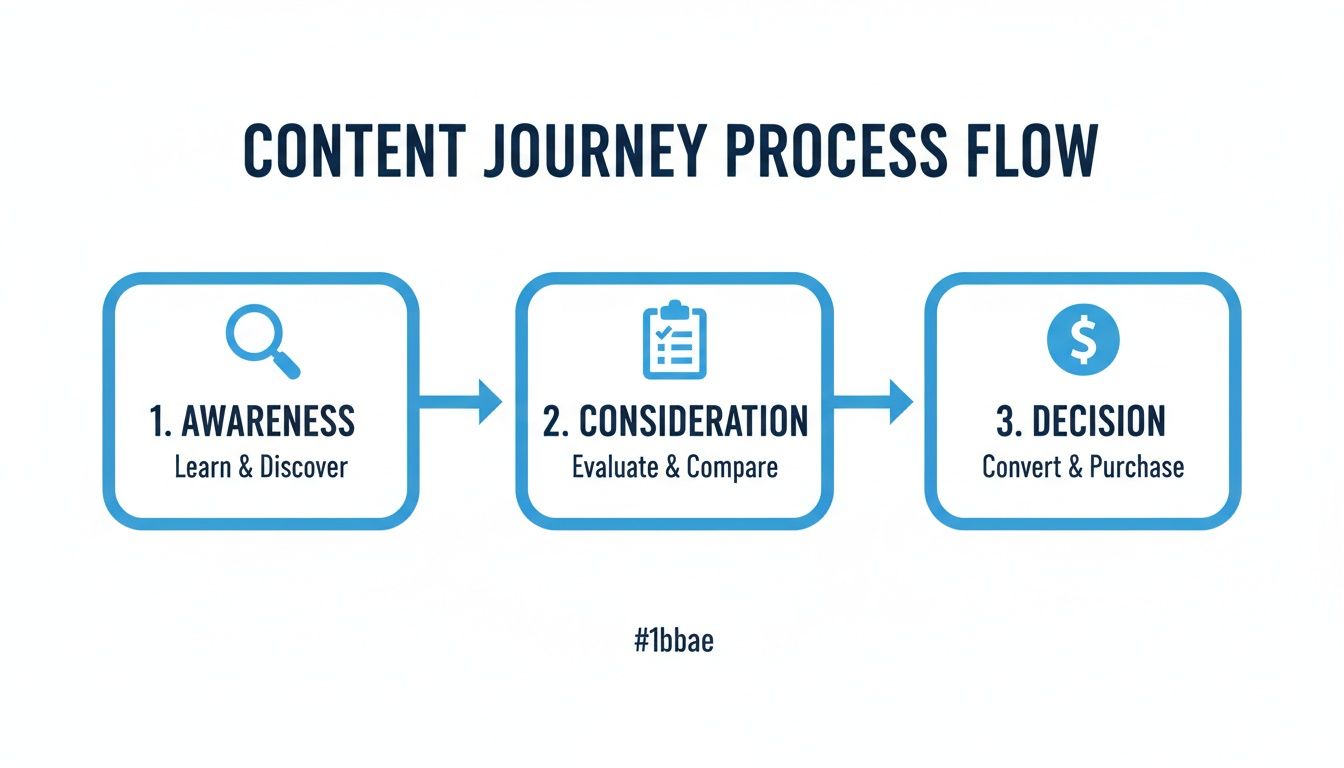
This visual shows why you need different types of content for each stage of the buyer’s journey. Your internal production cycle should mirror this, with clear steps designed to serve each phase.
Typically, the process looks something like this:
- Ideation and Planning: Brainstorming topics based on your keyword research and what your audience actually needs.
- Briefing and Outlining: Creating a detailed content brief that acts as a blueprint for the writer.
- Writing and Drafting: The actual creation of the content piece.
- Editing and Review: A crucial quality control step to check for clarity, accuracy, and brand voice.
- Publishing and Promotion: Getting the content live and then making sure your audience sees it.
Building Your Content Toolkit
Once you’ve defined the stages, you need the right tools to keep everything moving. This doesn’t mean you need expensive, complicated software; simple and accessible tools often work best, especially for small teams. The goal is just to create a central hub for your content operations.
A content calendar is non-negotiable. This is your master plan, scheduling what gets published and when. It gives your entire team a single source of truth and helps you maintain a consistent publishing schedule. You can find some excellent advice on https://netcodesign.com/how-to-create-a-content-calendar/ that fits what you need.
A content brief is the most important document in the entire workflow. A great brief ensures the writer understands the goal, audience, keywords, and key talking points, reducing the need for heavy edits later.
Project management tools like Trello or Asana are perfect for visualizing your workflow. You can set up columns for each stage (e.g., “To Do,” “Writing,” “In Review,” “Published”), making it easy to see the status of every article at a glance.
To really optimize your content pipeline, you can also explore the best AI tools for content creation available today. These can help with everything from research to drafting, saving you a ton of time.
By putting this system in place, you create a well-oiled machine. It frees up your team’s creative energy to focus on what truly matters: producing exceptional content that gets results.
Optimizing Content for Search Engines and People
You’ve poured your heart into creating incredible content. But here’s the tough truth: amazing content is useless if no one can find it. Getting it discovered is the other half of the battle.
Not too long ago, marketers treated search engines and human readers like two separate audiences. You’d have keyword-stuffed pages for Google and then try to make them readable for people. Thankfully, those days are over. The needs of search engines and people have merged. Optimizing your content now means making it both discoverable for Google and genuinely helpful for the people who land on your page.
This whole process is called on-page SEO. It’s all about structuring your content to send clear signals to search engines about its topic and value. The best part? These same practices also make your content a joy to read, understand, and act on.
The Core Elements of On-Page SEO
Think of on-page SEO like setting up signposts for both Google and your readers. Each element helps them understand what your page is about and how it’s organized. When you get this right, these “technical” tweaks feel completely natural to the reader, guiding them through your ideas.
Here are the essential components you need to get right:
- Title Tags: This is the clickable headline that shows up in Google’s search results. Your job is to make it compelling, include your main keyword, and accurately promise what the page delivers to earn that click.
- Meta Descriptions: This is the little blurb of text under the title tag in search results. It doesn’t directly help you rank, but it’s your 160-character ad. A great one persuades users that your page has the exact answer they’re looking for.
- Header Tags (H1, H2, H3): Headers are your content’s skeleton. They break up your text and create a logical flow. Your main title is always an H1, with H2s for major sections and H3s for the sub-points within them. If you want to see how keywords fit into this structure, it’s worth reviewing a solid SEO keyword strategy.
Balancing AI Assistance with Human Expertise
Artificial intelligence has become a seriously powerful assistant in the content creation game, but it’s just that—an assistant, not the expert. It’s no surprise that 94% of marketers plan to use AI in their content strategy, but they aren’t abandoning what already works. Businesses are still prioritizing proven investments, with video content getting 32% of budgets and SEO getting 26%. You can explore detailed marketing statistics from HubSpot to see more on these trends.
AI tools are fantastic for getting the ball rolling. Use them for brainstorming topics, doing some initial research, or even whipping up a quick outline. This frees up your human experts to do what they do best: add unique insights, share real experiences, and inject a genuine brand voice that actually connects with your audience.
AI can build the house, but a human writer is needed to turn it into a home. Your unique perspective, storytelling ability, and authentic voice are what build trust and authority—qualities that AI cannot replicate.
Writing for Readability and Engagement
At the end of the day, the best SEO is a fantastic user experience. Google wants to rank content that people find valuable, and a huge part of that value comes down to readability. Nobody wants to slog through a dense wall of text or get lost in confusing jargon.
To make sure you’re optimizing for actual humans, always keep these principles in mind:
- Use Short Paragraphs: Break your content into small, digestible chunks of just one to three sentences. This creates white space on the page and makes your article feel way less intimidating to read.
- Incorporate Bullet Points and Lists: Whenever you’re breaking down complex ideas, steps, or features, use a list. They are incredibly easy to scan and help readers find exactly what they need in seconds.
- Write in a Clear, Conversational Tone: Ditch the academic language. Write like you’re explaining a concept to a friend. Simple words and clear examples always win.
When you focus on clarity and structure, you create content that pleases both algorithms and people. This dual approach is the secret to building a website content strategy that actually lasts.
How to Measure Content Performance and Prove Its Value
Creating great content is only half the battle. If you aren’t measuring its performance, you’re flying blind. You have no real way of knowing what’s working, what isn’t, and where you should put your time and money next.
Tracking performance is what turns website content creation from a creative guessing game into a predictable driver of business growth. The real goal is to get past vanity metrics like page views and start connecting your work to a clear return on investment (ROI).
You need to draw a straight line from that blog post you published to a new lead in your pipeline, or from a service page update to a noticeable jump in sales calls. This is how you prove the real-world value of your content to stakeholders and lock down the budget you need for future projects.
Identifying Your Key Performance Indicators
Not all metrics are created equal. The key performance indicators (KPIs) that truly matter depend entirely on what you’re trying to achieve. Chasing the wrong numbers will send you down the wrong path, so it’s critical to align your metrics with your actual business goals.
For instance, if your main objective is to boost brand visibility and pull in new visitors, your focus should be on top-of-funnel metrics. These numbers tell you how well your content is reaching and engaging a fresh audience.
Key metrics for brand awareness and traffic include:
- Organic Traffic: The number of visitors finding your site through search engines like Google. This is a direct measurement of your SEO success.
- Keyword Rankings: Where your site appears in search results for your target keywords. Climbing the ranks means more eyeballs on your content.
- Backlinks: The number of other websites linking back to your content. Backlinks are a huge signal of authority and trust for search engines.
- Time on Page: How long visitors actually stick around to read what you’ve written. A higher time on page suggests your content is genuinely engaging and valuable.
On the other hand, if your goal is to generate revenue, you need to track metrics that directly tie into your bottom line. These KPIs show how effectively your content is turning casual visitors into paying customers.
Proving the value of content isn’t just about showing off traffic graphs. It’s about telling a compelling story with data that connects your content efforts directly to business results like leads, sales, and revenue growth.
Tracking Conversions and Business Impact
To really nail down the value of your website content, you have to measure how it influences customer actions. This is where you connect your content directly to activities that make the cash register ring. To get a better handle on this, you can learn more about how to calculate marketing ROI in our detailed guide.
Essential metrics for measuring business impact are:
- Conversion Rate: The percentage of visitors who take a desired action—like filling out a contact form, downloading a guide, or making a purchase. This is one of the most powerful metrics for proving ROI.
- Leads Generated: The total number of new contacts or inquiries that came from a specific piece of content. This proves your content is actively building your sales pipeline.
- Cost Per Lead (CPL): How much you’re spending to acquire each new lead through your content. An effective content strategy should consistently drive this number down over time.
By regularly tracking these KPIs with free tools like Google Analytics and Google Search Console, you can build a crystal-clear picture of what’s working. This data-driven approach allows you to double down on successful topics, optimize underperforming pages, and confidently show everyone how your content is fueling the company’s growth.
Frequently Asked Questions About Content Creation
Even with a solid plan, a few questions always pop up during the website content creation process. It’s completely normal. Below are some straightforward answers to the most common queries we hear from business owners and marketing teams as they get started.
How Often Should I Publish New Content?
Here’s the truth: consistency is far more important than frequency.
For most businesses, aiming to publish one to four high-quality pieces of content per month is a fantastic goal. This sets a predictable rhythm for your audience and signals to search engines that your site is a reliable source of fresh information.
It’s always better to publish one amazing, well-researched article than four rushed, mediocre ones. Focus on creating genuinely valuable content that serves your audience, not just hitting some arbitrary quota. A steady drumbeat builds momentum over time.
Can I Use AI to Write All My Website Content?
AI is an incredible tool for brainstorming, outlining, and even drafting, but you absolutely should not rely on it to write everything. AI-generated text often misses the unique brand voice, empathy, and expert insights that build real trust with an audience.
It can definitely speed up your workflow, but it can’t replace the human connection.
Use AI as a powerful assistant to get you 80% of the way there, but always have a human expert edit, fact-check, and refine the final piece. This is how you guarantee the quality, authenticity, and authority your brand needs to stand out.
What Is the Difference Between SEO and Writing for Readers?
In the past, these were often treated as separate jobs. Not anymore. Today, there’s almost no difference between them.
Modern SEO is all about creating high-quality content that satisfies what a user is looking for. The best website content creation strategies recognize that writing for people and optimizing for search engines are the exact same thing.
Search engines like Google are designed to reward content that is comprehensive, authoritative, and gives the reader an excellent experience. When you focus on writing for your audience first—answering their questions clearly and solving their problems—you are naturally creating the kind of content that search engines want to rank at the top.
At Netco Design LLC, we turn these best practices into a powerful growth engine for your business. From crafting a content strategy that attracts your ideal customers to building a website that converts them, we provide the expertise you need to succeed. Schedule a consultation with us today and let’s build a digital presence that delivers real results.

