

table of contents
TL;DR:
- Keyword intent reveals the purpose behind a search query, guiding page type and content strategy. Matching content to searcher goals improves rankings, engagement, and conversions, especially with AI search features emphasizing structured, intent-driven pages. Prioritizing intent fit over search volume ensures efforts target the most actionable keywords for business success.
Keyword intent, also called search intent, is the goal a searcher has when they type a query into Google. Knowing that goal tells you which page type to build. Check the SERP for your target keyword right now: the dominant page types you see are Google’s answer to what intent it expects.
What does keyword intent mean, and why does it matter?
Search intent is the purpose behind a query, not just the words themselves. Two people can type nearly identical phrases and want completely different things. “Running shoes” could mean someone browsing for ideas, someone ready to buy, or someone looking for a specific brand’s site. The literal keyword is the same; the underlying goal is not.

That gap between words and purpose is exactly what keyword intent captures. When you understand it, you stop guessing which page to build and start making decisions based on what the searcher actually expects to find.
Quick signals that reveal intent at a glance:
- Question words (who, what, how, why) point to informational intent
- “Buy,” “price,” “near me,” “order” point to transactional intent
- “Best,” “vs,” “review,” “top” point to commercial investigation
- Brand names or specific URLs point to navigational intent
A page that matches the intent ranks better, holds attention longer, and converts more often. One that fights the intent rarely does any of those things.
The four types of keyword intent explained with examples
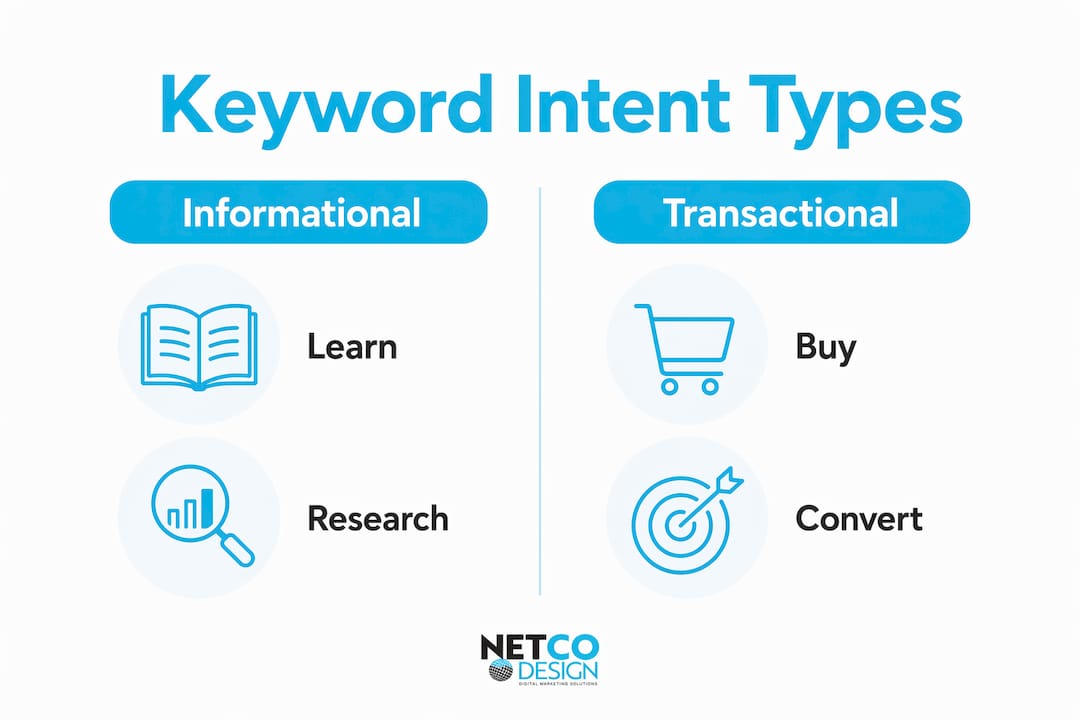
Search engines recognize four canonical intent categories: informational, navigational, commercial, and transactional. Each maps to a different searcher goal and a different page type.
- Informational — The searcher wants to learn. They are not ready to buy; they want an answer, a definition, or a how-to. Example: “how does SEO work” → a long-form guide or blog post.
- Navigational — The searcher already knows where they want to go and is using Google as a shortcut. Example: “Semrush login” → the Semrush sign-in page.
- Commercial investigation — The searcher is comparing options before committing. Example: “best project management tools for small teams” → a comparison article or review roundup.
- Transactional — The searcher is ready to act. Example: “buy noise-canceling headphones under $100” → a product page or landing page with a clear call to action.
Google’s Search Quality Evaluator Guidelines use a parallel framework: Know, Do, Website, and Visit-in-person. These map closely to the four SEO categories and reinforce why page-type matching matters at the algorithm level.
A note on mixed intent. Some SERPs show both blog posts and product pages for the same query. “Protein powder for beginners” might surface buying guides alongside product listings. When a SERP shows a mix of page types, intent is ambiguous and a hybrid approach often works best: a page that educates while keeping a low-friction path to conversion. Trying to force a pure sales page into a mixed-intent SERP is a common reason pages underperform.
How to identify keyword intent from the SERP
The most reliable method is to run the query yourself and read what Google returns. No tool replaces that first-hand look.
Step-by-step SERP review:
- Type the exact keyword into Google in a private/incognito window to avoid personalization bias.
- Note the dominant page types in the top five organic results: guides, product pages, homepages, local listings, or videos.
- Check for SERP features: AI Overviews, a local pack, shopping results, video carousels, or featured snippets. Each feature signals a specific intent.
- Read the “People Also Ask” and “Related Searches” sections. These are diagnostic tools that reveal sub-intents and clarify ambiguous queries, not just idea generators.
- Map what you see to the four intent types. If the top results are all how-to guides, the intent is informational. If they are all product pages, it is transactional.
Quick modifier checklist to run before the SERP review:
- Does the query start with who/what/how/why? → Likely informational
- Does it include buy/order/price/near me/coupon? → Likely transactional
- Does it include best/vs/review/compare/top? → Likely commercial investigation
- Does it include a brand name or a specific URL fragment? → Likely navigational
Walk-through example: Run “content marketing strategy.” The SERP returns long-form guides and pillar pages, a “People Also Ask” box with questions like “what is a content marketing strategy,” and no shopping results. That combination confirms informational intent. The right page to build is a comprehensive guide, not a service page.
Pro Tip: Open three to five top-ranking URLs and scan their H1 and first paragraph. If every page opens with a definition or a how-to, that is a strong signal the intent is informational and your page should do the same.

Which tools help you determine search intent at scale?
Manual SERP review gives you accuracy; tools give you speed. The best workflow combines both. Tools like Google Keyword Planner, Semrush, and KeywordIntent.io can verify intent signals across large keyword lists, but they should always be paired with spot-check SERP reviews for high-priority terms.
Tool breakdown:
- Semrush labels every keyword with an intent abbreviation: I (informational), N (navigational), C (commercial), or T (transactional). It factors in SERP features, keyword indicators, and branding. Use it to tag intent across an entire keyword list in minutes.
- Google Keyword Planner shows search volume and competition data. It does not label intent directly, but the suggested bid column is a reliable proxy: high bids usually mean transactional or commercial intent because advertisers pay more for buyers.
- Yoast SEO (WordPress plugin) prompts you to set a focus keyword and checks whether your content structure aligns with what the SERP expects. Useful for on-page alignment after you have already identified intent.
- KeywordIntent.io classifies keywords by intent type in bulk. It is a fast way to pre-sort a large list before doing deeper SERP checks on the highest-priority terms.
Four-step workflow:
- Query check — Enter the keyword in Google incognito and note the dominant page type and SERP features.
- SERP audit — Record the top five results: page type, title pattern, and any featured snippets or AI Overviews.
- Tool verification — Cross-reference in Semrush or KeywordIntent.io to confirm the intent label and check volume and difficulty.
- Tagging and prioritization — Log the keyword in a spreadsheet with these fields: keyword, intent type, SERP evidence (what you saw), page type to create, and priority tier.
A simple spreadsheet with those five fields keeps your team aligned and prevents the most common mistake: building the wrong page type because someone assumed intent without checking.
How to use keyword intent when creating content
Once you know the intent, the page structure follows logically. Forcing a sales page onto an informational query rarely succeeds, and the reverse is equally true: a how-to guide targeting a transactional keyword leaves conversion on the table.
Intent-to-page mapping:
- Informational intent → Long-form guide or blog post. Lead with a direct answer, use H2/H3 subheadings to address sub-questions, include a FAQ section, and avoid aggressive CTAs. The goal is to satisfy curiosity and build trust.
- Navigational intent → Brand page, login page, or a specific product/service page. Make it easy to find exactly what the searcher already knows they want.
- Commercial investigation intent → Comparison article, review roundup, or “best of” list. Include pros and cons, side-by-side feature breakdowns, and a soft CTA (e.g., “see pricing” or “read full review”). The searcher is not ready to buy yet.
- Transactional intent → Product page, service landing page, or a paid ad landing page. Lead with the offer, include social proof, and place a clear CTA above the fold. Every element on the page should reduce friction between the searcher and the action.
- Mixed intent → Hybrid page that opens with educational depth and closes with a low-friction conversion path. Think of a service page that starts with “what is X and why does it matter” before presenting the offer.
Metrics to watch by intent type:
- Informational pages: time on page, scroll depth, and organic CTR
- Commercial pages: pages per session and return visits
- Transactional pages: conversion rate and cost per acquisition
- Navigational pages: bounce rate (a high bounce is often fine here; the searcher found what they wanted)
A well-matched page improves user experience, reduces bounce, and sends positive engagement signals that support better rankings on Google.
Statistic callout: Google’s algorithm has shifted from simple keyword matching to understanding user objectives. Matching content to that objective improves CTR and reduces bounce rate, both of which are signals that influence rankings.
Keyword intent vs. search volume: which one should you prioritize?
High volume is appealing. A keyword with high monthly searches looks like a big opportunity. But if the intent behind that keyword does not match the page you can realistically build, that volume is largely unreachable.
Intent fit is the first filter in keyword selection: if you cannot serve the intent or convert it, the keyword is usually not worth the investment regardless of volume or difficulty. A 500-search-per-month keyword with clear transactional intent and a well-matched product page will outperform a 50,000-search informational keyword that sends curious readers to a sales page they did not ask for.
Prioritization order:
- Intent fit — Can you build the page type the SERP expects?
- Conversion potential — Does the intent align with a business goal (lead, sale, sign-up)?
- Volume and difficulty — Is there enough search demand to justify the effort?
When to skip a high-volume keyword:
- The SERP is dominated by a page type you cannot or should not build (e.g., e-commerce product pages when you run a service business)
- The intent is purely informational but your only relevant page is a service landing page
- The query is so broad that the intent is unclear and the SERP shows wildly mixed results
- The keyword requires a domain authority you do not yet have, making ranking unlikely in a reasonable timeframe
Pairing intent fit with a solid SEO keyword strategy is what separates keyword lists that drive revenue from ones that just look impressive in a spreadsheet.
Common mistakes and a publish checklist for intent alignment
Most intent mistakes fall into a small number of patterns. Recognizing them before you publish saves weeks of rework.
Common errors:
- Building a product page for a keyword where the SERP shows only guides and how-tos
- Ignoring SERP features (an AI Overview or featured snippet signals that Google wants a concise, structured answer, not a long narrative)
- Choosing keywords based on volume alone without checking what the top results actually look like
- Missing mixed intent and publishing a page that is either too salesy or too educational for the query
- Writing for a keyword modifier (“best”) but structuring the page like a definition article
Pre-publish intent checklist:
- Run the keyword in Google incognito and confirm the dominant page type matches what you are building.
- Check for SERP features: if there is a featured snippet, structure your answer to compete for it.
- Verify your H1 and opening paragraph reflect the intent (informational pages should answer a question; transactional pages should present the offer).
- Confirm your CTA matches the intent stage: soft CTAs for informational, direct CTAs for transactional.
- Check internal links: do they lead to pages that serve the next logical intent step in the buyer journey?
- Review the “People Also Ask” questions and confirm your page addresses at least two of them.
- Confirm the page type you built matches the intent label in your keyword tracking spreadsheet.
A page that passes all seven checks is aligned. One that fails even two or three is worth revising before it goes live. For a broader look at what makes a page fully optimized, the criteria for a well-optimized page covers the structural and technical side of the equation.
Why keyword intent matters more now with AI search features
Google’s shift from keyword matching to understanding user objectives has been underway for years, but AI Overviews have made intent alignment a survival issue for organic traffic. Sites that fail to address intent clearly may lose traditional click traffic to synthesized answers that appear above organic results.
Practical implications:
- AI Overviews pull from pages that give clear, structured, direct answers. If your page buries the answer in paragraph five, it is less likely to be cited.
- Pages with strong E-E-A-T signals (Experience, Expertise, Authoritativeness, Trustworthiness) that also match intent are more likely to appear in AI-generated responses.
- Content structured around sub-questions (H2/H3 headings that mirror “People Also Ask” queries) gives AI systems more to work with when assembling a synthesized answer.
- Click-through rates on informational queries are declining as AI Overviews answer questions directly. This makes commercial and transactional intent keywords more valuable for driving actual site visits.
Understanding how content strategy works for AI search is now as important as understanding intent itself. The two are inseparable in a search environment where AI features sit above the organic results.
Key Takeaways
Keyword intent is the single most important filter in content planning: build the page type the SERP expects, or the page will struggle to rank regardless of how well it is written.
| Point | Details |
|---|---|
| Intent before volume | Prioritize intent fit, then conversion potential, then search volume and difficulty. |
| Four intent types | Informational, navigational, commercial, and transactional each require a different page type and CTA approach. |
| SERP-first workflow | Run every target keyword in incognito, note the dominant page type and SERP features, then verify with a tool like Semrush or KeywordIntent.io. |
| AI search raises the stakes | AI Overviews favor structured, intent-matched content; pages that bury answers lose visibility to synthesized responses. |
| Netco Design | Netco Design maps keyword intent to content type and page structure as part of its SEO and content strategy services. |
The part most SEO guides skip about intent
There is a version of intent analysis that gets taught in every beginner SEO course: look at the keyword modifier, assign a category, build the matching page. It is a fine starting point. The problem is that it treats intent as a fixed property of a keyword when it is actually a property of the SERP at a given moment.
Google updates its understanding of what searchers want. A query that returned product pages two years ago might now return guides because user behavior shifted. That means intent is not something you check once during keyword research and file away. It is something you re-check when a page stops performing, when you are planning a refresh, and when you notice a ranking drop that has no obvious technical cause.
The other thing most guides underemphasize: mixed intent is not a problem to solve, it is information to use. When a SERP shows both guides and product pages, Google is telling you that searchers at different stages are using the same query. A hybrid page that serves both stages is not a compromise; it is often the most competitive page type you can build for that keyword.
The teams that get the most out of intent analysis are the ones who treat the SERP as a living document, not a one-time research artifact.
Netco Design puts intent-driven content to work for your business
Getting keyword intent right is one thing. Building the pages that actually rank and convert is another. Netco Design handles both, connecting intent analysis directly to page structure, content type, and on-page conversion strategy for businesses that need results, not just research.
Netco Design’s SEO and content strategy services cover the full workflow: keyword intent mapping, content planning, on-page optimization, and AI SEO to keep your pages visible as search features evolve. Whether you need a single landing page built around transactional intent or a full content architecture mapped to every stage of the buyer journey, the team builds it with measurable KPIs from day one.
- Get a clear picture of where your current content misses the mark with an online presence analysis
- See how intent-driven content fits into a broader digital marketing strategy for small businesses
- Ready to move? Contact Netco Design to start with a strategy session tailored to your market and goals.
Useful sources
The following sources were used to build this guide and are worth bookmarking for deeper reading on search intent and SERP analysis:
- What Is Search Intent? — Semrush Blog: Covers the four intent types with keyword examples and explains how Semrush labels intent in its keyword tools.
- What Is Search Intent and Why Does It Matter? — Moz: Explains the SERP-reading method and the impact of AI Overviews on intent-driven content.
- What Is Search Intent in SEO? — Search Engine Land: Detailed guide on the canonical intent taxonomy and page-type matching.
- Search Intent — Yoast: Connects Google’s Search Quality Evaluator Guidelines to practical SEO page-type decisions.
- Keyword Intent — Ahrefs Blog: Covers intent as a strategic filter for keyword prioritization and explains when to skip high-volume keywords.
- Searcher Intent — SEO Brothers: Practical guidance on using “People Also Ask” and “Related Searches” as diagnostic tools and handling mixed intent.
Use the Semrush and Ahrefs pages specifically when you want to go deeper on tool-assisted intent verification. The Yoast and Search Engine Land guides are the best starting points for understanding how intent connects to page structure and Google’s quality standards.
FAQ
What is keyword intent with an example?
Keyword intent is the goal behind a search query. For example, “how to write a meta description” signals informational intent, so the right page to build is a how-to guide, not a product page.
What are the four types of keyword intent?
The four intent types are informational (the searcher wants to learn), navigational (they want a specific site), commercial investigation (they are comparing options), and transactional (they are ready to act or buy).
What are the 3 C’s of search intent?
The 3 C’s are Content type (what format the page should take), Content format (how it is structured, such as a guide, list, or product page), and Content angle (the unique positioning, such as “for beginners”). They help you match not just the intent category but the specific execution the SERP rewards.
How do you determine keyword intent?
Run the keyword in Google incognito, note the dominant page types and SERP features in the top five results, and cross-reference with a tool like Semrush or KeywordIntent.io. The SERP itself is the most reliable signal.
Why does keyword intent matter more than search volume?
A high-volume keyword with the wrong intent sends traffic that will not convert and may not even stay on the page. Intent fit determines whether the traffic you attract can actually become a customer, which makes it a more useful filter than raw volume when selecting targets.

