

table of contents
An external link, often called a backlink, is simply a hyperlink pointing from one website to another. Think of it as one site giving another a vote of confidence. In the world of SEO, these “votes” are critical signals that boost a site’s authority and, ultimately, its search rankings.
Understanding External Links in Simple Terms
Ever recommended a great new local restaurant to a friend? That personal referral is a powerful endorsement. In the digital world, an external link does the exact same thing—it’s a vote of confidence from one website to another.
These links are the primary pathways search engines like Google use to discover new pages and figure out how credible they are. Without them, a web page is like an island with no bridges leading to it—isolated and nearly impossible for anyone to find.
This concept is at the heart of how search engines decide which pages are actually valuable. When another website links to your content, it’s essentially telling Google, “Hey, this page over here is trustworthy and genuinely useful.” This transfer of credibility is what we in the industry call link equity.
Think of link equity as borrowed authority. When a highly respected site links to you, some of its good reputation passes to your site, signaling to search engines that your content is high-quality.
This process is fundamental if you want to improve your website’s visibility. The more high-quality “votes” you collect, the more authoritative your site appears to be. It’s a cornerstone of any solid SEO strategy. To get a better handle on the bigger picture, you can learn more about how to do search engine optimization yourself in our detailed guide.
But here’s the reality check: earning these endorsements is a huge challenge. A staggering 94-95% of all web pages have zero backlinks. That means the vast majority of content online remains invisible, all because it lacks this crucial support. This statistic alone highlights why understanding what an external link is and how to earn them is the first step toward climbing the search results and getting your content noticed.
The Different Types of External Links Explained
Not all links are created equal. Just like a personal recommendation from a trusted friend carries more weight than one from a stranger, external links have different levels of influence. To really get a handle on their power, you need to understand the different types and what they signal to search engines.
The biggest distinction is between “dofollow” and “nofollow” links.
Think of a dofollow link as a strong vote of confidence. This is the default for most links on the web. When another site links to you with a dofollow link, they’re essentially telling search engines, “Hey, this content is valuable and credible.” This ‘vote’ passes along SEO authority—often called “link equity”—which can help boost your rankings.
A nofollow link, on the other hand, is more like a casual mention. It has a special HTML tag (rel="nofollow") that tells search engines not to pass any authority or “link equity.” You’ll often find these in places like blog comments, forums, or paid ads where a site owner doesn’t necessarily want to endorse the destination.
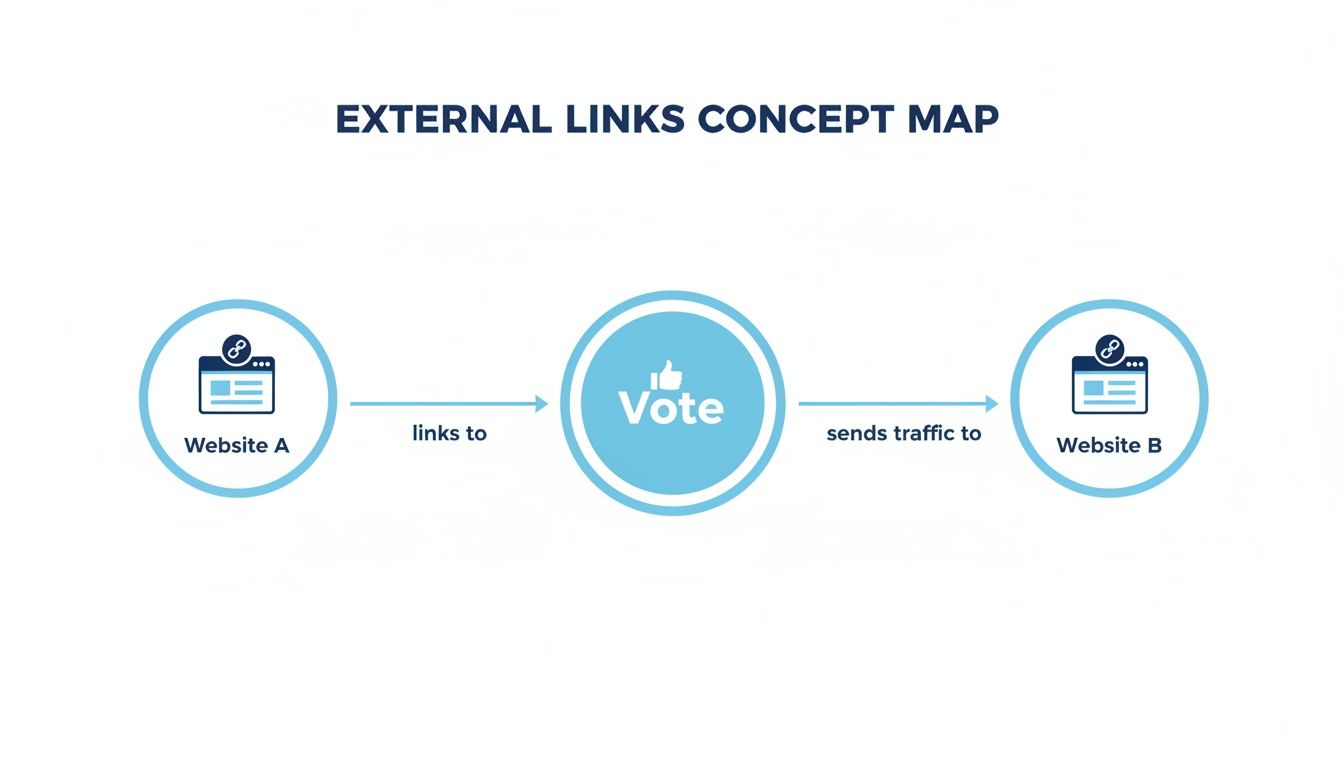
This simple illustration shows how a link from Website A acts as a “vote” that sends traffic and authority over to Website B.
This digital referral system is the bedrock of off-page SEO, a critical piece of the puzzle that works alongside your on-site efforts. It’s worth digging into the differences between on-page vs off-page SEO to see how they fit together to build a powerful online presence.
Newer Link Attributes to Know
A few years back, Google rolled out a couple of new attributes to give everyone more clarity about why a link exists. Getting familiar with these will help you better analyze the links pointing to your site.
- Sponsored Links: The
rel="sponsored"tag is a must for any link that’s part of a paid advertisement, sponsorship, or other commercial deal. It makes it crystal clear that the link is there because money changed hands. - User-Generated Content (UGC) Links: The
rel="ugc"tag is used to identify links created by users themselves, like those you see in forum posts or blog comments. This helps search engines differentiate between content editorially placed by the site owner and content added by the public.
By understanding the full spectrum of external links—dofollow, nofollow, sponsored, and UGC—you get a much clearer picture of your own backlink profile. This knowledge is power. It helps you see exactly what kind of digital endorsements you’re earning and what they’re truly worth from an SEO perspective.
Why External Links Are a Pillar of Modern SEO
External links are far more than just clickable text. Think of them as a fundamental pillar of modern SEO, directly connecting your hard work to real business results. When a highly respected industry publication links to your company’s guide, search engines see it as proof that your business is a legitimate expert. This powerful endorsement builds authority and trust in a way that’s hard to replicate.
This process is critical because search engines like Google have been very clear: backlinks are one of their top three ranking factors. An external link from a credible source essentially tells Google, “This content is valuable, and you should pay attention to it.” A strong collection of these “votes” helps you move from being just another option to becoming the authoritative choice in your market.
The Direct Impact on Rankings and Traffic
The connection between backlinks and search visibility is undeniable. It’s not just theory; the data backs it up. Pages that achieve the coveted #1 ranking on Google have, on average, 3.8 times more backlinks than pages ranking in positions #2 through #10. This statistic alone shows that a robust backlink profile is non-negotiable if you’re aiming for page-one dominance.
That top spot is incredibly valuable. It captures an average of 27.6% of all clicks, while positions further down the page see a dramatic drop-off. A strong backlink profile doesn’t just boost your rankings; it also drives highly qualified referral traffic—visitors who land on your site already primed to trust you because of that initial endorsement.
A strategic backlink profile signals to both search engines and potential customers that your business is a trustworthy leader in its field, which is essential to increase your organic search traffic and build a sustainable online presence.
Ultimately, each high-quality external link you earn strengthens your website’s authority, making it much more difficult for competitors to outrank you. To make sure your content is ready to earn those links, it helps to use advanced tools like Surfer SEO for comprehensive optimization. This strategic approach ensures your content is not just seen but also respected.
Smart Strategies for Earning High-Quality External Links
Ready to put all this theory into practice? Earning valuable external links isn’t about finding risky shortcuts. Instead, it’s about focusing on sustainable, “white-hat” strategies that build real, lasting authority.
The most reliable approach is to create “linkable assets”—content so genuinely useful that other websites want to reference it. Think original research, in-depth guides, or unique case studies that answer a reader’s question completely. This kind of content acts like a magnet for backlinks.
In fact, data shows that long-form content, which averages around 1,447 words on Google’s first page, pulls in 77.2% more backlinks than short articles. It’s clear proof that depth and quality attract high-authority editorial links.
Of course, creating amazing content is only half the battle. Active outreach is what closes the deal. Digital PR involves promoting your best work to journalists, bloggers, and industry leaders, aiming for features in news stories or expert roundups. It’s a fantastic way to secure top-tier links while boosting your brand’s visibility.
To make your outreach truly effective, you need to find the right people. Mastering the art of prospecting on LinkedIn can give your efforts a significant boost.
Building Relationships and Local Authority
Another powerful strategy is guest posting on respected industry blogs. By contributing valuable content, you get a link back to your site in return. It’s a classic win-win that establishes your expertise and introduces your brand to a new, relevant audience.
For businesses that serve a specific area, building local citations is a must. This means getting your business name, address, and phone number (NAP) listed in reputable online directories like Yelp, Yellow Pages, and other industry-specific portals. Each citation acts as a small but important signal that reinforces your geographic relevance to search engines.
Here are a few proven tactics to focus on:
- Create Linkable Assets: Develop original research, ultimate guides, and free tools that others will want to share.
- Pursue Digital PR: Pitch your unique content and brand stories to relevant media outlets and bloggers.
- Build Local Citations: Get your business listed with consistent information across major online directories.
- Engage in Guest Posting: Write valuable articles for other authoritative sites in your niche to earn a backlink and build relationships.
Each of these strategies helps you build a strong, diverse backlink profile that stands the test of time. For a deeper dive, check out our complete guide on how to build links for your website. It’s a playbook filled with actionable steps for earning links that both search engines and customers will love.
Common Mistakes to Avoid in Your Link Building Efforts
In the world of link building, it’s easy to make mistakes that do more harm than good. Knowing what not to do is just as important as knowing what to do. A solid link profile is built by sidestepping the common pitfalls that can get your site penalized.
The single most damaging mistake is chasing low-quality links from irrelevant sites, often called “link farms.” These are websites created for the sole purpose of selling links and offer zero real value to actual people. Google’s algorithms are incredibly smart and can easily spot these manipulative tactics, often resulting in penalties that can tank your rankings overnight.
It’s a classic case of quality over quantity. One single link from a highly respected industry authority is worth far more than a hundred links from spammy, unrelated websites.
Subtle but Critical Errors
Beyond the obvious spam, several other mistakes can quietly sabotage your hard work. A big one is creating an unnatural anchor text profile. If every single external link pointing to your site uses the exact same keyword-stuffed phrase, it screams “manipulation” to search engines.
Here are a few key pitfalls to sidestep:
- Focusing on Quantity Over Quality: Prioritizing the sheer number of links above their relevance and authority is a recipe for disaster. It’s a short-term game with long-term consequences.
- Ignoring Website Relevance: A link from a pet grooming blog to your financial services firm just doesn’t make sense. It provides no real value and looks completely unnatural to Google.
- Unnatural Anchor Text: Over-optimizing your anchor text is a huge red flag. A healthy, natural link profile has a mix of branded anchors (like your company name), keyword-rich phrases, and generic text (like “click here” or “read more”).
Avoiding these common errors is key to building a link profile that helps, not hurts. You can find more tips on how to improve your website ranking on Google by focusing on a solid, long-term strategy that stands the test of time.
How to Monitor and Analyze Your Link Profile

A strong external link strategy isn’t a “set it and forget it” kind of deal. It needs constant care and attention. Think of a regular backlink audit as a health check for your site’s reputation—it’s how you stay on top of your link profile and keep your authority intact.
This means firing up tools like Ahrefs or Semrush to see who’s linking to you. By keeping a close eye on new links, you can celebrate the high-quality endorsements and quickly snuff out any harmful or “toxic” links that might be dragging you down.
This kind of proactive monitoring is more important than ever. With AI chatbots poised to change how people search, external links will become crucial for AI citations, helping your brand show up in generated answers. Brands that invest in their backlink profile will see a huge return, especially since SEO leads close at a 14.6% rate—a massive jump from the 1.7% seen with outbound marketing. You can discover more insights about these SEO statistics to stay ahead of the game.
Finding Opportunities and Cleaning Up
A good audit isn’t just about your own site; it’s also about peeking at your competitors. Analyzing their link profiles shows you exactly where they’re getting their best links, uncovering a goldmine of opportunities for your own outreach campaigns. You can pinpoint authoritative blogs, directories, or news sites that are already linking to content just like yours.
A backlink audit isn’t just about finding bad links; it’s about spotting high-value opportunities and understanding where you stand in your industry.
What if you find a bunch of spammy or sketchy links pointing your way? Don’t panic. Google’s Disavow Tool is your last line of defense. It lets you tell Google to simply ignore those specific links when it evaluates your site. This helps you clean up your profile and shield your rankings from potential penalties down the road.
Answering Your Top Questions About External Links
Now that we’ve covered the what and the why, let’s dig into the questions that usually come up when people start thinking about external links. This is where the theory meets the real world.
So, How Many External Links Do I Actually Need?
This is easily the most common question, and the answer is always the same: quality over quantity. There’s no magic number.
Instead of chasing a specific count, your energy is better spent earning relevant links from authoritative websites in your niche. A few powerful links from trusted sources will do more for your SEO than hundreds of spammy, low-quality ones ever could.
Are Internal Links as Important as External Links?
They’re both critical, but they have completely different jobs. Think of it like a sports team.
External links are like endorsements from famous athletes—they build your team’s overall reputation and credibility with the league (aka, search engines). Internal links, on the other hand, are like your team’s playbook, guiding players (users and search bots) to the right places and distributing strength across the entire roster. You need both to win.
How Long Does It Take for External Links to Start Working?
The impact isn’t instant. It can take several weeks or even months for search engines like Google to crawl, index, and re-evaluate your site based on new backlinks.
The timeline really depends on the authority of the site linking to you and how often Google’s bots visit it. A link from a major news site might get noticed in days, while one from a small blog could take much longer. Patience is the name of the game—SEO is a marathon, not a sprint.
Is Buying External Links Ever a Good Idea?
The short answer is a hard no. Buying links directly violates Google’s webmaster guidelines and is a classic “black-hat” tactic. If you get caught, your site could face a severe penalty, which might mean a massive drop in rankings or even being removed from search results entirely.
Instead of buying links, invest in creating top-tier content that earns them naturally. While some surveys show the average cost of acquiring a quality backlink is around $361, the ROI from doing it the right way is immense. You can learn more about the importance of backlinks in recent SEO surveys to see just how critical they remain for growth.
At Netco Design LLC, we focus on building sustainable, white-hat link-building strategies that create lasting results without putting your business at risk. Learn how we can elevate your digital presence.

