

table of contents
Hyperlocal SEO is defined as the practice of optimizing your online presence for a specific micro-geographic area, such as a neighborhood, district, or landmark, rather than a broad city or region. It goes beyond what is local SEO in the traditional sense by targeting customers within walking or driving distance of your exact location. 46% of all Google searches are local, which means nearly half of all searches carry intent to find something nearby. Add the fact that 68% of local voice queries include specific neighborhood names or landmarks, and the case for neighborhood-level search optimization becomes impossible to ignore.
What is hyperlocal SEO and how does it differ from local SEO?
Hyperlocal SEO and traditional local SEO share the same foundation but operate at very different scales. Traditional local SEO targets a city or metro area. A plumber ranking for “plumber in Chicago” is doing local SEO. A plumber ranking for “plumber in Wicker Park” is doing hyperlocal SEO. That distinction matters because the searcher intent is far more specific, and the competition is far more manageable.
The geographic scale is the first major difference. Local SEO covers cities, counties, or regions. Hyperlocal SEO covers neighborhoods, zip codes, or even individual blocks. A coffee shop in St. Petersburg, Florida does not need to outrank every café in the Tampa Bay area. It needs to show up when someone two streets away searches for coffee on their phone.

The ranking factors also differ. Google uses invisible neighborhood polygons to influence map pack rankings, so using the canonical name of a neighborhood matters more than you might expect. Typing “South Side” when Google maps the area as “Southside” can cost you visibility. Generic city-wide pages with swapped location names trigger doorway page penalties and do not rank well at the neighborhood level.
Search intent specificity is the third key difference. Hyperlocal searchers are typically ready to act. They are not researching options across a city. They want the closest, most relevant result right now. That urgency makes hyperlocal search optimization one of the highest-converting traffic sources available to small businesses.
Here is a quick comparison of how the two approaches differ in practice:
Local SEO targets:
- City or metro-wide audiences
- Broader keyword phrases like “dentist in Austin”
- General Google Business Profile optimization
- City-level landing pages
Hyperlocal SEO targets:
- Neighborhood or district-level audiences
- Specific phrases like “dentist near South Congress, Austin”
- Neighborhood-specific content pages with local landmarks
- Schema markup tied to precise geographic coordinates
Key hyperlocal SEO strategies to improve neighborhood-level rankings
Effective hyperlocal SEO strategies require more than adding a neighborhood name to your title tag. The approach needs to be built around genuine local knowledge, technical precision, and consistent signals across multiple platforms.
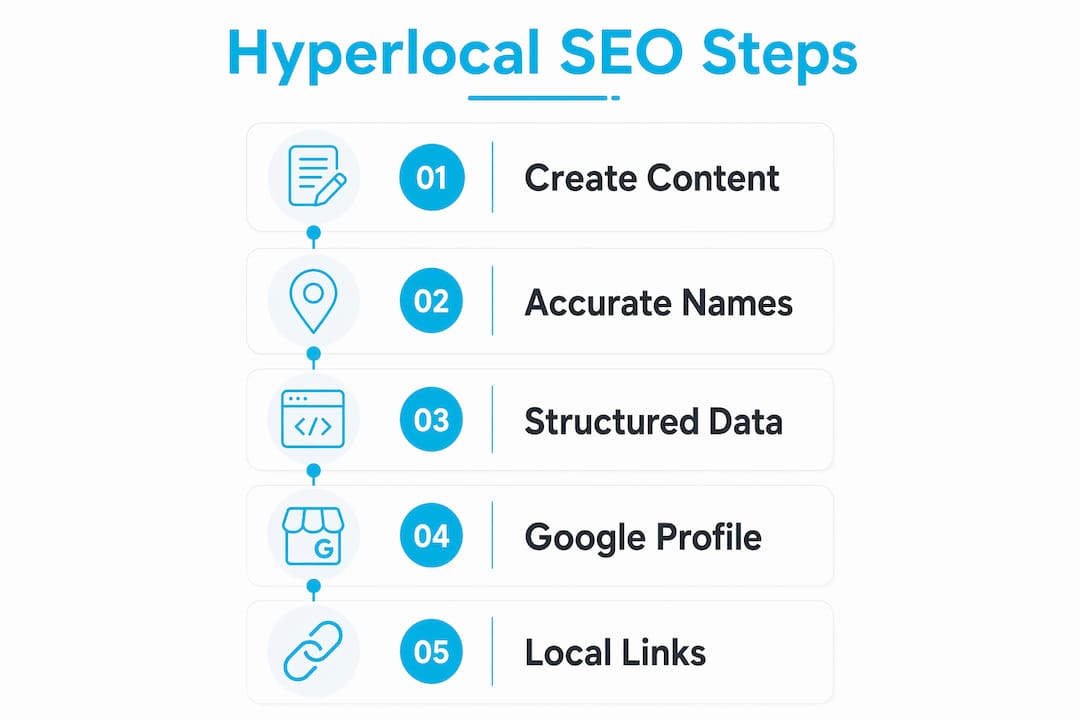
1. Create neighborhood-specific content pages
Successful hyperlocal content pages require 700 or more unique words focused on local details such as neighborhood housing, tailored FAQs, and embedded maps. That word count is not arbitrary. It gives Google enough signal to understand the geographic and topical relevance of the page. Write about the neighborhood itself: nearby landmarks, transit stops, local events, and community character. A roofing company serving Hyde Park in Chicago should mention the University of Chicago, the Metra stops, and the age of housing stock in the area. That specificity builds relevance that a generic city page cannot replicate.
2. Use canonical neighborhood names accurately
Google automatically normalizes “near me” queries based on user GPS, so stuffing “near me” into your page titles and H1 headers adds no value. Focus your titles on the service plus the neighborhood name instead. “Plumber in Wicker Park” outperforms “Best Plumber Near Me in Wicker Park” every time. Use the exact neighborhood name that Google Maps recognizes, not a colloquial variation.
3. Implement structured data markup
Hyperlocal SEO requires precise schema markup including LocalBusiness, Service, Review, and FAQPage types to provide machine-readable filters for AI-driven local discovery. Schema markup tells search engines and AI assistants exactly what your business does, where it operates, and what customers say about it. Without it, AI-powered search tools have to guess. With it, they can cite your business with confidence.
4. Optimize your Google Business Profile for the neighborhood
Your Google Business Profile is the anchor of your hyperlocal presence. Add your neighborhood name to your business description. Use the services section to list what you offer in that specific area. Upload photos that show recognizable local landmarks or your storefront in context. Respond to reviews and encourage customers to mention the neighborhood by name in their feedback.
5. Build neighborhood-level links and reviews
Local link building at the hyperlocal level means getting mentions from neighborhood blogs, community associations, local news outlets, and nearby businesses. A link from a Wicker Park neighborhood association carries more geographic signal than a generic directory listing. Reviews that mention specific streets, landmarks, or neighborhood names also strengthen your local relevance signals.
Pro Tip: Ask satisfied customers to mention the neighborhood or a nearby landmark in their review. A review that says “best plumber in Wicker Park, right near the Blue Line stop” does more for your hyperlocal rankings than a five-star rating with no location context.
How AI and voice search are reshaping hyperlocal SEO
AI-powered search has changed the rules for local visibility. The old model rewarded businesses that appeared in a list of ten results. The new model compresses local results into a single answer or a short list of two or three citations. AI compression of local pack results into single definitive answers means prominence is now tied to the specificity of your online signals, not the volume of your listings.
Voice search amplifies this effect. When someone asks a voice assistant for a nearby service, the assistant picks one answer. That answer comes from the business with the most precise, consistent, and specific local signals. AI and voice search engines interpret hyperlocal queries by calculating distance within invisible neighborhood boundary polygons defined by Google Maps. Businesses that mention specific landmarks and local transit stops in their content align more closely with how these systems score geographic relevance.
Here is what this means for your hyperlocal strategy in 2026:
- Specificity beats volume. One detailed, neighborhood-specific page outperforms ten thin city-wide pages.
- Reviews need detail. AI-driven search engines prioritize review content specificity, such as mentions of service hours or insurance accepted, over generic five-star ratings.
- Multi-platform presence matters. Optimizing for Google Maps alone is not enough. Apple Business Connect, Bing Places, and voice assistant directories each carry weight in AI-driven local discovery.
- Voice search favors landmarks. Queries like “coffee shop near the Riverwalk” are growing. Content that references local landmarks ranks better for these queries.
“Hyperlocal strategy requires omnipresent optimization across multiple local data sources and AI platforms to maximize neighborhood-level visibility.” — BrightLocal
Understanding how AI is transforming local search signals is now a core competency for any small business competing at the neighborhood level. The businesses that adapt early will hold positions that are very difficult for late movers to displace.
Measuring success and scaling hyperlocal SEO for small businesses
Tracking hyperlocal SEO performance requires more granularity than standard SEO reporting. City-level keyword rankings tell you very little about how you are performing in a specific neighborhood. You need metrics tied to the micro-geographic areas you are targeting.
Key metrics to monitor:
- Neighborhood-level keyword rankings. Track rankings for “service + neighborhood name” queries separately from city-level terms.
- Google Business Profile insights. Monitor direction requests, calls, and website clicks filtered by the neighborhoods driving the most activity.
- Foot traffic attribution. Use Google’s store visit data or ask new customers directly how they found you and where they were when they searched.
- Review velocity and specificity. Track not just the number of new reviews but whether they include neighborhood-specific language.
- Local pack appearance rate. Check how often your business appears in the map pack for your target neighborhood queries.
Scaling hyperlocal SEO across multiple neighborhoods is where many small businesses stumble. The temptation is to copy a successful neighborhood page and swap the location name. Duplicate pages with swapped location names can trigger penalties and harm your overall rankings. Each new neighborhood page needs genuinely unique content.
The most practical solution is to involve local knowledge in your content creation. Interview a team member who lives in the neighborhood. Partner with a local community blogger. Reference real local events, businesses, and landmarks that only someone familiar with the area would know. That authenticity is what separates a page that ranks from one that gets filtered out.
Pro Tip: Expand to adjacent neighborhoods only after your primary neighborhood page is ranking and converting. Spreading your effort too thin too early produces mediocre results everywhere instead of strong results in one place. Build a model that works, then replicate it with genuine local input.
For home service businesses in particular, hyperlocal SEO for home services follows a clear pattern: one strong neighborhood page, consistent Google Business Profile signals, and a steady flow of specific local reviews.
Key takeaways
Hyperlocal SEO works because geographic specificity, structured data, and detailed local content combine to produce the precise signals that AI-driven search engines use to select a single local answer.
| Point | Details |
|---|---|
| Hyperlocal vs. local SEO | Hyperlocal targets neighborhoods and landmarks; local SEO targets cities or regions. |
| Content depth requirement | Neighborhood pages need 700 or more unique words with local details to rank effectively. |
| Schema markup is non-negotiable | LocalBusiness, Service, Review, and FAQPage schema give AI systems the filters they need to cite your business. |
| Reviews need specificity | Reviews mentioning neighborhoods, landmarks, or service details outperform generic star ratings in AI-driven results. |
| Scale carefully | Each new neighborhood page requires genuinely unique content to avoid doorway page penalties. |
The hyperlocal shift I keep seeing businesses miss
I have watched a lot of small businesses invest in local SEO and then wonder why their foot traffic does not move. The answer is almost always the same: they are targeting the city when their customers are searching the neighborhood.
The businesses that win at hyperlocal search are not necessarily the ones with the biggest budgets. They are the ones that understand their community well enough to write about it authentically. A plumber who mentions the specific age of the pipes in a historic neighborhood, or a salon that references the parking situation near a local park, signals something that no amount of keyword density can fake. That signal is genuine local knowledge, and AI systems are getting better at detecting it.
The other mistake I see constantly is treating voice search as a future concern. Voice queries are happening right now, and optimizing for voice search at the neighborhood level is still an area where most small businesses have done almost nothing. That gap is an opportunity. The businesses that build out their neighborhood-specific content and schema markup now will be the ones that voice assistants cite six months from now.
My honest advice: pick one neighborhood, build one genuinely great page, get ten specific reviews, and measure the result before you scale. The compounding effect of a well-executed hyperlocal strategy is real. But it only compounds if the foundation is solid.
— Lori
How Netcodesign helps small businesses win at neighborhood-level search
Small businesses that want to compete at the neighborhood level need more than a Google Business Profile and a city-wide landing page. Netcodesign builds the technical and content foundation that hyperlocal SEO requires, from schema markup and neighborhood-specific page architecture to Google Business Profile optimization and local link building.

Netcodesign’s team in St. Petersburg, Florida works with small businesses across Tampa Bay and beyond to build small business websites that are fast, mobile-first, and structured for neighborhood-level search visibility. The agency also tracks the latest SEO trends shaping AI-driven local discovery so your strategy stays current. If you are ready to move from city-wide visibility to neighborhood-level dominance, Netcodesign is the team to call.
FAQ
What is hyperlocal SEO in simple terms?
Hyperlocal SEO is the practice of optimizing your online presence to appear in searches from people in a specific neighborhood or micro-area near your business. It targets customers who are ready to visit or call, not just browsing options across a city.
How is hyperlocal SEO different from local SEO?
Local SEO targets a city or metro area, while hyperlocal SEO targets a specific neighborhood, district, or landmark. The search intent is more specific, the competition is smaller, and the conversion rate is typically higher.
Does “near me” belong in my page titles for hyperlocal SEO?
No. Google normalizes “near me” queries automatically using GPS data, so placing it in page titles adds no ranking benefit. Use “service + neighborhood name” instead for better alignment with how search algorithms resolve proximity queries.
How many words should a hyperlocal content page have?
Effective hyperlocal pages require 700 or more unique words covering local details such as neighborhood characteristics, tailored FAQs, and embedded maps. Thin pages with swapped location names do not rank and risk penalties.
What role does schema markup play in hyperlocal SEO?
Schema markup, specifically LocalBusiness, Service, Review, and FAQPage types, gives AI-driven search engines the machine-readable signals they need to identify and cite your business for neighborhood-level queries. Without it, AI systems have to infer your relevance rather than confirm it.

