

table of contents
Medical SEO is the practice of optimizing a healthcare website so it ranks higher in Google search results and attracts more patients. Unlike general SEO, it operates under stricter standards because Google classifies health content as “Your Money or Your Life” (YMYL), meaning it applies its E-E-A-T framework — experience, expertise, authoritativeness, and trustworthiness — more rigorously to medical pages than to almost any other category. A dental practice, urgent care clinic, or specialty group that ignores these standards will consistently lose search visibility to providers who meet them.
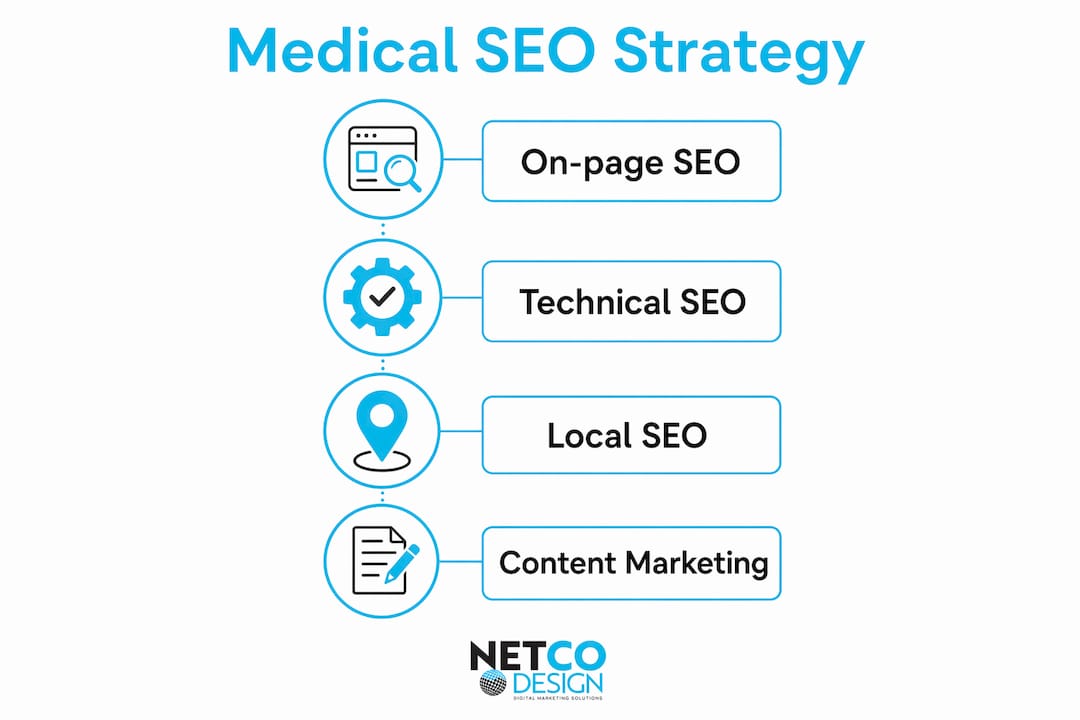
The four core pillars of healthcare SEO are:
- On-page SEO: keyword targeting, meta tags, structured headings, and internal linking
- Technical SEO: site speed, mobile-first design, SSL certificates, and schema markup
- Local SEO: Google Business Profile management, local citations, and patient reviews
- Content marketing: clinician-authored blog posts, FAQs, and patient education pages
Each pillar reinforces the others. A fast, well-structured site with no authoritative content will still underperform, and great content on a slow, poorly indexed site rarely reaches the patients who need it.
Why medical SEO matters for your practice
The numbers tell a clear story. 77% of patients use search engines before booking a healthcare appointment, which means your Google ranking is often the first impression you make. Patients are not just browsing — they are actively deciding. And many “near me” healthcare searches result in a visit to a business within a day.
Beyond raw traffic, consistent search visibility builds the kind of trust that converts browsers into booked appointments. When your practice appears at the top of results with strong reviews, accurate information, and authoritative content, patients arrive already confident in your credibility. That pre-built trust shortens the decision cycle considerably.
The benefits of a well-executed healthcare SEO strategy include:
- More patient volume: higher rankings mean more clicks, more calls, and more appointments
- Reputation management: proactive review collection and response shapes how new patients perceive you
- Competitive advantage: practices that rank on page one capture the majority of clicks; those on page two rarely get found
- Lower long-term cost per acquisition: organic search traffic compounds over time, unlike paid ads that stop the moment you pause spending
- HIPAA-aligned trust signals: a compliant, privacy-respecting website signals professionalism to both patients and Google
HIPAA compliance is not just a legal obligation — it directly affects your SEO. Practices that mishandle patient data or use non-compliant contact forms risk both regulatory penalties and a loss of the trustworthiness signals Google rewards.
What does a medical SEO strategy actually involve?
Medical SEO strategies work across four interconnected areas. Here is how each one functions in practice.

On-page SEO
On-page SEO covers everything visible on your web pages. That means targeting the specific terms patients type into Google (“cardiologist in Tampa” or “what causes chest pain”), writing clear meta titles and descriptions, structuring pages with proper H1 and H2 headings, and building internal links that guide both patients and search crawlers through your site. Every service page should target a distinct set of patient-focused queries rather than generic medical jargon.
Technical SEO
Fast-loading, mobile-friendly websites with SSL certificates rank better and convert more patients. Google’s mobile-first indexing means your site is evaluated primarily on its mobile version, so a desktop-only design is a direct ranking liability. Schema markup, specifically the MedicalWebPage schema available at schema.org, helps search engines understand your content’s context and can produce rich results in the search listings.
Local SEO
For most practices, local search is where appointments are won or lost. A complete, regularly updated Google Business Profile with accurate hours, photos, and service categories is the foundation. Consistent name, address, and phone number (NAP) data across directories like Healthgrades and Yelp reinforces your local authority. Patient reviews are a direct ranking factor for local results, and actively managing your Google Business Profile with fresh reviews improves both visibility and patient trust. For a deeper look at local tactics, Netco Design’s guide to local SEO for medical practices covers the full playbook.

Content marketing and reputation management
Content authored by qualified clinicians earns higher credibility with Google’s E-E-A-T evaluation. A physician-authored blog post on managing Type 2 diabetes outperforms a generic article written without clinical context. Patient education pages, condition FAQs, and procedure explainers all serve dual purposes: they answer real patient questions and signal expertise to search algorithms. Reputation management ties directly into this — 84% of patients check online reviews before choosing a provider, so a strategy that generates and responds to reviews is part of your SEO, not separate from it.
Pro Tip: Focus your content on the questions patients actually type, not the terminology clinicians use. “What is an echocardiogram?” outperforms “echocardiography indications” for most practice websites.
How long does it take to see results from medical SEO?
Medical SEO is not a quick fix. Results typically take consistent effort over several months before they become measurable in patient volume. The exact timeline depends on several factors:
- Market competition: a solo practice in a mid-size city will generally see movement faster than a specialty group competing in a major metro
- Starting point: a site with existing domain authority and indexed pages builds on a stronger foundation than a brand-new website
- Content volume: practices that publish quality content regularly accelerate their authority growth compared to those that post occasionally
- Local market size: smaller geographic markets tend to respond faster to local SEO improvements
- Consistency of effort: one-time fixes rarely hold; ongoing optimization compounds over time
Tracking progress requires the right tools. Google Search Console shows which queries are driving impressions and clicks. Google Analytics reveals how patients behave once they land on your site. Monitoring your Google Business Profile insights tells you how many people called, requested directions, or visited your website from local search. Combining these data points gives you a clear picture of what is working and where to focus next.
Pairing organic SEO with Google Ads for medical practices can fill the gap during the early months when organic rankings are still building, giving your practice visibility while the long-term SEO investment matures.
Best practices for medical SEO, from Netco Design’s experience
Getting medical SEO right requires more than checking boxes. These are the practices that consistently produce results for healthcare providers:
- Publish quality content on a regular schedule. A blog that goes six months without a new post signals stagnation to Google. Monthly or biweekly publishing keeps your site active and gives you more opportunities to rank for patient queries.
- Keep your Google Business Profile current. Update hours for holidays, add new photos, respond to every review (positive and negative), and use the Posts feature to share practice news. Stale profiles lose ground to competitors who treat theirs as a living asset.
- Design mobile-first. More than half of all web traffic now comes from mobile devices, and Google indexes your mobile site first. A healthcare website that loads slowly or displays poorly on a phone is losing patients before they ever read a word.
- Make HIPAA compliance part of your technical checklist. Contact forms, appointment request tools, and patient portals must handle data securely. Using non-compliant third-party plugins or tracking pixels that capture protected health information creates legal exposure and undermines the trustworthiness signals your SEO depends on.
- Use AI SEO tools to stay ahead of algorithm changes. Google’s search algorithms update frequently, and AI-driven tools help practices adapt their content and technical setup without waiting months to notice a rankings drop.
- Train your in-house team. The practices that sustain SEO gains over time are the ones where staff understand the basics. Netco Design offers customized training so your marketing team can manage content, reviews, and performance tracking with confidence.
Pro Tip: Treat medical SEO as a long-term investment, the same way you would treat building a referral network. The practices that commit to 12-plus months of consistent effort build authority that is very difficult for competitors to displace.
For a broader view of how SEO fits into your overall growth plan, Netco Design’s resource on medical practice marketing strategies covers the full picture.
What successful medical SEO looks like in practice
Real-world medical SEO results follow a recognizable pattern, even when the specialty and market differ.
A primary care practice that had no Google Business Profile optimization and minimal on-page content typically starts seeing local pack appearances within the first few months of consistent work. Once the profile is complete, reviews are actively collected, and service pages are rewritten around patient-focused queries, call volume from organic search tends to climb noticeably. The practice is not just getting more traffic — it is getting traffic from patients who already searched for exactly what the practice offers.
For specialty practices, content marketing tends to be the bigger lever. A dermatology group that publishes clinician-authored articles on conditions like eczema, rosacea, and skin cancer screening builds topical authority that generalist sites cannot replicate. Over time, those articles rank for the specific questions patients type before booking a consultation, and the practice captures patients earlier in their decision process.
The common thread across successful implementations is consistency. Practices that treat SEO as a one-time website project rarely hold their gains. Those that maintain their Google Business Profile, publish content regularly, and monitor their technical health month over month build a compounding advantage. The benefits of SEO for small business apply directly here: organic visibility grows over time, and the cost per patient acquired through search drops as authority builds.
Netco Design helps healthcare practices grow through search
Healthcare providers who want to compete in search need more than a checklist. They need a team that understands both the technical side of SEO and the compliance requirements that make medical websites different from every other industry.

Netco Design builds and optimizes healthcare websites from the ground up, with mobile-first design, HIPAA-aware technical setups, and content strategies built around how patients actually search. The agency’s work spans local SEO, AI SEO, reputation management, and ongoing performance tracking, giving practices a single point of accountability for their entire digital presence. Whether you are starting from a weak online presence or trying to hold ground against well-funded competitors, the team tailors the approach to your market and your goals. Get started by reviewing Netco Design’s healthcare SEO trends for 2026 and then reach out to discuss what a focused strategy looks like for your practice.
Key Takeaways
Medical SEO requires consistent execution across on-page, technical, local, and content pillars, all held to Google’s E-E-A-T standard for health content.
| Point | Details |
|---|---|
| Patients search before booking | 77% of patients use search engines before scheduling a healthcare appointment. |
| Reviews shape rankings and trust | 84% of patients check online reviews before choosing a provider, making reputation management part of SEO. |
| Compliance is a ranking factor | HIPAA-compliant websites signal trustworthiness to both patients and Google’s E-E-A-T evaluation. |
FAQ
What does SEO mean in medical terms?
Medical SEO refers to optimizing a healthcare practice’s website so it ranks higher in search engine results and attracts more patients. It follows the same core principles as general SEO but must meet Google’s stricter E-E-A-T standards for health content.
How do you explain medical SEO basics to someone new to it?
Medical SEO is the process of making your practice easier to find on Google by improving your website’s content, speed, local listings, and online reviews. When patients search for a doctor or service you offer, good SEO puts your practice at the top of those results.
What are the four types of SEO used in healthcare?
The four pillars of medical SEO are on-page SEO, technical SEO, local SEO, and content marketing. Each addresses a different aspect of how search engines find, evaluate, and rank your practice’s website.
Does SEO apply to nursing or clinical staff websites?
Yes. Any healthcare professional with a public-facing website benefits from SEO, including nurses, nurse practitioners, and allied health providers. Google applies its E-E-A-T framework to all health-related content, so author credentials and content accuracy matter regardless of the clinical specialty.
How long before a medical practice sees SEO results?
Most practices begin to see measurable movement in rankings and patient inquiries after several months of consistent SEO work. The timeline varies based on market competition, content volume, and how well the technical foundation is built from the start.
Recommended
- Web Design for Healthcare: Build Trust & Attract Patients – Netco Design LLC
- Master Local SEO for Medical Practices: Boost Bookings – Netco Design LLC
- Top 10 Medical Practice Marketing Strategies to Dominate in 2026 – Netco Design LLC
- Top SEO Services for Dentists: Attract More Patients in 2026 – Netco Design LLC

