

table of contents
Paid search advertising is how you get your business seen at the very top of search results, right when people are looking for you. It’s a direct way to drive traffic to your website, and it works on a pay-per-click (PPC) model. That means you only pay when someone is interested enough to actually click your ad.
What Exactly Is Paid Search Advertising?
Think of a search engine like Google as the world’s biggest shopping mall. Millions of people are walking around, looking for specific things. Paid search is like renting a pop-up shop right at the main entrance. You get to show your products to people the exact moment they’re searching for them.
Instead of spending months or even years trying to earn a spot on the front page through organic efforts, paid search gives you an express pass.
This approach is so effective because it taps directly into customer intent. Someone searching for “emergency plumber in Tampa Bay” isn’t just browsing—they have a burst pipe and need help now. Paid search puts your business front and center as the immediate solution to their problem.
The Power of Paying Per Click
Unlike putting up a billboard where you pay for eyeballs, the magic of paid search is the pay-per-click (PPC) model. Your ad appearing on the screen costs you nothing. You only pay the small fee when a user finds your message compelling enough to click through to your site.
This direct-response system is a game-changer for a few key reasons:
- Immediate Visibility: Once your campaign is approved, your ads can show up at the top of search results almost instantly.
- Laser-Focused Targeting: You can pinpoint users based on the exact keywords they type, where they live, the device they’re on, and much more.
- Totally Measurable: Every dollar is accounted for. You can track every click, every impression, and every sale, giving you a crystal-clear picture of your return on investment.
Paid Search vs. Organic Search
It’s crucial to know the difference between paid and organic search results. The listings with a small “Ad” label at the top of the page? Those are the result of paid search advertising.
The results below the ads are organic. They earned their spot over time through a long-term strategy called search engine optimization (SEO). While both are essential for a healthy marketing mix, paid search delivers speed and precision that SEO can’t. If you want a deeper dive into the other side of the coin, you can learn more about how organic results work in our detailed guide on what is search engine optimization.
And this isn’t a small channel—it’s enormous. Global spending on paid search is on track to hit around $351.6 billion in 2025, making it the biggest piece of the search advertising pie. A huge part of that growth comes from mobile users, who now make up about half of all PPC clicks. That tells you everything you need to know about how vital this channel is for reaching customers wherever they are. You can dig into more of these PPC trends in recent industry reports.
How the Paid Search Auction Actually Works
Most people assume the top ad spot goes to the highest bidder. Simple, right? But the reality is far more interesting. While how much you’re willing to pay matters, it’s just one part of the equation. Every time someone hits “enter” on a search, a lightning-fast, real-time auction kicks off to decide which ads show up and in what order.
This whole process happens in milliseconds. The search engine’s algorithm zips through all the advertisers competing for that search term and picks the winners. The twist? The winner isn’t always the one with the biggest budget; it’s the one who offers the most value to the searcher.
This diagram breaks down the flow from the moment a user searches to the point where you pay for a click.
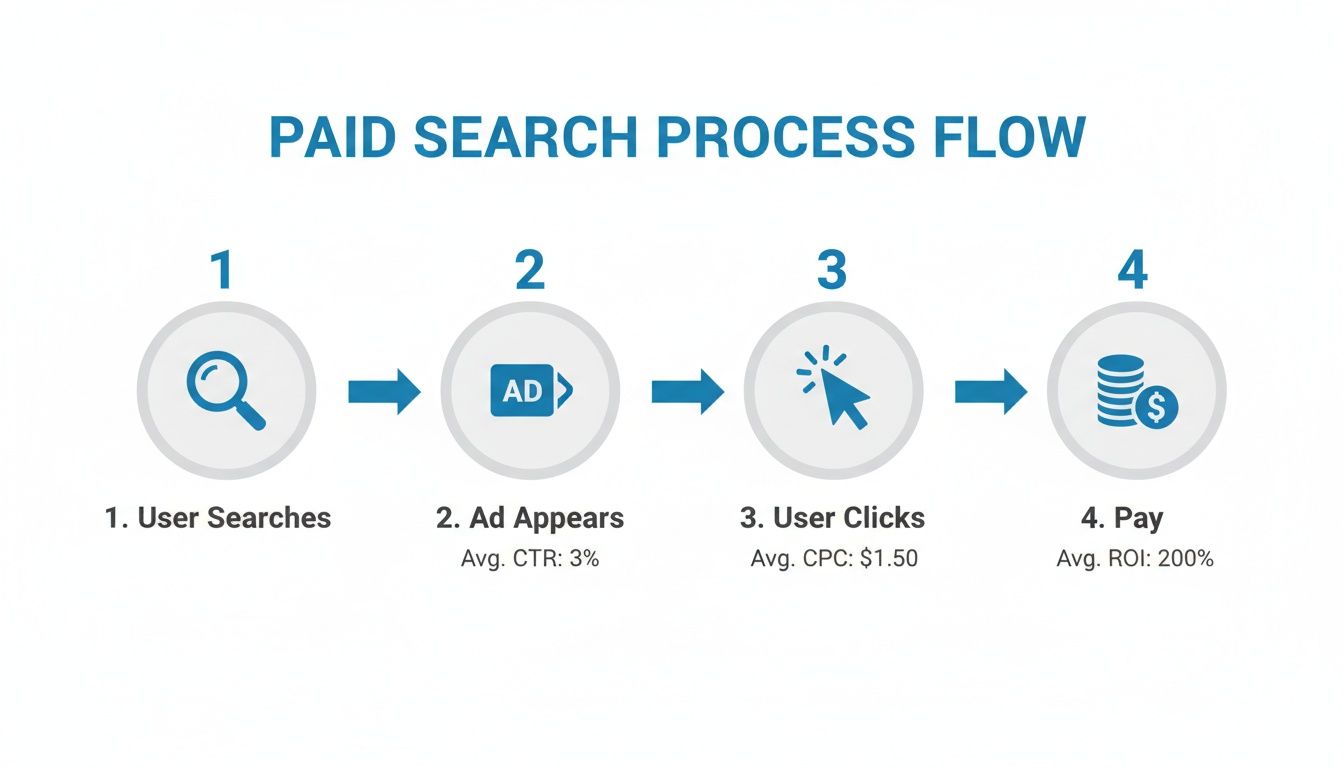
It’s a straightforward journey: a user has a need (the search), your ad appears, they click, and you pay. It’s all powered by relevance and intent.
Decoding Ad Rank and Quality Score
The secret sauce behind this whole auction is a metric called Ad Rank. This score is what determines your ad’s position on the results page. The higher your Ad Rank, the better your placement, which usually means more clicks and more traffic. It’s calculated with a simple but powerful formula.
Ad Rank = Maximum Bid x Quality Score
Your Maximum Bid is easy enough to understand—it’s the most you’re willing to spend for one click. But the Quality Score is where the real strategy comes in. Think of it as the search engine’s report card for your ad, keywords, and landing page, graded on a scale of 1 to 10.
A high Quality Score can actually lower your costs while boosting your ad position. Search engines want to give their users the best possible experience, so they reward advertisers who help them do that. Your score boils down to three key things:
- Expected Click-Through Rate (CTR): How likely is someone to click your ad when they see it?
- Ad Relevance: Does your ad’s message actually match what the user was searching for?
- Landing Page Experience: Once someone clicks, does the page they land on deliver? Is it relevant, easy to use, and trustworthy?
A Tale of Two Coffee Shops
Let’s put this into practice. Picture two local coffee shops in downtown Tampa, “The Daily Grind” and “Espresso Express,” both trying to show up for the keyword “best espresso downtown.”
- The Daily Grind goes in strong with a $4.00 bid per click. But their ad is bland—”We Have Coffee”—and it just links to their homepage, which doesn’t even mention espresso. Their Quality Score is a dismal 3 out of 10.
- Espresso Express is a bit more conservative, bidding $2.50 per click. Their ad, however, is spot-on: “Award-Winning Espresso Downtown – Try Our Signature Roast!” It sends users to a page all about their espresso menu, complete with rave reviews. They earn a stellar Quality Score of 9 out of 10.
Now, let’s do the math and find their Ad Rank:
- The Daily Grind: $4.00 (Bid) x 3 (QS) = 12 (Ad Rank)
- Espresso Express: $2.50 (Bid) x 9 (QS) = 22.5 (Ad Rank)
Even with a much lower bid, Espresso Express snags the better ad position. They’ll get more eyes on their ad and probably pay less for each click because the search engine sees them as the more helpful result. This gets to the heart of paid search: relevance is more powerful than budget alone.
Mastering this balance requires a solid strategy. You can dive deeper into these tactics in our guide to Google Ads best practices. When you focus on quality, you make every single advertising dollar work harder for you.
Once you’ve got a handle on how the ad auction works, the next logical step is figuring out where to run your ads and what they should look like. While Google often feels like the only game in town, the world of paid search is a lot bigger than most people realize. Picking the right platform and ad format is just as critical as picking the right keywords.
Think of it like choosing a location for a brick-and-mortar store. You wouldn’t open a high-end boutique in an industrial park, right? The same logic applies here. You have to place your digital ads where your target audience actually spends their time and use a format that grabs their attention.
Google Ads vs Microsoft Ads
The two heavyweights in paid search are Google Ads and Microsoft Ads (which you might remember as Bing Ads). They operate on similar principles, but they reach slightly different audiences and can produce surprisingly different results.
- Google Ads: This is the undisputed market leader, handling a staggering volume of search queries every single day. Its enormous reach means you can connect with just about any demographic you can think of. The downside? That popularity fuels intense competition, which often drives up the Cost Per Click (CPC).
- Microsoft Ads: This platform powers searches on Bing, Yahoo, and AOL. Its audience often skews a bit older, is more affluent, and tends to have more disposable income. Because there’s less competition, many advertisers find lower CPCs and a better Return On Ad Spend (ROAS) here. It’s a powerful and frequently overlooked channel.
For many businesses, the smartest strategy isn’t an “either/or” choice but a “both/and” approach. Starting on Google gives you massive reach, while layering in Microsoft Ads can help you capture a valuable slice of the market, often at a lower cost.
Selecting the Right Ad Format for Your Goals
Beyond picking a platform, you need to choose the right ad format. Each one is built for a specific job, whether it’s driving e-commerce sales or bringing back past website visitors. Getting this right is a cornerstone of effective PPC management for small business success.
Here are a few of the most common and effective formats you’ll encounter:
- Text Ads: These are the classics of paid search—just headlines and descriptions. They’re perfect for capturing people with high intent who are actively looking for a solution, like a plumber, a lawyer, or a specific software tool.
- Shopping Ads: If you run an e-commerce business, these are non-negotiable. They are highly visual ads that put a product image, price, and your store name right in the search results. They do an incredible job of attracting shoppers who are ready to buy now.
- Dynamic Search Ads (DSAs): This is a powerful, automated option where the ad platform crawls your website and generates headlines and landing pages for you based on what the user searched for. DSAs are a lifesaver for businesses with huge inventories or content-heavy sites, ensuring you don’t miss out on all those super-specific, long-tail keyword searches.
A crucial strategy is using Remarketing Lists for Search Ads (RLSA). This format lets you specifically target people who have already been to your website. You can bid more aggressively to get in front of these high-value users or show them custom ad copy, which can dramatically increase your chances of getting a conversion.
Ultimately, the best approach is usually a mix of different ad formats, each tailored to a different stage of the customer journey. When you align your platform and ad choices with your actual business goals, you start building a paid search strategy that delivers real, measurable results.
Measuring Success with Key Performance Metrics

Running a paid search campaign without tracking metrics is like driving a car blindfolded. Sure, you’re moving and spending money, but you have no clue where you’re headed or if you’re about to crash. To find out if your ads are actually working, you have to learn to read the story the data is telling you.
These numbers, often called Key Performance Indicators (KPIs), turn a mess of confusing acronyms into real business insights. They show you exactly what’s connecting with customers and what’s falling flat, letting you make smart decisions that directly impact your bottom line.
Core Metrics for Campaign Health
While you can track dozens of different data points, a few core metrics give you the clearest picture of your campaign’s health. Focusing on these will help you cut through the noise and see what truly matters.
- Click-Through Rate (CTR): This is the percentage of people who see your ad and actually click on it. A high CTR is a great sign that your ad copy and keywords are relevant to your audience—you’ve grabbed their attention.
- Cost Per Click (CPC): This is the average price you pay every time someone clicks your ad. Keeping an eye on CPC is critical for managing your budget. A lower CPC means you can get more traffic without spending more.
These two numbers are closely related. A really compelling ad (high CTR) can boost your Quality Score, which in turn can help lower your CPC. It’s the search engine’s way of rewarding you for creating a good experience for its users.
Measuring What Really Matters: Conversions and Profitability
Getting traffic is nice, but it doesn’t pay the bills. The real goal of most paid search campaigns is to drive specific, valuable actions. This is where conversion and profitability metrics become the true test of success.
A conversion is any action you want a user to take after they click your ad, like making a purchase, filling out a contact form, or signing up for a newsletter. The Conversion Rate is the percentage of clicks that lead to one of these actions. A solid conversion rate tells you that your landing page is doing its job and persuading visitors to take that next step. If you want to dive deeper, check out our guide on what is conversion rate in marketing.
The most important profitability metric is Return On Ad Spend (ROAS). This simple calculation tells you how much revenue you’re generating for every dollar you spend on advertising. A ROAS of 4:1, for example, means you’re making $4 for every $1 spent.
It’s also important to understand the difference between ROI vs ROAS to accurately measure your campaigns. While ROAS looks only at ad spend, ROI takes all business costs into account for a more complete picture of profit.
Across most industries, paid search is a major driver of new business, often accounting for 23–28% of new visitor sessions. With average conversion rates in the mid-single digits, tracking these metrics isn’t just a good idea—it’s essential for smart, sustainable growth.
Developing Smart Budgeting and Bidding Strategies
Success in paid search isn’t just about having the biggest budget; it’s about having the smartest one. The real trick is making every single dollar pull its weight. Before you even think about launching a campaign, you need a realistic budget and a bidding strategy that lines up perfectly with your goals, whether that’s getting your name out there or making the phone ring today.
Your bidding approach is one of the most important calls you’ll make. It’s what tells Google or Bing how to spend your money and how aggressively to compete in the ad auction. You’ve got two main paths to choose from: going manual or letting the machines take over with automated bidding.
Manual Bidding vs. Automated Bidding
Manual bidding puts you in the driver’s seat. You set the maximum cost-per-click (CPC) you’re willing to pay for your keywords and ad groups. This hands-on method is perfect for anyone who wants total control, allowing you to make tiny, precise adjustments based on what you’re seeing in real-time. The downside? It’s a ton of work, especially as your campaigns get bigger and more complex.
On the flip side, automated bidding lets the platform’s machine learning do the heavy lifting. You tell it your goal—more clicks, more sales, whatever—and its algorithms adjust your bids for every single auction. It’s incredibly powerful. For a closer look at what goes into campaign costs, our article on the cost of PPC advertising breaks it all down.
Common Automated Bidding Strategies
Picking the right automated strategy is all about knowing what you want to accomplish. Each one is built for a different outcome, and matching the strategy to your objective is the secret to getting the results you’re after.
- Maximize Clicks: The name says it all. The goal is to drive as much traffic as possible to your website within your set budget. This is a great starting point for new businesses looking to build awareness and get some initial data flowing. Think of a brand-new coffee shop in Tampa using this to get its name out and attract first-time visitors to its site.
- Maximize Conversions: This one is laser-focused on getting the most conversions—like contact form submissions or phone calls—for your money. The algorithm looks at historical data and bids more aggressively on clicks that seem more likely to turn into a lead. A local home service company would use this to generate as many qualified inquiries as they can.
- Target ROAS (Return On Ad Spend): For e-commerce businesses, this is usually the holy grail. You set a specific return you want for every dollar you spend. For example, a ROAS of 400% means you want to earn $4 in revenue for every $1 you spend on ads. The system then works its magic to try and hit that exact profitability target.
The key thing to remember is that no single bidding strategy is “the best” forever. Your ideal approach will change as your business grows and your goals shift. Start with what makes sense now, but be ready to pivot as you gather more data.
These days, many advertisers also turn to advanced AI-powered bidding assistants to fine-tune their budgets and squeeze every last drop of performance out of their campaigns. These tools can analyze thousands of signals in a split second to make incredibly smart bidding decisions. By choosing your bidding strategy with care, you turn your budget from a simple line item into a powerful engine for growth.
Avoiding Common Mistakes in Paid Search
Running a paid search campaign can feel like navigating a minefield. The potential rewards are huge, but it’s shockingly easy to waste thousands of dollars on simple, preventable errors. Getting a handle on these common pitfalls is the first step toward building campaigns that are not just active, but genuinely profitable.
The biggest mistake is often the simplest: forgetting to use negative keywords. Without them, you’re basically paying for clicks from people searching for things completely unrelated to what you sell. Think about it: a company selling “project management tools” could burn through its budget on clicks from users searching for “free project management tools” unless “free” is added as a negative keyword.
Another classic blunder is sending all that valuable traffic to the wrong place. Directing every single ad to your homepage is a massive missed opportunity. Each ad should point to a dedicated, highly relevant landing page that continues the conversation started in the ad copy, making it dead simple for the user to take the next step.
Writing Ads That Don’t Get Ignored
Generic, uninspired ad copy is a guaranteed way to lose money. Your ads are fighting for attention in an incredibly crowded space, and a bland message will get scrolled past every single time.
To stop this from happening, focus on creating compelling ads that connect directly with what the user is looking for:
- Highlight a Unique Selling Proposition (USP): What makes you different? Is it your free shipping, 24/7 support, or a special guarantee? Put that front and center.
- Include a Strong Call to Action (CTA): Don’t just inform people; instruct them. Use clear, action-oriented language like “Get a Free Quote Today” or “Shop the Sale Now” to tell users exactly what to do next.
The goal of your ad isn’t just to get a click; it’s to get the right click. By pre-qualifying users with specific, benefit-driven copy, you attract visitors who are far more likely to become customers, boosting your overall return.
Knowing When to Call for Help
Many business owners start out managing their own campaigns, which is great for learning the ropes. But it’s crucial to recognize when it’s time to bring in an expert. The paid search world is always in motion, with technical shifts constantly altering strategy and how we measure success.
Take the recent transition to Google Analytics 4 (GA4), which changed how ad credit is assigned, or new privacy rules that have increased reliance on platform automation. In fact, about 55% of companies now hire agencies to manage their PPC. With costs rising across roughly 86% of industries, professional oversight is more critical than ever. You can learn more about navigating these changes by reading up on the current state of paid search advertising.
If you find yourself struggling with declining performance, lacking the time to manage campaigns effectively, or just feeling overwhelmed by the complexity, it’s a clear sign. Hiring a professional agency can provide the expertise needed to turn a costly campaign into a profitable growth engine.
Frequently Asked Questions About Paid Search
Even after you get the hang of the basics, a few questions always seem to pop up about paid search. It’s completely normal. Here are some of the most common ones we hear from business owners, with straight-up answers to help you feel confident about your next steps.
How Much Should I Budget for Paid Search?
There’s no magic number here. The right budget really depends on how competitive your industry is, what the going rate (cost-per-click) is for your keywords, and what you’re trying to achieve. A small local shop might start with $500 to $1,000 per month just to get their feet wet and collect some initial data.
A much better way to think about it is to work backward from your goals. Figure out how many new customers you need and what you’re willing to pay to get each one (your Cost Per Acquisition). This way, your budget is tied to real business results, not just a number you pulled out of thin air.
The average small to medium-sized business often spends between $1,000 and $10,000 per month on paid search. The key is to start with a budget that’s big enough to run meaningful tests, then scale up once you know what’s working.
How Long Does It Take to See Results?
This is one of the best parts about paid search: you can see results almost instantly. Unlike SEO, which can take months to gain traction, a well-built paid search campaign can start sending people to your website within hours of going live.
But seeing meaningful results—like a steady stream of leads and a solid return on ad spend (ROAS)—takes a bit longer. Give it one to three months for proper testing and fine-tuning. This gives the ad platform’s algorithm time to learn and gives you enough data to tweak your keywords, ads, and bidding strategies for the best possible performance.
Can I Just Do SEO Instead of Paid Search?
While they both help you get found on search engines, they play different roles and you shouldn’t think of it as an either/or decision. SEO is your long-term play for building organic traffic and trust. Paid search is for getting immediate, targeted traffic exactly when you need it.
The smartest strategies use both together.
- Paid search delivers quick wins and uncovers valuable keyword data that you can use to supercharge your SEO efforts.
- A strong SEO presence builds credibility and can actually make your paid ads perform even better.
Think of it this way: paid search is the accelerator pedal, while SEO is the powerful, sustainable engine that keeps you moving forward for the long haul.
Ready to stop guessing and start growing with a professional paid search strategy? The team at Netco Design LLC builds revenue-focused PPC campaigns that drive qualified traffic and maximize your return on investment. Schedule your free consultation today and discover how we can elevate your digital presence.

