

table of contents
Revenue-focused web design is the practice of building websites where every design decision, from layout to copy to button placement, is made to drive measurable business outcomes like leads, sales, and conversions. It is not about making a site look impressive. It is about making it perform. Unlike traditional web design that prioritizes aesthetics, this approach treats your website as a revenue-generating asset that works around the clock to qualify visitors and move them toward a decision.
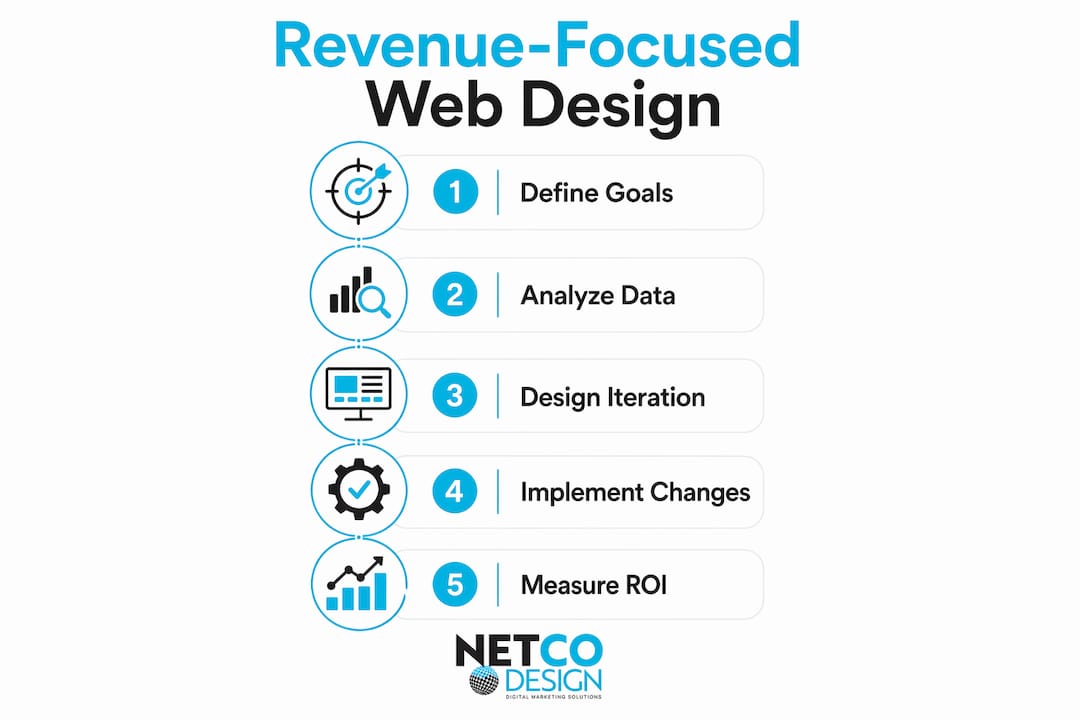
The distinction matters more in 2026 than ever. Paid traffic costs are rising, attention spans are shrinking, and a beautiful site that does not convert is just an expensive brochure. Revenue-driven web design closes that gap by combining data-driven decision making, conversion optimization, and user-centric structure into one purposeful system.

What is revenue-focused web design, and how does it differ from traditional design?

Revenue-focused web design starts with a single question: what do you want this visitor to do? Every page is built around a specific outcome, whether that is filling out a form, booking a call, or starting a free trial. Traditional design often starts with brand aesthetics and works backward to function. Revenue-oriented design does the opposite.
The core elements that separate the two approaches:
- Purpose-first layout: Attention is directed by structure, not decoration. Headlines, visuals, and calls to action are placed where visitors naturally pause and decide.
- Clarity over cleverness: Messaging answers the visitor’s silent question, “Is this for me?” in seconds, using plain language instead of buzzwords.
- Measurable outcomes: Success is defined by conversion rates, lead quality, and sales growth, not by how the site looks in a portfolio.
- Continuous iteration: The design evolves based on real visitor behavior, not assumptions or trends.
Sites built solely for style often cause user frustration and lower conversion rates compared to revenue-optimized sites. A well-balanced site can be visually strong and purposeful at the same time. The difference is intent.
1. Key principles that define a revenue-driven website
Conversion-focused web design creates a logical flow built on clarity, intent alignment, and a simplified user experience. These principles are the foundation:
- Data-driven decisions: Design choices are informed by analytics, heatmaps, and user session recordings, not gut instinct. Pages that convert well get studied; pages that bleed traffic get fixed.
- Conversion optimization: Every element, from form length to button color to headline phrasing, is tested and refined to reduce friction and increase the rate at which visitors take action.
- User-centric, intent-aligned structure: Visitors arrive with a specific problem or question. Revenue-oriented design meets them exactly where they are and guides them toward a solution without making them work for it.
- Clear calls to action: CTAs are specific, visible, and matched to where the visitor is in their decision journey. “See how it works in 10 minutes” outperforms “Contact us” on a demo page every time.
- Social proof placed strategically: Customer logos, testimonials, and case study results appear near decision points, not buried in a footer.
- Performance and load speed: Slow pages kill conversions, especially on mobile. Speed is a design requirement, not an afterthought.
- Continuous testing: A/B experimentation isolates which changes actually move revenue, separating real behavioral shifts from vanity metrics.
2. How to measure ROI and the business impact of your web design
Measuring the ROI of revenue-focused design means tracking the metrics that connect directly to money. Traffic volume is not one of them.
- Conversion rate: The percentage of visitors who complete a desired action. Even a modest improvement here compounds across all your traffic.
- Lead quality: Are the people filling out your forms actually qualified buyers? Revenue-oriented design filters out poor-fit visitors through specific messaging, so your sales team spends time on real opportunities.
- Cost per acquisition: When your site converts better, every dollar spent on ads or SEO goes further. Better design lowers the cost to acquire each customer.
- Bounce rate and time on page: High bounce rates on key landing pages signal a mismatch between what visitors expected and what they found. Analytics and heatmaps pinpoint exactly where attention drops off.
- Sales growth over time: Month-over-month revenue tied to organic and paid traffic reveals whether design changes are translating into actual business growth.
- Properly conducted A/B tests isolate behaviors that lead to measurable revenue increases, rather than surface-level improvements that look good in a report but do not move the bottom line.
Pro Tip: Set up goal tracking in Google Analytics 4 before you launch any design change. Without a baseline, you cannot prove what moved the needle.
3. How agencies apply revenue-focused design to drive client growth
Professional agencies that specialize in revenue-driven web design follow a structured process rather than jumping straight to mockups. The work starts with data.
- User behavior analysis: Traffic sources, scroll depth, click maps, and session recordings reveal where visitors engage and where they leave. This shapes every design decision that follows.
- Targeted landing pages: Each page is built for one audience segment and one goal. A page trying to serve everyone converts no one.
- Persuasive, specific CTAs: Generic button text like “Submit” or “Learn More” gets replaced with action-oriented language tied to the visitor’s actual next step.
- Responsive, mobile-first design: Most web traffic now comes from mobile devices. Agencies that design mobile-first ensure the conversion path works on every screen size, not just desktop.
- Continuous optimization cycles: After launch, the work continues. Conversion data informs the next round of changes, creating a compounding improvement effect over time.
Pro Tip: Small UX improvements deliver outsized results. Switching from a six-field sign-up form to a two-field version can significantly increase trial starts. Start with the highest-traffic pages and the simplest friction points.
4. Why SEO and analytics integration are critical to revenue-focused design
SEO and revenue-focused design are not separate disciplines. They reinforce each other directly. SEO supports revenue-focused web design by improving traffic quality and aligning site visibility with user intent, which amplifies conversion opportunities.
- Keyword-to-page alignment: When a page ranks for a specific search query and its content matches exactly what that searcher needs, bounce rates drop and conversions rise.
- Optimized content structure: Headers, meta descriptions, and page copy that serve both search engines and human readers create a consistent experience from the search result to the conversion.
- Analytics as a feedback loop: Google Analytics 4, combined with tools like Google Search Console, shows which organic landing pages drive qualified traffic and which ones attract visitors who leave immediately.
- Funnel bottleneck identification: Analytics reveal where visitors drop out of the conversion path. A page with strong traffic but weak conversions is a design problem, not a traffic problem.
- Ongoing site adaptation: Revenue-oriented design is never finished. SEO data and behavioral analytics together inform continuous updates that keep the site aligned with how your audience searches and decides.
Netco Design integrates SEO and digital marketing trends directly into the design process, so sites are built to rank and convert from day one rather than patched together after launch.
5. The real benefits business owners and marketers gain from this approach
The benefits of revenue-focused design show up in the metrics that actually matter to a business owner or marketing director.
- Higher lead quality: Specific messaging attracts visitors who match your ideal customer profile. You get fewer tire-kickers and more buyers.
- Increased sales conversions: A site built around the visitor’s decision journey removes the friction that causes people to leave without acting.
- Reduced bounce rates: When visitors land on a page that immediately answers their question, they stay longer and explore further.
- Stronger trust signals: Consistent design, clear social proof, and transparent pricing build the kind of credibility that turns first-time visitors into paying customers.
- Better ROI on ad spend: Conversion-focused design is a growth multiplier that amplifies ad spend efficiency. Every dollar you put into paid traffic returns more when the landing page is built to convert.
- Adaptability: A data-driven site can be updated quickly as your market shifts, your offers change, or new audience segments emerge.
6. Why targeting your ideal customer profile maximizes revenue
Generic websites that try to appeal to everyone fail to retain customers and reduce revenue. The principle is straightforward: generic positioning leads to generic value and higher customer churn. When your site tries to speak to everyone, it resonates with no one strongly enough to convert.
- ICP-aligned messaging: Your value proposition should make your ideal customer feel immediately understood and make everyone else self-select out. That is not a flaw. It is the goal.
- Polarized content: Messaging that speaks directly to a specific pain point, industry, or buyer type filters out unqualified visitors and builds strong trust with the right ones.
- Value proposition clarity: Visitors need to know within seconds what you do, who it is for, and what happens next. Vague positioning forces them to do mental work you should have done for them. See value proposition examples that convert for practical models.
- Long-term retention: Alignment between your website message and your ideal customer profile results in higher visitor qualification and stronger trust that fuels recurring purchases and revenue expansion over time.
- Lower churn: When customers arrive with accurate expectations set by clear messaging, they are far less likely to cancel or disengage after the first interaction.
Pro Tip: Use data-driven audience segmentation to refine your messaging continuously. Review your CRM data quarterly to identify which customer segments have the highest lifetime value, then update your site copy to speak directly to that profile.
What real revenue impact looks like in practice
The most instructive examples of revenue-focused design in action tend to involve small, specific changes that produce outsized results. A demo request page buried under three layers of navigation, using jargon like “schedule a discovery call,” will bleed qualified leads. Replacing it with a clear headline like “See how it works in 10 minutes” over a clean calendar embed removes the friction that was costing booked meetings.
Pricing pages follow the same logic. When plans are labeled “Starter,” “Pro,” and “Enterprise” with no clear differentiation, visitors are forced to do mental math that should have been done for them. Making plans scannable, highlighting the recommended option, and answering “What’s included?” without requiring a scroll marathon consistently lifts conversions on pricing pages.
The pattern across successful revenue-focused redesigns is consistent: identify the specific friction point, make one targeted change, measure the result. Effective revenue-focused design feels like a calm, helpful conversation, earning trust while smoothly guiding decisions without pushiness. That quality is not accidental. It is the result of deliberate design choices made with conversion data in hand.
Tools and technologies that support revenue-focused design
The right tools make the difference between guessing and knowing. These are the categories that matter most:
- Analytics platforms: Google Analytics 4 tracks user behavior, goal completions, and traffic source performance. Google Search Console adds organic search data to the picture.
- Heatmap and session recording tools: Hotjar and Microsoft Clarity show exactly where visitors click, scroll, and stop. This behavioral data is the raw material for every design improvement.
- A/B testing platforms: Google Optimize’s successor tools and platforms like VWO allow you to test headline variations, CTA placements, and page layouts against real traffic before committing to a change.
- CRM integration: Connecting your website forms to a CRM like HubSpot or Salesforce closes the loop between web leads and actual revenue, so you can trace which pages produce your best customers.
- Page speed tools: Google PageSpeed Insights and GTmetrix identify load time issues that are costing you conversions. For website speed optimization, even a one-second improvement on a high-traffic page can produce a measurable lift in conversions.
- SEO tools: Ahrefs and Semrush surface the keyword opportunities and content gaps that, when addressed, bring in more qualified organic traffic aligned with buyer intent.
Best practices for ongoing testing and optimization
Revenue-focused design is not a one-time project. It is a continuous process of measurement, hypothesis, and improvement.
- Fix the flow before you test: A/B testing a headline on a page with broken navigation or unclear messaging produces misleading results. Clarify the structure and message first, then test individual elements.
- Test one variable at a time: Changing the headline, CTA, and layout simultaneously makes it impossible to know what drove the result. Isolate variables to get clean data.
- Prioritize high-traffic, high-intent pages: Your homepage, pricing page, and primary landing pages have the most to gain from optimization. Start there before moving to secondary pages.
- Set a minimum sample size before reading results: Ending a test too early because early numbers look promising is one of the most common mistakes. Let tests run until you have statistically meaningful data.
- Document every test and its outcome: A running log of what you tested, what changed, and what the result was becomes a compounding asset. It prevents repeating failed experiments and builds institutional knowledge about your audience.
- Review and update quarterly: Markets shift, offers change, and audience behavior evolves. A lead generation strategy that worked in early 2025 may need adjustment by mid-2026. Schedule regular reviews rather than waiting for performance to drop.
Key Takeaways
Revenue-focused web design drives measurable business growth by aligning every design decision with conversion goals, user intent, and continuous data-driven optimization.
| Point | Details |
|---|---|
| Design with a purpose | Every page needs one clear goal; layout, copy, and CTAs should all point toward that outcome. |
| ICP alignment reduces churn | Generic positioning leads to generic value and higher customer churn; specific messaging attracts and retains better customers. |
| Small UX changes compound | Reducing form fields or clarifying CTA language can significantly increase trial starts and lead volume. |
| SEO and design work together | Optimized content and site structure reduce bounce rates and bring in more qualified organic visitors. |
| Testing sustains growth | Properly conducted A/B tests isolate behaviors that lead to measurable revenue increases, not just vanity metrics. |
FAQ
What is revenue-focused web design in simple terms?
Revenue-focused web design means building a website where every decision, from layout to copy to button placement, is made to drive leads, sales, and conversions rather than to look impressive.
Is web design still worth investing in for 2026?
Yes. With rising paid traffic costs, a website that converts well lowers your cost per acquisition across every marketing channel, making it one of the highest-return investments a business can make.
What are four practical ways to increase revenue through web design?
Clarify your value proposition so visitors immediately understand your offer, simplify your forms to reduce friction, place social proof near decision points, and improve page load speed on your highest-traffic pages.
What is a revenue-focused bidding strategy, and how does it connect to web design?
A revenue-focused bidding strategy in paid advertising optimizes ad spend toward conversions rather than clicks or impressions. It only works well when the landing page it sends traffic to is built to convert, making web design the direct multiplier on that ad investment.
How long does it take to see results from revenue-focused design changes?
Simple changes like CTA copy or form length can show measurable results within weeks. Larger structural redesigns typically take several weeks to produce reliable conversion data, depending on traffic volume.

