

table of contents
So, what exactly is search engine optimization?
In the simplest terms, search engine optimization (SEO) is the practice of improving your website so it shows up more often when people search for your products or services. It’s how you get found on Google without paying for ads.
Think of it this way: the more visible your pages are in search results, the more likely you are to attract the right kind of customers.
What Is Search Engine Optimization
Let’s use an analogy. Imagine your website is a new bookstore in a massive city, and a search engine like Google is the city’s most trusted librarian. SEO is the process of organizing your store and making it so helpful and well-known that the librarian recommends it to everyone looking for the books you sell.
It’s about making a direct connection between customers actively searching for what you offer and your website.
Forget the complex algorithms for a second. The real goal is to make your online presence helpful, credible, and easy for both people and search engines to understand. SEO isn’t a secret trick or a one-time fix; it’s an ongoing effort to prove your website deserves to be at the top.
The Bridge Between You and Your Customers
SEO is the bridge that connects you to your customers. On one side, you have potential clients with a specific need. On the other, you have your website with the solution. SEO makes sure that bridge is strong, easy to find, and clearly marked so traffic flows right to you.
This connection is incredibly valuable because it captures active intent. Unlike a billboard or social media ad that interrupts someone’s day, SEO targets people who are already looking for what you offer.
That’s a huge deal. It’s why 68% of all online experiences begin on a search engine and why the SEO industry is valued at over $86.8 billion.
The relationship between search engines, users, and your website is the foundation of it all. If you’re looking to dive deeper, our guide can help you understand SEO without the jargon.
“At its heart, SEO is about one thing: providing the best possible answer to a person’s query. Everything else—keywords, links, and technical setups—is just a method to achieve that goal.”
How Search Engines Discover And Rank Websites
To really get what SEO is all about, you have to understand how search engines like Google work under the hood. Picture the internet as a gigantic, constantly growing library with billions of books but no central filing system. Search engines take on the monumental job of reading every single book, organizing them, and then recommending the perfect one when someone asks a question.
This whole operation boils down to a continuous, three-step process. It’s a logical flow that starts with discovery and ends with serving up the most relevant results in a split second. Understanding this system is the key to making your website pop up when customers are looking.
Step 1: Crawling The Web For Information
The first step is crawling. Search engines use automated programs, often called “spiders” or “bots,” that travel across the internet 24/7. These crawlers are like tireless digital librarians, jumping from link to link to discover every publicly available webpage out there.
They begin with a list of known web addresses and follow the hyperlinks on those pages to find new ones. Every new page, blog post, or product you add to your website is found this way. If your site has zero links pointing to it from other known websites, it’s like an unmarked building in the middle of a desert—the spiders will have a very hard time finding it.
This visual from Google gives you a great overview of how a search works, starting from the second you type something in.
The diagram shows that the heavy lifting of organizing all this information happens long before you ever search, which is why answers can be delivered almost instantly.
Step 2: Indexing And Organizing Content
Once a page is crawled, the next step is indexing. In this phase, the search engine analyzes everything on the page—the text, images, videos, and meta tags—and stores this information in a massive database called an index.
Think of the index as that library’s master catalog. It’s a highly organized system where every piece of content is categorized and filed away. A page that isn’t in the index is completely invisible to search engines and, therefore, to your potential customers. For a page to get indexed, it has to be seen as valuable, unique, and easy for the crawlers to read.
A common reason a page might not get indexed is if its content is a direct copy of another page, or if a technical glitch stops crawlers from properly reading it.
Step 3: Ranking The Best Results
The final and most important step is ranking. This is where SEO really shines. When you type a query into Google, its algorithm instantly sifts through billions of pages in the index to find the most relevant and authoritative answers.
This isn’t just about matching keywords anymore. Modern search engines evaluate hundreds of factors to figure out which pages best satisfy what a user is looking for. These ranking signals include:
- Relevance: How well does the content on the page match the topic of the search?
- Authority: How trustworthy is the website and the specific page? This is often gauged by the number and quality of other websites linking to it.
- User Experience: Is the page easy to use, mobile-friendly, and does it load quickly? You can learn more about Core Web Vitals and their impact on user experience in our detailed guide.
- Freshness: Is the information up-to-date, especially for topics that change quickly?
The whole practice of Search Engine Optimization got its start in the mid-1990s, right alongside the first search engines. The real game-changer was Google’s PageRank algorithm in 1998, which started ranking sites based on relevance and authority—specifically by analyzing backlinks—instead of just how many times a keyword appeared. You can discover more about the fascinating history of SEO to see just how far the industry has come.
Understanding The Three Pillars Of SEO
A great SEO strategy is a lot like building a sturdy house. It doesn’t rely on a single wall but stands strong on three distinct, interconnected pillars. To really get what SEO is all about, you have to see how these parts work together to create a solid foundation.
If you ignore any one of these pillars, the whole structure starts to weaken, leading to poor performance and frustrating results. The only way to get sustainable, long-term growth in search rankings is with a balanced approach across all three.
On-Page SEO: Your Digital Storefront
The first pillar is On-Page SEO. Think of this as everything you do to organize and decorate your storefront to attract customers. It covers all the elements you directly control on your own website.
This is all about making your content friendly for both humans and search engines. High-quality blog posts, clear product descriptions, well-structured page titles, and even the text you use to describe your images—it all falls under this category. The goal is to signal to Google exactly what your page is about and prove that it offers real value to users.
To picture how search engines process all this, just think about their basic workflow from discovery to display.
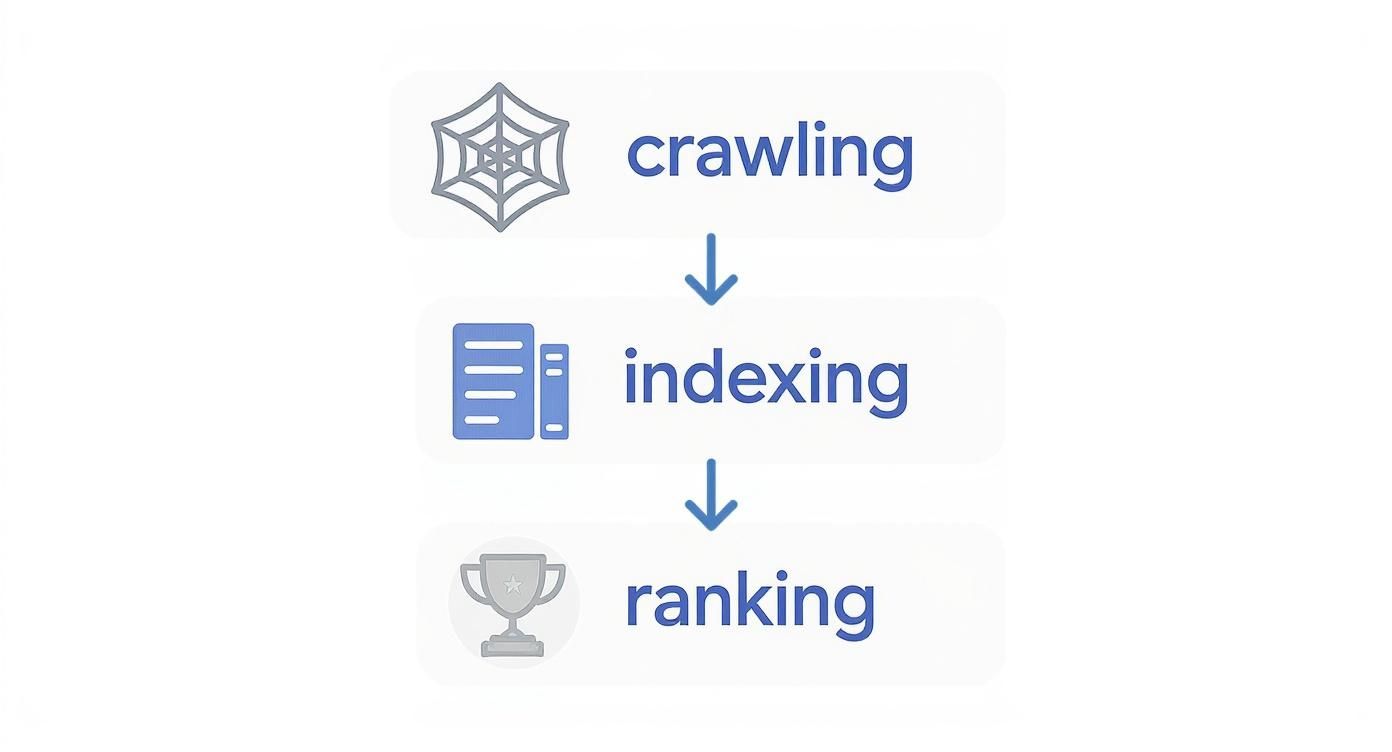
As you can see, organizing and ranking your content is the final step. That’s why sending clear on-page signals is so crucial for success.
Off-Page SEO: Building Your Reputation
Next up is the second pillar: Off-Page SEO. If on-page SEO is your storefront, then off-page SEO is your reputation around town. It’s all the work you do outside of your website to build its authority and trustworthiness in the eyes of search engines.
The biggest piece of this puzzle is backlinking. A backlink is just a link from another website to yours. Think of it as a vote of confidence or a referral. When a reputable, well-known website links to your content, it tells Google that your site is a credible source of information.
But it’s not just about the number of links; quality is way more important. A single link from an authoritative industry blog is worth more than a hundred links from low-quality, spammy sites. This pillar also includes activities like:
- Guest blogging: Writing for other publications in your niche to earn a link back to your site.
- Social media marketing: Sharing your content and engaging with your audience to boost its visibility.
- Brand mentions: Getting your business mentioned on other websites, even without a direct link.
The core idea behind off-page SEO is simple: prove that other respected players on the web vouch for your website’s quality and expertise.
Technical SEO: The Foundation Of Your Site
Finally, we have the third pillar: Technical SEO. This is the concrete foundation and internal wiring of your house. You might not see it, but without a solid technical setup, nothing else matters. It ensures your website is built in a way that search engines can easily find, crawl, and understand.
Technical SEO has nothing to do with the content itself but everything to do with your site’s infrastructure. Key elements include:
- Site Speed: How quickly your pages load. Slow-loading sites are a major turn-off for users, which is a negative signal to Google.
- Mobile-Friendliness: Making sure your site works perfectly on smartphones and tablets, where most searches happen today.
- Site Security (HTTPS): Using encryption to protect your visitors’ data. This is now a standard ranking factor.
- XML Sitemap: A roadmap of your website that helps search engines efficiently find all of your important pages.
To help you see how these three pillars compare, we’ve put together a quick reference table.
On-Page vs Off-Page vs Technical SEO At A Glance
This table breaks down the primary goals and common tactics for each pillar, offering a clear snapshot of their roles.
| Pillar of SEO | Primary Goal | Common Tactics |
|---|---|---|
| On-Page SEO | Make content clear and valuable for users and search engines. | Keyword research, content creation, title tags, meta descriptions, image optimization, internal linking. |
| Off-Page SEO | Build authority, trust, and reputation through external signals. | Backlink building, guest blogging, social media marketing, online reviews, brand mentions. |
| Technical SEO | Ensure search engines can easily crawl, index, and understand the site. | Improving site speed, mobile optimization, site security (HTTPS), creating an XML sitemap, fixing crawl errors. |
As you can see, each pillar has its own distinct job, but they all work toward the same end goal: better search visibility.
A strong technical foundation makes it effortless for search engine “spiders” to do their job, ensuring all your great on-page content and off-page authority get the credit they deserve. For businesses targeting a specific geographic area, understanding the nuances between broad organic SEO and localized strategies is also a critical part of the puzzle. You can dive deeper into that topic in our guide that compares organic SEO vs. local SEO.
Ultimately, these three pillars can’t exist in isolation. You can have the most technically perfect website in the world, but it won’t rank without great content (on-page) and authority (off-page). A balanced, integrated strategy is the key to mastering what search engine optimization is all about.
Why SEO Is An Essential Business Investment
Thinking about SEO as just another line item on your marketing budget is a mistake. Seeing it as a core business function is what separates the companies that win from the ones that get left behind. SEO isn’t an expense; it’s a powerful investment in a predictable growth engine for your business.
It’s the difference between chasing customers and having them find you.
Unlike paid ads, which vanish the second you stop paying, SEO builds a sustainable asset. Think of it like owning your digital real estate instead of just renting it. Every optimized blog post and every quality backlink you earn adds to your website’s value, creating a compounding effect that delivers returns for months and even years.
Driving High-Quality Organic Traffic
The real magic of SEO is its ability to attract people who are ready to buy. When someone types a search into Google, they have an active need. They aren’t just scrolling through social media hoping to be distracted—they are actively looking for a solution, a product, or an answer right now.
This means the visitors arriving at your site from search engines are already pre-qualified. They’ve raised their hand and shown interest in what you offer. That translates to higher engagement rates, better conversion potential, and a much stronger return on your investment.
For example, a homeowner searching for “emergency plumber in Tampa” has an urgent, specific need. A well-executed SEO strategy ensures your plumbing business appears at the top, capturing a lead at the exact moment of intent. This is far more effective than a generic ad hoping to catch someone’s attention.
Building Lasting Brand Credibility
Ranking high on Google does more than just drive traffic—it builds trust. People instinctively trust organic search results more than they trust paid ads. In fact, organic search is responsible for 53% of all site traffic, blowing past paid search at just 15%. A top position signals to potential customers that you are an authoritative and credible leader in your field.
This trust is earned, not bought. It comes from consistently providing valuable content and a great user experience, which search engines reward with high visibility. Over time, this credibility becomes a core part of your brand’s reputation.
Putting Your Business On The Map
For local businesses, SEO is non-negotiable. When customers perform “near me” searches, they have their wallets out. Local SEO makes sure your business shows up in these critical moments, complete with your address, phone number, and glowing reviews. It’s the digital equivalent of having the best location in town.
For e-commerce stores, SEO puts your products directly in front of shoppers who are comparing options and are ready to buy. By optimizing your product pages and categories, you can capture sales that might otherwise go to bigger competitors. To get started, check out our comprehensive small business SEO guide for actionable steps you can take today.
Ultimately, investing in a solid SEO strategy means you’re building a system that generates leads and sales around the clock. It creates a powerful and sustainable competitive advantage by connecting you with your ideal customers at the most crucial point in their buying journey.
Adapting To The Future Of Search: AI And Local Intent
While the heart of SEO—connecting people with great content—hasn’t changed, the playing field is constantly being redrawn. Today, the ground is shifting under our feet, driven by two forces you simply can’t ignore: artificial intelligence and the user’s growing obsession with local results.
The biggest change agent is the rapid rise of AI in search. Systems like Google’s Search Generative Experience (SGE) are transforming the familiar list of blue links into a direct, conversational answer. Instead of just pointing you to a website, Google now frequently crafts its own summary to answer a question on the spot.
This means your goal is no longer just to rank at the top. It’s to become the go-to source that AI models trust and cite in their answers.
The Rise Of AI And Semantic Search
This move toward AI isn’t some overnight sensation; it’s a trend that’s been building for more than a decade. Since 2010, Google’s updates have steadily shifted from simple keyword matching to a much deeper understanding of what your content actually means.
Think about it. The 2015 RankBrain update was a huge first step, using AI to figure out ambiguous searches. Then the 2019 BERT update came along, refining how Google processes natural language and impacting nearly 10% of all global searches.
To succeed in this new reality, your content must be structured to answer questions directly and with authority. Our guide on adapting to geo and AI search shows how to make your content appear in chatbot answers—a skill that’s quickly becoming table stakes for modern SEO.
The new benchmark for content is simple: Is your information so clear, trustworthy, and comprehensive that an AI would be confident presenting it as the definitive answer? If not, it’s time to level up.
The Undeniable Power Of Local Intent
Running parallel to the AI revolution is the explosion of Local SEO. People are constantly looking for products and services in their immediate area, using search terms like “near me” or tacking a city name onto their query.
If you have a physical storefront or serve a specific geographic area, optimizing for local intent isn’t just a good idea—it’s a direct line to revenue.
This calls for a dedicated strategy that extends beyond your main website. To build a powerful local presence, you need to focus on:
- Google Business Profile (GBP) Optimization: Your GBP is your digital storefront on Google. It needs to be perfect, with accurate hours, a full list of services, great photos, and regular posts.
- Gathering Local Reviews: Good reviews are one of the most powerful signals of trust for both potential customers and search engines.
- Creating Location-Specific Content: Build out pages or blog posts that speak directly to the neighborhoods, towns, and cities you serve.
By embracing both AI-readiness and a strong local focus, you’re not just preparing your business to survive the future of search. You’re setting it up to lead the pack.
Your First Steps: An Actionable SEO Checklist
Learning about search engine optimization can feel like trying to drink from a firehose. The theory is interesting, but the real question is: where do you actually start? This section is all about turning those concepts into action with a straightforward, manageable checklist built for beginners.
The goal here isn’t to make you an expert overnight. Think of this as a roadmap for building momentum. These are clear, achievable tasks you can tackle today to start seeing real progress.
Let’s break it down into three practical phases.
Phase 1: Foundational Setup
Before you start tweaking content or chasing keywords, you have to get your technical house in order. These first steps are non-negotiable—they ensure search engines can find, crawl, and understand your website correctly. Consider this the essential groundwork for everything else to come.
- Set Up Google Search Console: This free tool from Google is your SEO command center. It shows you exactly how your site is performing in search, flags technical issues, and reveals the keywords people are using to find you. It’s a direct line of communication from Google.
- Install Google Analytics: While Search Console tells you how people find your site, Google Analytics tells you what they do once they arrive. Understanding this user behavior is the key to making smart improvements that actually matter.
- Check Mobile-Friendliness: More than 50% of all web traffic now comes from mobile devices. Your site has to work flawlessly on a small screen. Use Google’s free Mobile-Friendly Test to make sure you’re providing a great experience for every single visitor.
Phase 2: On-Page Essentials
With the technical foundation solid, it’s time to focus on your website’s actual content. This phase is all about sending clear signals to Google about what your business does and why you’re the best answer for a user’s search.
- Identify Five Core Keywords: Don’t try to rank for everything at once. Start small. Pinpoint five main keywords that directly relate to your most important product or service. The best way to do this? Think like a customer—what would they type into Google to find a business like yours?
- Optimize Your Homepage Title Tag: Your homepage’s title tag is one of the most critical on-page SEO elements. It needs to be clear and descriptive. A great formula is:
Primary Keyword in [City] | Your Business Name. For example, “Expert Plumbing Services in Tampa | Joe’s Plumbing Co.” tells both Google and users exactly what you do. - Review Your Website Speed: A slow website is a conversion killer and a major roadblock to ranking well. Use a free tool like Google PageSpeed Insights to get a baseline score and identify what’s slowing things down.
Remember, a good user experience is at the heart of modern SEO. A fast, easy-to-navigate website not only helps with rankings but also improves conversions.
Phase 3: Building Local Authority
If your business serves a specific geographic area, local SEO is non-negotiable. This phase focuses on cementing your presence in local search results, making it dead simple for nearby customers to find and choose you.
Your absolute top priority here is your Google Business Profile (GBP). This is your digital storefront on Google Search and Maps, and it’s a powerhouse for local visibility.
- Claim and Verify Your Google Business Profile: This is the single most important step for local SEO, period. Search for your business on Google Maps and follow the prompts to either create or claim your profile.
- Complete Every Section of Your GBP: Don’t cut corners. Fill out every single field you can—add your services, business hours, photos, and a detailed description. The more complete and accurate your profile is, the more Google will trust and feature it.
Common SEO Questions Answered
When you start digging into search engine optimization, a few questions pop up almost immediately. Getting straight answers is the first step toward building a strategy that actually works for your business. Let’s tackle the big ones.
How Long Does SEO Take To Show Results?
This is always the first question, and the honest answer is: it’s a long game. SEO isn’t like flipping a switch; it’s more like planting a tree. It needs consistent effort over time to grow strong and produce results.
Generally, you can expect to see some initial movement within three to six months. This might look like small ranking improvements or a slight bump in organic traffic. But for the kind of significant, business-changing results you’re really after, you should plan on a commitment of at least six to twelve months.
A few things can speed up or slow down that timeline:
- Competition: It takes longer to rank in a crowded market than in a quiet one.
- Website Age and Authority: An established website with a good reputation will often see results faster than a brand-new site.
- Resources: The budget and effort you put into creating content and building links will definitely accelerate your progress.
Can I Do SEO Myself Or Should I Hire Someone?
This is a classic “time vs. money” decision. Both paths are totally valid, but they come with very different trade-offs.
Doing it yourself (DIY SEO) is a great option if you have more time than money. You’ll gain a deep understanding of your business’s digital footprint. Just be warned: the learning curve is steep, and a few wrong moves can set you back.
Hiring an SEO professional or agency gives you instant access to specialized expertise, powerful tools, and proven strategies. While it requires a financial investment, it frees you up to do what you do best—run your business. The right partner can deliver faster, more predictable growth.
The best choice comes down to your goals. If you’re aiming for slow, steady learning, DIY can work. If you want efficient, expert-driven growth, hiring a professional is almost always the smarter investment.
What Is The Single Most Important Part Of SEO?
While all the technical details and backlinks matter, the single most important part of modern SEO is creating a valuable and trustworthy user experience. Google’s main goal is simple: give people the best possible answer to their questions.
That means your focus should always be on your audience. Create content that’s genuinely helpful, easy to read, and shows you know your stuff. Build a website that’s fast, secure, and works great on any device.
At the end of the day, SEO isn’t about tricking an algorithm. It’s about earning your spot at the top by being the most credible and useful resource for your potential customers. When you put the user first, the rankings tend to follow.
Ready to stop guessing and start growing? The team at Netco Design LLC builds expert SEO strategies that deliver measurable results, connecting you with customers who are actively searching for your services. Let’s build your growth engine together.

