

table of contents
TL;DR:
- Local SEO helps small businesses attract high-intent customers at the exact moment they are ready to buy.
- Consistent optimization, reviews, and profile updates boost rankings, drive traffic, and generate sustained revenue.
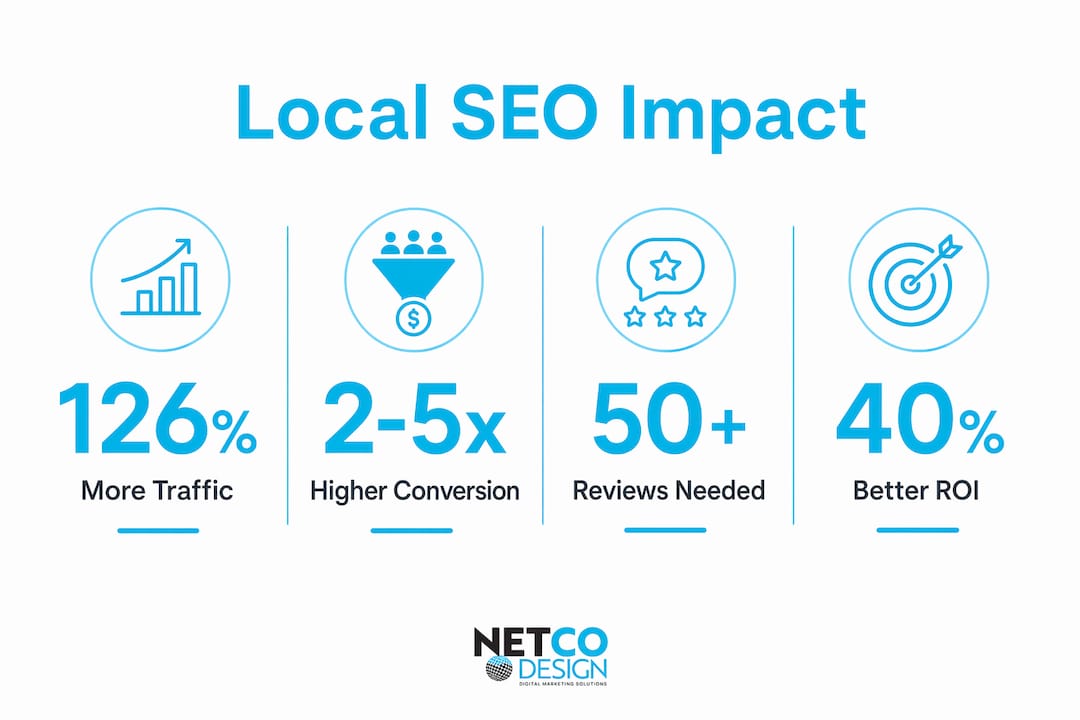
Local search engine optimization (local SEO) is the most direct way for small businesses to connect with nearby customers at the exact moment they are ready to buy. When a shopper types “coffee shop near me” or “plumber in St. Petersburg,” they are not browsing. They are deciding. Businesses that appear in Google’s Local Pack at that moment gain 126% more traffic and 93% more calls, clicks, and direction requests than lower-ranked listings. That gap between visible and invisible is the gap between growing and stalling. Understanding why local SEO drives purchases is the first step toward closing it.
Why local SEO drives purchases through search visibility
Local SEO works because it puts your business in front of buyers who have already decided to act. The Google Local Pack, the three-business map block that appears at the top of local search results, captures the highest-intent clicks on the page. Searchers using terms like “near me” or city-specific phrases are not researching. They are comparing final options before making a purchase.

The conversion numbers reflect that intent. Local-intent traffic converts at 2 to 5 times the rate of non-local traffic, particularly in retail and home services. A general Google search might bring curious visitors. A local search brings someone who wants to spend money today.
Mobile behavior makes this even more urgent. Consumers using local mobile searches visit a store within 24 hours 76% of the time, and 28% of those visits result in a purchase. That is a remarkably short path from search to sale.
What drives this speed? Three factors stand out:
- Proximity signals. Google ranks businesses that are physically close to the searcher, so appearing in local results already filters for geographic relevance.
- Search intent. Local queries carry commercial intent by default. The searcher is not asking “what is a dentist?” They are asking “dentist open now near me.”
- Trust shortcuts. A business appearing in the Local Pack carries an implied endorsement from Google. Consumers treat that placement as a credibility signal.
Pro Tip: Claim and fully complete your Google Business Profile before anything else. An incomplete profile is the single fastest way to lose a Local Pack placement you could have earned.
Why do reviews matter so much for local purchase decisions?
Reviews are not a soft marketing asset. They are a hard ranking and conversion factor. Businesses with 50 or more reviews are 266% more likely to appear in the Local Pack, and every 10 new reviews boost Google Business Profile conversion by 2.8%. Those numbers compound fast.
The consumer psychology behind reviews is equally clear. 85% of consumers are more likely to use a business after reading positive reviews. On the other side, 77% actively avoid businesses with negative reviews. A single bad review left unanswered can cost you more than the original complaint.
Reviews also shape what happens after the first impression. 66% of consumers do more research after reading positive reviews, while 34% make an immediate purchase. That means reviews both close sales and start longer buying journeys. Either way, they move people forward.
Here is what effective review management looks like in practice:
- Ask for reviews at the right moment, right after a completed service or purchase, not days later.
- Respond to every review, positive and negative, within 48 hours. Responses show future customers that you are attentive.
- Address negative reviews with a solution, not a defense. Potential buyers read your response more carefully than the original complaint.
- Spread review requests across platforms. Google is primary, but Facebook and industry-specific directories add credibility.
Pro Tip: Add a QR code at your checkout counter that links directly to your Google review page. Removing the friction of finding where to leave a review increases follow-through significantly.
What makes a Google Business Profile conversion-ready?
A Google Business Profile (GBP) is not a set-it-and-forget-it listing. It is the digital front door of your business, and buyers judge it in seconds. Modern local SEO removes friction by making GBPs conversion-ready with real-time hours, stock information, and current photos. When that information is missing or outdated, buyers leave.
The buyer journey has compressed. AI-powered search and mobile-first behavior mean consumers expect answers before they click. If your profile does not answer “Are you open right now?” and “Do you have what I need?” immediately, a competitor’s profile will.
A conversion-ready GBP includes:
- Accurate hours, updated for holidays and special events.
- Current photos of your storefront, products, and team. Profiles with photos receive significantly more direction requests.
- Direct call and booking buttons that work on mobile without extra steps.
- Product and service listings with prices where applicable.
- Posts and updates that signal the business is active and engaged.
Local content depth matters beyond the GBP itself. Location-specific service pages, FAQ sections, and neighborhood-level content help your website rank for city-specific queries and attract buyers who are further along in their research. A plumber in Tampa who has a page titled “Emergency Pipe Repair in Ybor City” will outrank a generic “plumbing services” page every time.
Pro Tip: Update your GBP at least once a week with a post, photo, or offer. Google treats active profiles as more relevant, and buyers notice that you are paying attention.
Does local SEO deliver better ROI than paid advertising?
Local SEO delivers stronger long-term returns than paid advertising for most small businesses. 40% of local SEO campaigns achieve 500% or more ROI because organic traffic persists after the work is done. A paid ad stops the moment you stop paying. A well-ranked local listing keeps generating calls and visits for months.
The cost-per-acquisition difference is significant. Paid search charges you for every click, regardless of whether that click converts. Local SEO traffic comes from buyers who already filtered themselves by location and intent. You pay once to build the ranking, then collect the traffic.
The compounding effect is the real advantage. Reviews accumulate. Content ages into authority. A business that invests consistently in local search optimization for 12 months does not just rank better. It becomes harder for competitors to displace. Paid advertising offers no such moat.
For small retailers with limited budgets, this matters enormously. Spending $1,000 on local SEO builds an asset. Spending $1,000 on pay-per-click buys a month of visibility. Both have a place, but local SEO is the foundation.
What practical steps drive more local purchases today?
Small businesses that want to see results from local search need to act across several areas at once. Local SEO success requires managing consistent business data, review acquisition, conversion-focused profiles, and original local content simultaneously. No single tactic wins alone.
- Claim and complete your Google Business Profile. Fill every field. Add photos. Set your service area. This is the highest-leverage first step.
- Build a review acquisition system. Ask every satisfied customer. Use email follow-ups, SMS, or in-store QR codes. Consistency beats volume.
- Create location-specific content pages. Write unique pages for each city or neighborhood you serve. Include local landmarks, specific services, and FAQs that reflect real buyer questions.
- Audit your website for mobile performance. Mobile-friendly website experience is not optional. Google ranks mobile-first, and buyers abandon slow or broken mobile pages instantly.
- Verify your business data across all directories. Your name, address, and phone number must match exactly on Google, Yelp, Facebook, Apple Maps, and every other listing. Inconsistencies hurt rankings.
- Track your local SEO performance monthly. Monitor Local Pack rankings, profile views, call volume, and direction requests. Direction clicks to store locations have risen 6.4% year over year, confirming that in-person visits remain a key outcome worth measuring.
- Connect your GBP to your social channels. Cross-posting updates and promotions reinforces your local presence and drives additional discovery. Most local business searches start on Google (52%) or Google Maps (9%), but a multi-channel presence captures the rest.
Key Takeaways
Local SEO drives purchases by placing your business in front of high-intent buyers at the exact moment they are ready to act, and the businesses that invest consistently in visibility, reviews, and conversion-ready profiles win the most sales.
| Point | Details |
|---|---|
| Local Pack visibility multiplies results | Businesses in the Local Pack gain 126% more traffic and 93% more calls and clicks than lower-ranked listings. |
| Reviews are a ranking and conversion factor | 50 or more reviews makes a business 266% more likely to appear in the Local Pack, and every 10 new reviews lift conversions by 2.8%. |
| Mobile searches convert fast | 76% of local mobile searchers visit a store within 24 hours, and 28% make a purchase on that visit. |
| GBP optimization removes buyer friction | Real-time hours, photos, and direct call buttons reduce drop-offs and accelerate purchase decisions. |
| Local SEO compounds over time | 40% of local SEO campaigns achieve 500%+ ROI because organic rankings persist long after the initial investment. |
What I’ve learned about local SEO and real purchase behavior
By Lori Piencykoski
The most common mistake I see small business owners make is treating their Google Business Profile like a phone book listing. They fill it in once and forget it. Meanwhile, a competitor two blocks away is posting weekly updates, responding to every review, and adding new photos every month. That competitor wins, not because they have a better product, but because they look more alive online.
The second thing I’ve noticed is that business owners underestimate how fast the buyer journey has compressed. AI-powered search now surfaces answers before a user even clicks a result. If your profile and website do not answer the buyer’s core questions instantly, you are invisible at the most critical moment. This is not a future concern. It is happening now.
My honest take: local SEO is not complicated, but it requires consistency. The businesses I’ve seen get the best results are not the ones who do a big push once a year. They are the ones who treat their local SEO services like a utility, something they maintain every single week without drama. That consistency is what builds the compounding returns that paid advertising can never match.
— Lori Piencykoski
How Netco Design helps local businesses turn searches into sales
Small businesses in Tampa Bay and across Florida are leaving real revenue on the table by not appearing where their buyers are looking. Netco Design builds and manages local SEO programs that put your business in front of the right customers at the right moment.
The team at Netco Design handles everything from Google Business Profile optimization and review management to location-specific content and mobile-first website performance. Every strategy is built around measurable outcomes: more calls, more visits, more sales. If you want to understand where your local search presence stands today and what it will take to compete in 2026, the 2026 SEO trends guide is a strong place to start. Reach out to Netco Design for a personalized assessment of your local search opportunity.
FAQ
Why does local SEO lead to more purchases than general SEO?
Local SEO targets buyers who are searching with geographic and commercial intent, meaning they are already close to a purchase decision. Local-intent traffic converts at 2 to 5 times the rate of non-local traffic.
How quickly can local SEO produce results for a small business?
Results vary by market and competition, but many businesses see measurable increases in calls and profile views within 60 to 90 days of consistent optimization. Mobile searches in particular drive fast outcomes, with 76% of local mobile searchers visiting a store within 24 hours.
How many reviews does a business need to rank in the Local Pack?
There is no fixed minimum, but businesses with 50 or more reviews are 266% more likely to appear in the Local Pack. Consistent review acquisition matters more than reaching a single target number.
What is the single most important local SEO asset for a small business?
A fully completed and regularly updated Google Business Profile is the highest-leverage asset. It controls how your business appears in the Local Pack, Google Maps, and AI-generated search summaries.
Is local SEO worth it compared to running paid ads?
For most small businesses, local SEO delivers better long-term value. 40% of campaigns achieve 500% or more ROI because organic rankings continue generating traffic after the initial investment, unlike paid ads that stop the moment the budget runs out.

