

table of contents
SEO, or search engine optimization, is the process of improving your startup website’s visibility in search engines so customers find you without paid ads. Organic search drives 53% of all online traffic and contributes to 44% of revenue share for businesses. That single fact explains why startup websites need SEO from day one. Without it, you are building a product nobody can find. With it, you create a compounding traffic engine that grows while you sleep.
Why startup websites need SEO to compete from day one
SEO is the foundation of inbound marketing for startups. When someone searches for a problem your product solves, SEO determines whether your site appears or your competitor’s does. SEO improves brand awareness by positioning your startup ahead of established players in search results. That visibility matters most when you have no brand recognition yet.
Paid ads deliver traffic the moment you fund them and stop the moment you don’t. SEO works differently. SEO scales visibility without the linear costs of paid advertising. A blog post you publish today can generate leads for three years. That compounding effect is what makes SEO so valuable for startups with limited budgets.

SEO also builds trust in a way ads cannot. Ranking organically signals to users that your site is credible and relevant. Users trust organic results more than sponsored listings, which means your click-through rates are higher and your leads are warmer. For a startup trying to establish credibility fast, that trust signal is worth more than most founders realize.
Here is what SEO delivers that paid channels cannot match:
- Compounding traffic: Each piece of optimized content builds on the last, growing your reach over time.
- Pre-qualified visitors: People who find you through search are already looking for what you offer.
- Lower cost per acquisition: SEO-driven acquisition is often cheaper than paid ads over time, especially as your content library grows.
- Brand authority: Consistent top rankings signal expertise and reliability to your audience.
- 24/7 visibility: Your content works around the clock without a daily ad budget.
Pro Tip: Build your SEO foundation before you launch. Pre-launch SEO best practices for startups include setting up Google Search Console, writing keyword-targeted landing pages, and building your site architecture around search intent. Starting early means you rank faster.
What does startup SEO actually involve in 2026?
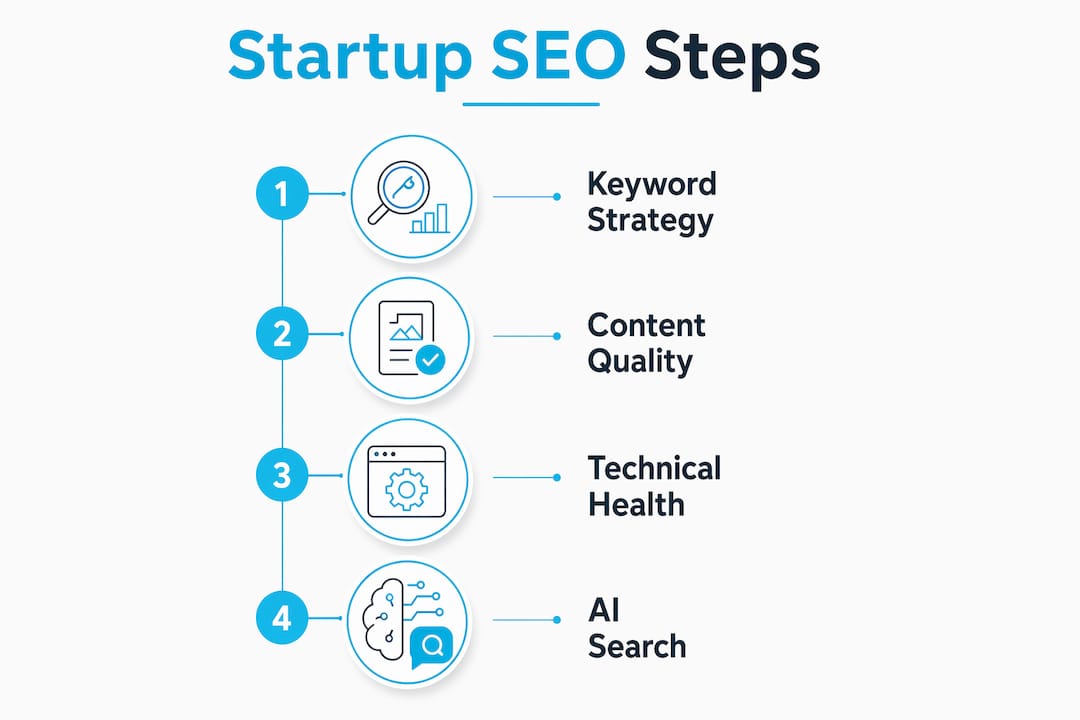
Startup website optimization covers four core areas: keyword strategy, content quality, technical health, and AI search visibility. Each one affects how search engines and AI tools understand and rank your site.
Keyword strategy built on intent
Keyword research for startups starts with understanding what your potential customers type when they have a problem you solve. You are not targeting broad terms like “project management.” You are targeting specific, intent-driven phrases like “project management tool for remote teams under 10 people.” Those long-tail queries have less competition and higher conversion rates. Tools like Google Search Console and Google Keyword Planner surface real search data to guide your choices.
Content that answers real questions
Content optimization goes beyond placing keywords in headings. Startups should create comprehensive, long-form content that answers multiple related questions in a single piece. This approach aligns with how both Google and AI search tools evaluate relevance. A 1,500-word guide that covers a topic thoroughly outperforms five thin 300-word posts every time. Adding FAQ sections to your pages also captures featured snippet placements, which drive significant click-through traffic.
Technical SEO essentials
Technical SEO makes sure search engines can crawl, index, and understand your site. The non-negotiable items for any startup website include:
- Site speed: Pages that load in under 3 seconds reduce bounce rates and satisfy Google’s Core Web Vitals requirements.
- Mobile usability: Google indexes the mobile version of your site first. A mobile-first design is not optional.
- Schema markup: Structured data tells search engines exactly what your content is about, improving how your pages appear in results.
- Clean URL structure: Short, descriptive URLs help both users and crawlers understand page content instantly.
- Internal linking: Connecting related pages distributes authority across your site and helps users find more of your content.
Generative Engine Optimization for AI search
SEO is no longer just about Google rankings. Over 37% of users now start searches using AI-driven tools instead of traditional search engines. That shift means startups must also optimize for platforms like ChatGPT and Perplexity. Generative Engine Optimization, or GEO, is the practice of structuring content so AI tools cite and surface it in their answers. 76% of AI-cited pages rank in the top 10 on Google, which means strong traditional SEO and GEO reinforce each other. Entity-based optimization and structured data markup help both search engines and AI tools understand your content, boosting visibility across all platforms.
Pro Tip: Add a dedicated FAQ section to every major page on your site. AI search tools pull heavily from FAQ-style content when generating answers. This single tactic improves your chances of being cited in AI responses and capturing featured snippets on Google simultaneously.
How long does SEO take to show results for startups?
Realistic expectations prevent founders from abandoning SEO too early. The standard timeline for SEO results on startup websites is 3 to 6 months. That range is not a delay. It reflects how search engines build confidence in new sites over time.
Early wins are possible before the three-month mark. A well-optimized page targeting a low-competition keyword can rank within weeks. Those early rankings rarely drive massive traffic, but they confirm your strategy is working and build domain authority for harder keywords later.
Several factors affect how quickly your startup sees meaningful organic growth:
- Niche competition: A fintech startup competes against established banks. A local service startup competes against fewer, weaker sites. Your timeline adjusts accordingly.
- Content production rate: Publishing two optimized articles per week compounds faster than one per month. Consistency accelerates results.
- Technical health: A site with crawl errors, slow load times, or duplicate content delays indexing and ranking.
- Domain age and authority: New domains start with zero authority. Building backlinks from credible sites speeds up the trust-building process.
Pro Tip: Track your keyword rankings weekly from launch using Google Search Console. You will see movement in rankings before you see movement in traffic. That early data tells you which pages to double down on and which to revise.
How do you measure SEO success and connect it to growth?
Measuring SEO impact requires tracking the right metrics from the start. Vanity metrics like total page views tell you little. The metrics that matter for startups are:
- Organic traffic: The number of visitors arriving from unpaid search results, tracked in Google Analytics 4.
- Keyword rankings: Your position for target keywords, monitored through Google Search Console.
- Engagement rate: Time on page and scroll depth signal whether your content satisfies user intent.
- Conversion rate from organic traffic: The percentage of organic visitors who sign up, purchase, or contact you.
- Backlink growth: New domains linking to your site indicate growing authority.
SEO requires balancing keyword intent targeting with user engagement metrics like time on page and bounce rate. AI search tools increasingly factor user behavior signals into their ranking decisions. A page that ranks well but drives immediate back-clicks tells Google the content did not satisfy the query. Fix the content before building more links to it.
SEO also multiplies the impact of your other marketing channels. A strong SEO content strategy gives your social media team ready-made material to share. Email campaigns that link to optimized blog posts drive return traffic that signals engagement to search engines. Paid ads that target keywords you already rank for organically reinforce brand recognition and improve Quality Scores. The digital marketing for startups playbook works best when SEO sits at the center of it.
The most common mistake startups make is treating SEO as a one-time task. Publishing 10 articles and waiting is not a strategy. SEO requires ongoing refinement: updating old content, building new backlinks, fixing technical issues as they arise, and expanding your keyword coverage as your product evolves.
Key takeaways
Startup websites that invest in SEO early build a compounding traffic asset that paid ads cannot replicate, and those that ignore it spend more to acquire every customer indefinitely.
| Point | Details |
|---|---|
| SEO drives organic growth | Organic search accounts for 53% of all online traffic, making it the largest traffic source for most websites. |
| Results take 3 to 6 months | SEO compounds over time; early content wins build authority for harder keywords later. |
| AI search requires GEO | Optimize for AI tools like ChatGPT alongside Google, since 76% of AI-cited pages already rank in Google’s top 10. |
| Track the right metrics | Monitor organic traffic, keyword rankings, engagement rate, and conversion rate from organic visits. |
| SEO multiplies other channels | Content built for SEO feeds social media, email, and paid campaigns, reducing overall acquisition costs. |
What I’ve learned about SEO and startups after years in the field
The biggest mistake I see startup founders make is treating SEO as something to figure out after launch. By the time they realize their site gets no organic traffic, they have already spent months and budget on paid ads just to keep the lights on. SEO bridges the awareness gap that every new product faces. Startups often fail to gain traction because their audience simply does not know they exist. SEO fixes that problem at the root.
The second mistake is expecting fast results and quitting too early. SEO is not a sprint. The founders I have seen succeed with it treat it like a savings account. Small, consistent deposits compound into something significant. The ones who quit after two months never see the return.
My honest advice: balance technical SEO with content quality from the start. A perfectly structured site with thin content ranks nowhere. A content-rich site with broken technical foundations ranks slowly. You need both. If you are a startup with limited resources, fix your technical foundation first, then produce one excellent piece of content per week. That combination beats a flood of mediocre posts every time.
— Lori
How Netcodesign helps startups build SEO-ready websites
Startups that want organic growth need more than a good-looking website. They need a site built with SEO baked into every layer, from page speed and schema markup to content architecture and mobile performance.

Netcodesign builds SEO-optimized websites for small businesses and startups that are designed to rank from day one. The team handles technical audits, keyword strategy, content planning, and GEO optimization so your site attracts pre-qualified visitors across both Google and AI-powered search tools. For startups ready to build a real organic growth engine, Netcodesign offers practical SEO tips for small businesses and full-service digital marketing tailored to your budget and market.
FAQ
Why do startup websites need SEO from the beginning?
Starting SEO at launch means your site builds domain authority and keyword rankings from day one. Waiting costs months of compounding growth that you cannot recover.
How long does SEO take to work for a new startup website?
The standard timeline is 3 to 6 months for meaningful organic traffic. Early keyword wins can appear sooner, but significant growth compounds over time with consistent effort.
Is SEO better than paid ads for startups?
SEO delivers compounding returns that paid ads do not. Paid ads stop generating traffic the moment your budget runs out, while optimized content continues ranking and attracting visitors indefinitely.
What is GEO and why does it matter for startups in 2026?
Generative Engine Optimization (GEO) is the practice of structuring content so AI search tools like ChatGPT cite your pages in their answers. Over 37% of users now start searches on AI platforms, making GEO a required part of any startup SEO strategy.
What metrics should a startup track to measure SEO success?
Track organic traffic, keyword rankings, engagement rate, and conversion rate from organic visits using Google Analytics 4 and Google Search Console. These four metrics give a complete picture of SEO performance.

