

table of contents
TL;DR:
- A well-executed website redesign can boost search engine rankings by fixing technical, structural, and user experience issues. Proper planning and management of redirects, Core Web Vitals, and content structure are essential to prevent traffic drops and long-term ranking setbacks. Ongoing monitoring and strategic content updates after the redesign help sustain and grow search visibility over time.
A website redesign improves search engine rankings by fixing the technical, structural, and user experience problems that hold your site back from page one. This is formally called site migration in SEO, and it carries both significant opportunity and real risk. Done right, a redesign strengthens Core Web Vitals, improves mobile performance, and creates a cleaner content architecture that Google rewards. Done carelessly, it can erase years of organic traffic in days. Understanding why website redesign improves rankings starts with knowing exactly which signals change during the process and how to control them.
What key SEO factors improve with a well-executed redesign?
A well-planned redesign touches nearly every ranking signal Google evaluates. The most measurable gains come from Core Web Vitals, mobile usability, and content structure. Each of these directly affects how Google scores your site against competitors.

Core Web Vitals are Google’s set of performance metrics covering loading speed (LCP), visual stability (CLS), and interactivity (INP). Improving Core Web Vitals from “poor” to “good” generally yields 5–15% organic traffic gains. Pushing beyond “good” has minimal additional impact, so the goal is to clear the threshold, not chase perfection. The highest-ROI target is LCP under 2.5 seconds on mobile.
Technical improvements during a redesign also include schema markup, image preloading, and cleaner HTML structure. Preloading the LCP image can improve loading by 800 ms on slow connections. That single change can shift a page from “needs improvement” to “good” on mobile, which removes a ranking penalty rather than adding a bonus.
Here are the core SEO factors a redesign typically improves:
- Mobile responsiveness: Google uses mobile-first indexing, so a redesign that prioritizes mobile layout directly affects how your pages rank.
- Internal linking: Redesigns often restructure navigation, which creates opportunities to build stronger internal link paths to high-value pages.
- Content organization: Cleaner site hierarchy helps Google understand topical relationships and index pages more accurately.
- Page speed: Removing legacy code, compressing images, and switching to modern hosting configurations all reduce load times.
- Schema markup: Adding structured data during a redesign helps Google display rich results, which increases click-through rates.
Pro Tip: Before your designer touches a single wireframe, pull your top 20 organic landing pages from Google Search Console. These pages must be protected throughout the redesign. Their URL structure, H1 tags, and content should change as little as possible.
How to manage SEO risks during a website redesign
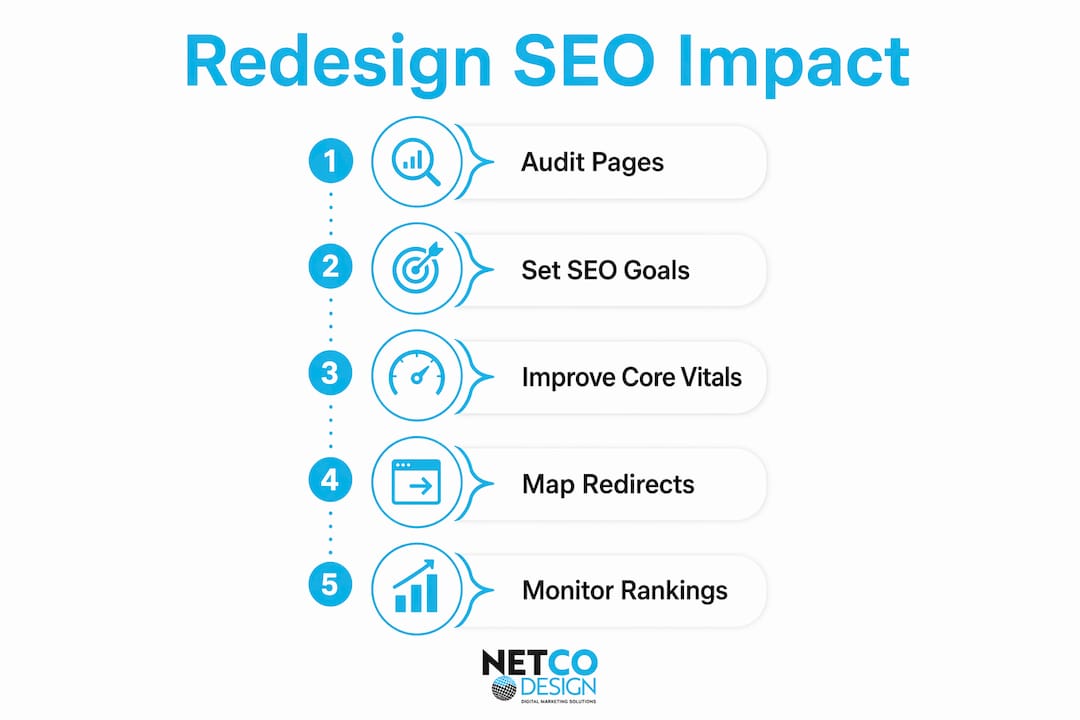
A website redesign is the highest-risk event for organic traffic. The most common causes of catastrophic ranking drops are not design choices. They are technical oversights that happen in the final hours before launch.
Follow this process to protect your rankings:
-
Run a full SEO audit before design begins. Document every URL that receives organic traffic, its ranking keywords, and its backlink count. This is your baseline. You cannot protect what you have not measured.
-
Map 301 redirects for every changed URL. Redirects are the single biggest SEO risk in a redesign. Every old URL that changes needs a direct 301 redirect to the closest topical equivalent. Redirecting everything to the homepage dilutes topical relevance and causes ranking drops.
-
Avoid redirect chains. Redirect chains dilute SEO signals and should be mapped as direct 301 redirects. A chain of three or more redirects loses meaningful link equity at each hop.
-
Check your staging robots.txt before launch. Sites disappear from Google’s index when they go live with a staging robots.txt that blocks crawlers. This is one of the most preventable redesign disasters and still happens regularly.
-
Audit for template regression. Template regression occurs when a redesign removes key SEO elements like H1 tags or FAQ schema markup. A cleaner design can accidentally strip the signals that drove your rankings.
-
Test crawlability before launch. Use a crawler to verify that all pages are reachable, no orphan pages exist, and internal links point to the correct new URLs.
The pages most at risk are your well-optimized SEO pages that rank for competitive terms. These pages need individual review, not just a bulk redirect.
Pro Tip: Run a full crawl of your staging site 48 hours before launch. Compare it against your pre-redesign crawl. Any page that disappears from the crawl report needs to be found and fixed before you go live.
Here are the most common causes of post-redesign ranking drops:
- Staging robots.txt left active on the live site
- Missing or incorrect 301 redirects for changed URLs
- H1 tags, title tags, or meta descriptions removed by new templates
- FAQ schema or product schema stripped during development
- Broken internal links pointing to old URLs
What does data show about traffic after a website redesign?
Traffic fluctuation after a redesign is normal. The severity depends entirely on how well the migration was managed.
A 0–20% traffic fluctuation is normal within the first month after launch as Google reevaluates your content. This is not a crisis. It is Google recrawling and reindexing your updated pages, which takes time.
The real danger zone looks different:
- 40–70% traffic loss in a single week signals a poorly managed migration with missing redirects or indexing errors.
- Gradual decline over 60–90 days often points to template regression or content quality issues introduced during the redesign.
- Sudden index drop almost always traces back to a robots.txt or noindex tag left in place from staging.
“Many SEO problems after redesign stem from late SEO involvement. Engage SEO experts before design commences, not after the site is built.”
The recovery timeline for a poorly executed redesign ranges from three months to over a year, depending on the severity of the errors. A well-executed redesign, by contrast, often shows ranking improvements within 60–90 days as Google processes the improved signals. Monitoring Google Search Console daily for the first 30 days after launch is the minimum standard. Watch for coverage errors, crawl anomalies, and any keywords that drop out of the top 50.
How to use a redesign to build long-term SEO rankings
A redesign is not just a risk to manage. It is the best opportunity you will have to fix structural SEO problems that have accumulated over years. The SEO strategy for a redesign should start before visual design, focusing on auditing top URLs and briefing the design team with SEO constraints.
Here is how to use the redesign to build lasting ranking gains:
- Protect evergreen content. Avoid dramatic rewrites of pages that already rank and drive organic revenue. Evolve the content gradually rather than replacing it wholesale.
- Rebuild your information architecture. A redesign lets you reorganize your site hierarchy so that your most important pages sit closest to the homepage and receive the most internal link equity.
- Target current search intent. Use Google Search Console and keyword research to identify gaps between what your pages cover and what users actually search for. A redesign is the right time to close those gaps.
- Optimize for AI-driven search. Google’s AI Overviews and other AI search tools favor pages with clear structure, direct answers, and strong entity signals. A redesign built with these in mind positions your site for the next phase of search. Netco Design’s AI-friendly website approach addresses exactly this shift.
- Balance technical and UX improvements. Core Web Vitals act as a tiebreaker rather than a primary ranking factor. Content relevance and backlink profiles remain dominant. Fix your Core Web Vitals to remove penalties, then focus on content quality and authority.
The SEO checklist for new websites from Netco Design covers the technical baseline every redesigned site should meet before launch. Use it as a final verification step, not an afterthought.
Pro Tip: Treat your redesign as a content audit, not just a visual refresh. Every page that gets a new URL or new template is an opportunity to update the content for current search intent. Pages that haven’t been touched in two or more years are the highest-priority candidates.
SEO is not a one-time event, and neither is a redesign. The ongoing SEO work that follows a launch determines whether your ranking gains compound or fade. Build a 90-day post-launch monitoring plan before you go live.
Key Takeaways
A website redesign improves rankings when SEO is integrated from the start, redirects are mapped correctly, and Core Web Vitals are brought to “good” before launch.
| Point | Details |
|---|---|
| Start SEO before design | Audit top-performing URLs and set SEO constraints before any wireframes are built. |
| Map every 301 redirect | Direct each changed URL to its closest topical equivalent to preserve link equity and rankings. |
| Fix Core Web Vitals to “good” | Reaching the “good” threshold removes ranking penalties; going beyond it adds minimal benefit. |
| Monitor for 30 days post-launch | Watch Google Search Console daily for coverage errors, crawl drops, and keyword losses. |
| Protect evergreen content | Avoid rewriting pages that already rank; evolve them gradually to keep organic revenue intact. |
What I’ve learned from watching redesigns go wrong
By Lori Piencykoski
The most expensive mistake I see business owners make is treating a redesign as a visual project with SEO bolted on at the end. By the time the developer hands off the site, the damage is already done. H1 tags are missing. Redirect maps are incomplete. The staging robots.txt is still active. These are not edge cases. They are the norm when SEO is not in the room from day one.
The second mistake is panic. A 10–15% traffic dip in the first three weeks after launch is not a failure. It is Google doing its job. The owners who react by making rapid content changes or reverting to the old site often create more instability than the original fluctuation caused.
What actually works is patience combined with preparation. Run your audit. Map your redirects. Protect your top pages. Then monitor closely and fix errors as they appear. The sites that come out of redesigns stronger are the ones where SEO was a constraint on the design, not an afterthought.
Core Web Vitals matter, but not in the way most people think. Fixing a failing LCP score removes a penalty. It does not catapult you past competitors with stronger content and more backlinks. The redesign is your chance to fix the floor, not skip to the top.
— Lori Piencykoski
How Netco Design approaches SEO-aware redesigns
Netco Design builds redesigns around SEO from the first conversation, not the last review. The team conducts a full technical audit before any design work begins, maps every redirect, and verifies Core Web Vitals targets are met before launch.

For business owners who want their redesign to produce measurable ranking gains, Netco Design’s process covers migration planning, technical SEO fundamentals, and post-launch monitoring. The team also integrates current SEO trends for 2026 into every project, so your site is built for where search is going, not just where it has been. If your site is due for an overhaul, the right time to bring in an SEO-aware team is before the first wireframe, not after the launch.
FAQ
Why does a website redesign improve search rankings?
A redesign improves rankings by fixing Core Web Vitals, improving mobile usability, and restructuring content architecture. These changes remove ranking penalties and strengthen the signals Google uses to evaluate page quality.
How much traffic loss is normal after a redesign?
A 0–20% traffic fluctuation in the first month is normal as Google recrawls and reindexes updated pages. Losses of 40–70% in a single week indicate a poorly managed migration with redirect or indexing errors.
What is the biggest SEO risk in a website redesign?
Redirects are the single biggest risk. Every URL that changes needs a direct 301 redirect to its closest topical equivalent. Sending all old URLs to the homepage destroys topical relevance and causes significant ranking drops.
How long does it take to recover rankings after a redesign?
A well-executed redesign typically shows ranking improvements within 60–90 days. A poorly executed one can take three months to over a year to recover, depending on the severity of the migration errors.
Should I rewrite my existing content during a redesign?
Avoid dramatic rewrites of pages that already rank and drive organic traffic. Evolve high-performing content gradually and focus new content efforts on gaps identified through current keyword research.
Recommended
- Why 2026 Is the Year to Redesign Your Website for AI Search | Netco Design
- Your Ultimate 10-Point Website Redesign Checklist for 2025 – Netco Design LLC
- Website Redesign Checklist: When and Why to Refresh Your Site | Netco Design
- Website Redesign vs. Website Refresh: What’s Right for Your Business? | Netco Design

